Solent University: Control, Power, and Influence in Organizations
VerifiedAdded on 2023/06/10
|10
|2370
|283
Essay
AI Summary
This essay examines the roles of power, control, and influence within organizations, drawing upon relevant theories and models such as control theory, Maslow's hierarchy of needs, and various leadership and management theories. It discusses how companies like Sainsbury's, Tesco, Unilever, and IKEA utilize these concepts to manage employees, maintain harmony, and achieve organizational goals. The essay concludes that power, control, and influence are interconnected, with effective leadership requiring a balance of all three to motivate employees and navigate organizational dynamics, while acknowledging that the specific application varies based on the organization's environment and needs. Desklib provides a platform for students to access this essay and other valuable study resources.
CONTEMPORARY
MANAGEMENT
MANAGEMENT

Paraphrase This Document
Need a fresh take? Get an instant paraphrase of this document with our AI Paraphraser
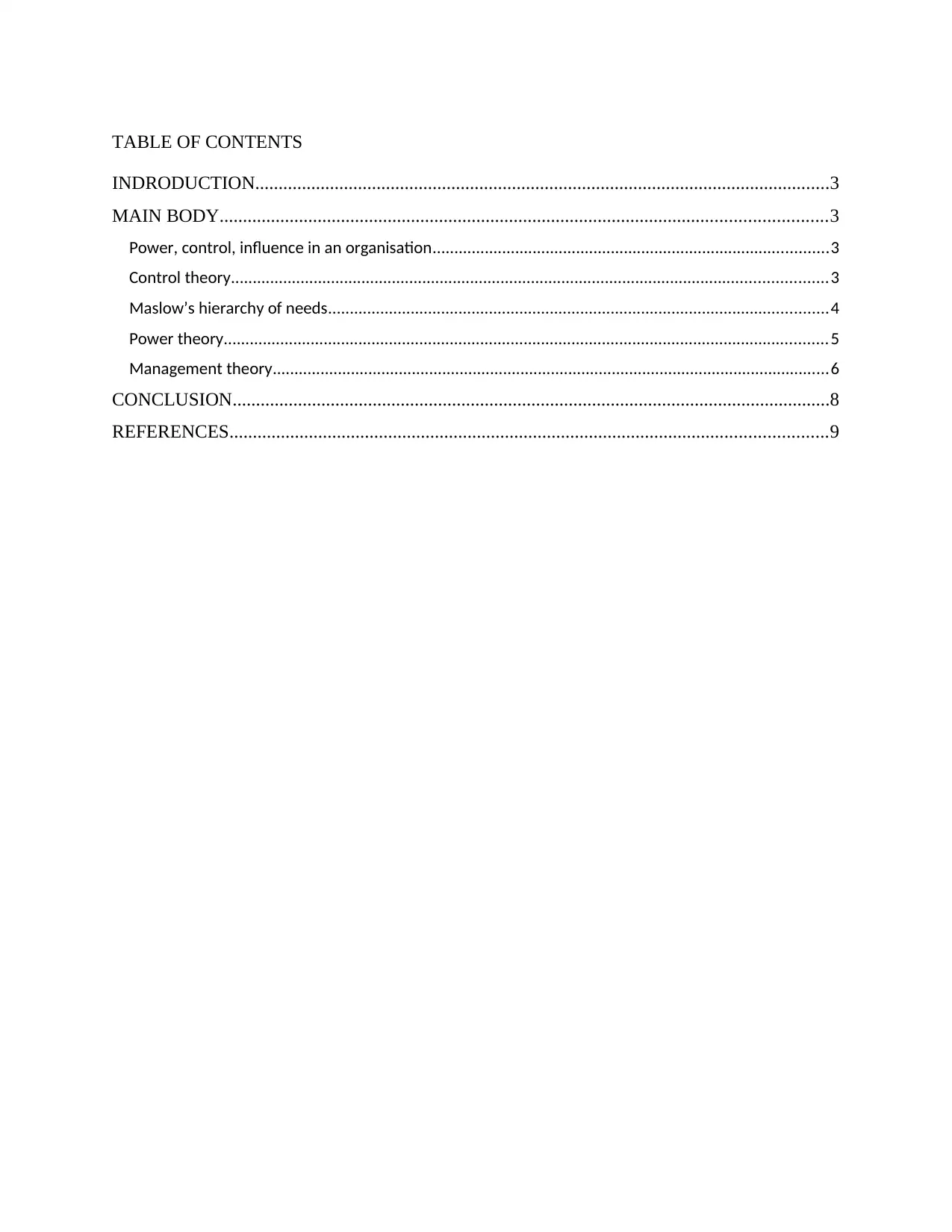
TABLE OF CONTENTS
INDRODUCTION...........................................................................................................................3
MAIN BODY..................................................................................................................................3
Power, control, influence in an organisation...........................................................................................3
Control theory.........................................................................................................................................3
Maslow’s hierarchy of needs...................................................................................................................4
Power theory...........................................................................................................................................5
Management theory................................................................................................................................6
CONCLUSION................................................................................................................................8
REFERENCES................................................................................................................................9
INDRODUCTION...........................................................................................................................3
MAIN BODY..................................................................................................................................3
Power, control, influence in an organisation...........................................................................................3
Control theory.........................................................................................................................................3
Maslow’s hierarchy of needs...................................................................................................................4
Power theory...........................................................................................................................................5
Management theory................................................................................................................................6
CONCLUSION................................................................................................................................8
REFERENCES................................................................................................................................9
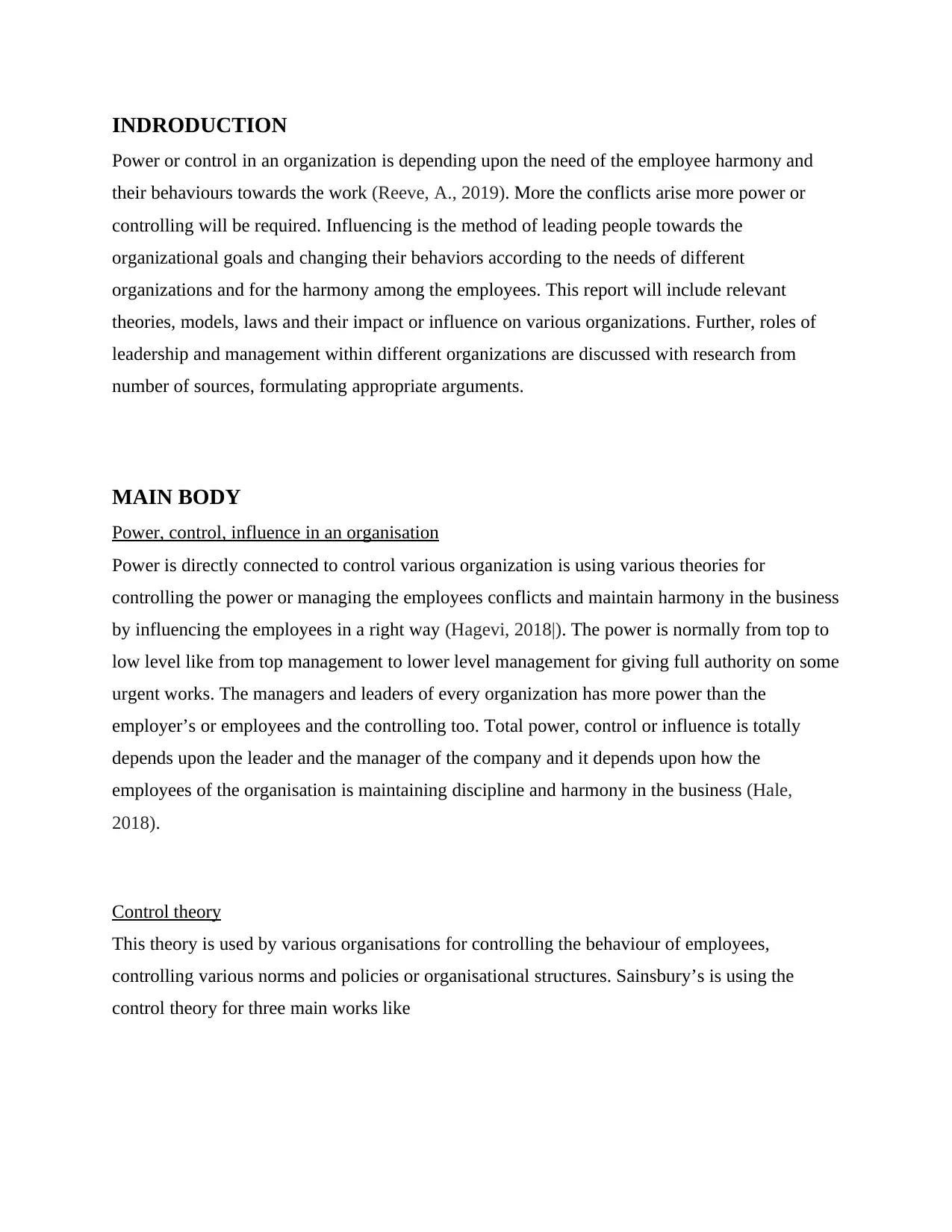
INDRODUCTION
Power or control in an organization is depending upon the need of the employee harmony and
their behaviours towards the work (Reeve, A., 2019). More the conflicts arise more power or
controlling will be required. Influencing is the method of leading people towards the
organizational goals and changing their behaviors according to the needs of different
organizations and for the harmony among the employees. This report will include relevant
theories, models, laws and their impact or influence on various organizations. Further, roles of
leadership and management within different organizations are discussed with research from
number of sources, formulating appropriate arguments.
MAIN BODY
Power, control, influence in an organisation
Power is directly connected to control various organization is using various theories for
controlling the power or managing the employees conflicts and maintain harmony in the business
by influencing the employees in a right way (Hagevi, 2018|). The power is normally from top to
low level like from top management to lower level management for giving full authority on some
urgent works. The managers and leaders of every organization has more power than the
employer’s or employees and the controlling too. Total power, control or influence is totally
depends upon the leader and the manager of the company and it depends upon how the
employees of the organisation is maintaining discipline and harmony in the business (Hale,
2018).
Control theory
This theory is used by various organisations for controlling the behaviour of employees,
controlling various norms and policies or organisational structures. Sainsbury’s is using the
control theory for three main works like
Power or control in an organization is depending upon the need of the employee harmony and
their behaviours towards the work (Reeve, A., 2019). More the conflicts arise more power or
controlling will be required. Influencing is the method of leading people towards the
organizational goals and changing their behaviors according to the needs of different
organizations and for the harmony among the employees. This report will include relevant
theories, models, laws and their impact or influence on various organizations. Further, roles of
leadership and management within different organizations are discussed with research from
number of sources, formulating appropriate arguments.
MAIN BODY
Power, control, influence in an organisation
Power is directly connected to control various organization is using various theories for
controlling the power or managing the employees conflicts and maintain harmony in the business
by influencing the employees in a right way (Hagevi, 2018|). The power is normally from top to
low level like from top management to lower level management for giving full authority on some
urgent works. The managers and leaders of every organization has more power than the
employer’s or employees and the controlling too. Total power, control or influence is totally
depends upon the leader and the manager of the company and it depends upon how the
employees of the organisation is maintaining discipline and harmony in the business (Hale,
2018).
Control theory
This theory is used by various organisations for controlling the behaviour of employees,
controlling various norms and policies or organisational structures. Sainsbury’s is using the
control theory for three main works like
⊘ This is a preview!⊘
Do you want full access?
Subscribe today to unlock all pages.

Trusted by 1+ million students worldwide
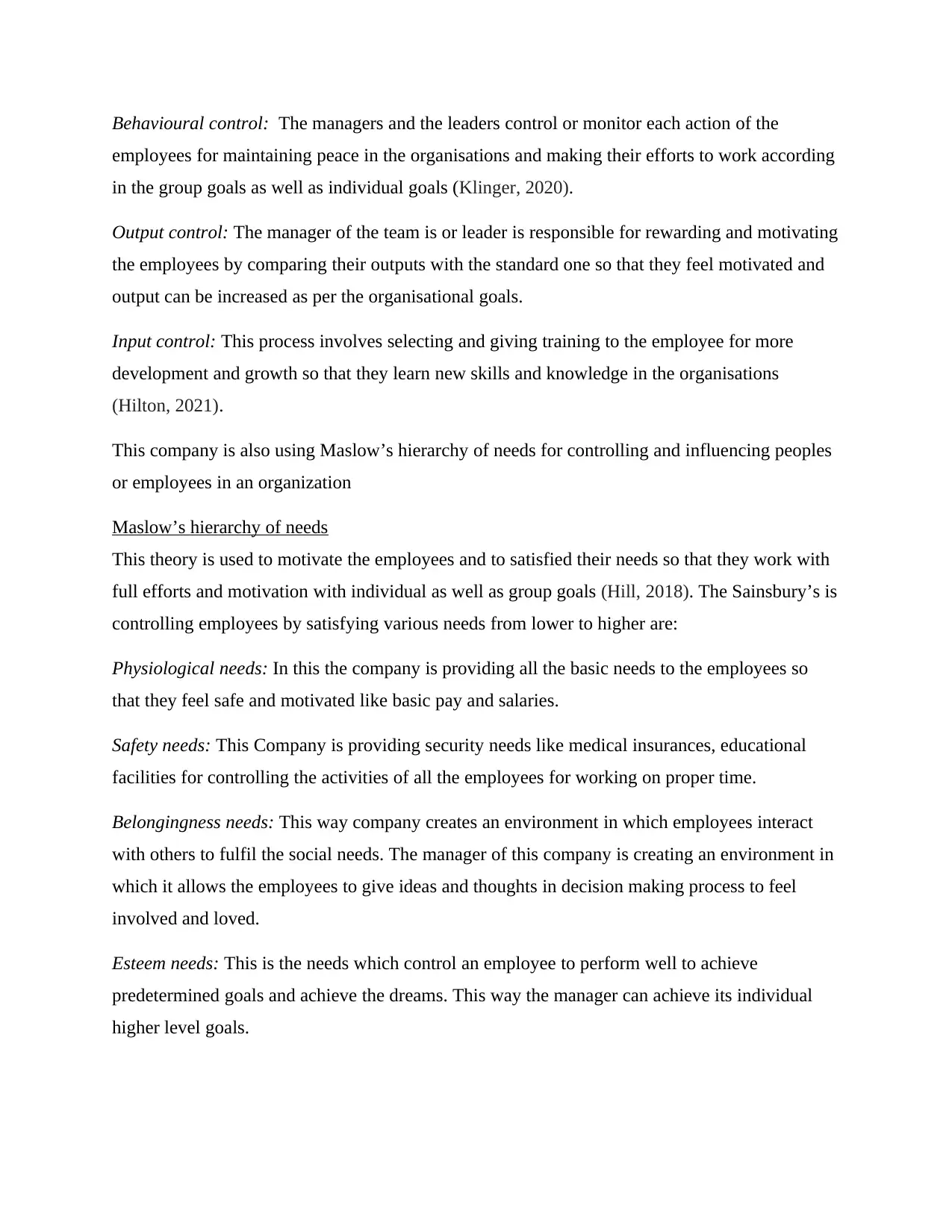
Behavioural control: The managers and the leaders control or monitor each action of the
employees for maintaining peace in the organisations and making their efforts to work according
in the group goals as well as individual goals (Klinger, 2020).
Output control: The manager of the team is or leader is responsible for rewarding and motivating
the employees by comparing their outputs with the standard one so that they feel motivated and
output can be increased as per the organisational goals.
Input control: This process involves selecting and giving training to the employee for more
development and growth so that they learn new skills and knowledge in the organisations
(Hilton, 2021).
This company is also using Maslow’s hierarchy of needs for controlling and influencing peoples
or employees in an organization
Maslow’s hierarchy of needs
This theory is used to motivate the employees and to satisfied their needs so that they work with
full efforts and motivation with individual as well as group goals (Hill, 2018). The Sainsbury’s is
controlling employees by satisfying various needs from lower to higher are:
Physiological needs: In this the company is providing all the basic needs to the employees so
that they feel safe and motivated like basic pay and salaries.
Safety needs: This Company is providing security needs like medical insurances, educational
facilities for controlling the activities of all the employees for working on proper time.
Belongingness needs: This way company creates an environment in which employees interact
with others to fulfil the social needs. The manager of this company is creating an environment in
which it allows the employees to give ideas and thoughts in decision making process to feel
involved and loved.
Esteem needs: This is the needs which control an employee to perform well to achieve
predetermined goals and achieve the dreams. This way the manager can achieve its individual
higher level goals.
employees for maintaining peace in the organisations and making their efforts to work according
in the group goals as well as individual goals (Klinger, 2020).
Output control: The manager of the team is or leader is responsible for rewarding and motivating
the employees by comparing their outputs with the standard one so that they feel motivated and
output can be increased as per the organisational goals.
Input control: This process involves selecting and giving training to the employee for more
development and growth so that they learn new skills and knowledge in the organisations
(Hilton, 2021).
This company is also using Maslow’s hierarchy of needs for controlling and influencing peoples
or employees in an organization
Maslow’s hierarchy of needs
This theory is used to motivate the employees and to satisfied their needs so that they work with
full efforts and motivation with individual as well as group goals (Hill, 2018). The Sainsbury’s is
controlling employees by satisfying various needs from lower to higher are:
Physiological needs: In this the company is providing all the basic needs to the employees so
that they feel safe and motivated like basic pay and salaries.
Safety needs: This Company is providing security needs like medical insurances, educational
facilities for controlling the activities of all the employees for working on proper time.
Belongingness needs: This way company creates an environment in which employees interact
with others to fulfil the social needs. The manager of this company is creating an environment in
which it allows the employees to give ideas and thoughts in decision making process to feel
involved and loved.
Esteem needs: This is the needs which control an employee to perform well to achieve
predetermined goals and achieve the dreams. This way the manager can achieve its individual
higher level goals.
Paraphrase This Document
Need a fresh take? Get an instant paraphrase of this document with our AI Paraphraser
Self-actualization needs: This are the last needs and the higher level needs which every satisfied
employee wants for his full satisfaction and the company is providing this need for controlling
all the employee activities.
Sainsbury’s is controlling in the employees in a way so that proper output and training will be
maintained for proper coordination of the activities.
Power theory
People with power have control of all the legal knowledge of the company or resources and have
the authority to change any legal actions or policies if needed. More power is required when
there is huge conflict between the employees or the employees are not doing the work properly.
The company Tesco is using power leadership theory for encouraging and controlling the
employees and influencing them to work according to the group goals.
Leadership theory
Power is directly connected to the leadership theory because if the leaders is strict and have more
authority and following the autocratic leadership style in which all the decisions are taken by the
leaders. There is no involvement of the employees in any decisions for any kind of ideas and
thoughts. The TESCO is using the leadership theories are
Transformational leadership
This is the leadership style followed by Tesco leaders in which the leaders work with teams so
that they can identify the needs and wants of the groups and the changes which are needed to
accomplish the task with full accuracy and efficiency. It involves various types of steps followed
by the leaders of Tesco are:
The leader provides creative thinking by the employees by involving them into various group
decisions for new ideas and thoughts that will help to achieve the goals with more efforts.
The leaders are properly listening to the employees complains and the problems so that they feel
encouraged and motivated (Chen, 2018).
The leaders of Tesco is trusting the team members and creating mutual trust with using fair
policies and practices on everyone.
employee wants for his full satisfaction and the company is providing this need for controlling
all the employee activities.
Sainsbury’s is controlling in the employees in a way so that proper output and training will be
maintained for proper coordination of the activities.
Power theory
People with power have control of all the legal knowledge of the company or resources and have
the authority to change any legal actions or policies if needed. More power is required when
there is huge conflict between the employees or the employees are not doing the work properly.
The company Tesco is using power leadership theory for encouraging and controlling the
employees and influencing them to work according to the group goals.
Leadership theory
Power is directly connected to the leadership theory because if the leaders is strict and have more
authority and following the autocratic leadership style in which all the decisions are taken by the
leaders. There is no involvement of the employees in any decisions for any kind of ideas and
thoughts. The TESCO is using the leadership theories are
Transformational leadership
This is the leadership style followed by Tesco leaders in which the leaders work with teams so
that they can identify the needs and wants of the groups and the changes which are needed to
accomplish the task with full accuracy and efficiency. It involves various types of steps followed
by the leaders of Tesco are:
The leader provides creative thinking by the employees by involving them into various group
decisions for new ideas and thoughts that will help to achieve the goals with more efforts.
The leaders are properly listening to the employees complains and the problems so that they feel
encouraged and motivated (Chen, 2018).
The leaders of Tesco is trusting the team members and creating mutual trust with using fair
policies and practices on everyone.
The leaders are inspiring the employees to participate in discussions and give new solutions and
ideas to new problems.
This leadership is helpful for the company Tesco to have full power of control on the employees
for achieving the objectives with full efficiency.
Democratic leadership
The company Unilever is using this style of leadership to involve its employees in decision
making process and giving full power to them to take decision accordingly. The leader
involvement is very less in this type of leadership but the in case of emergency or conflicts the
leaders are the sole member to have power to control the activities (Garvanova, 2019). The
leaders of Unilever used these styles are:
The leaders of this company is following participative leadership style in which it is including
the group members to come and participate in decision making process .
The leaders are sharing its power and control to the group members for better decisions and
employees are taking full responsibility for the task to achieve it with full accuracy.
This leadership is open book management rules and policies in which everyone has similar
power and control on the activities and the decisions are taken in front of everyone.
All the members are free to do the work in their own style of management for using their
personal skills and knowledge to the work.
This style of leadership is followed by the leaders of Unilever but has not succeeded in overall
decisions because in some emergency situations or the decisions on various wage or appraisal
policies the employee’s involvement creates conflict and dissatisfaction in the mind of
employees. This theory is helpful in the small and day to day activities of the employees which
requires less control.
Management theory
Management theory is the collection of ideas and rules that helps in controlling and managing
the activities in an organisation or maintain the authority for directing the peoples or employee.
This theory helps the company to influence or motivate the people to achieve group goals or
ideas to new problems.
This leadership is helpful for the company Tesco to have full power of control on the employees
for achieving the objectives with full efficiency.
Democratic leadership
The company Unilever is using this style of leadership to involve its employees in decision
making process and giving full power to them to take decision accordingly. The leader
involvement is very less in this type of leadership but the in case of emergency or conflicts the
leaders are the sole member to have power to control the activities (Garvanova, 2019). The
leaders of Unilever used these styles are:
The leaders of this company is following participative leadership style in which it is including
the group members to come and participate in decision making process .
The leaders are sharing its power and control to the group members for better decisions and
employees are taking full responsibility for the task to achieve it with full accuracy.
This leadership is open book management rules and policies in which everyone has similar
power and control on the activities and the decisions are taken in front of everyone.
All the members are free to do the work in their own style of management for using their
personal skills and knowledge to the work.
This style of leadership is followed by the leaders of Unilever but has not succeeded in overall
decisions because in some emergency situations or the decisions on various wage or appraisal
policies the employee’s involvement creates conflict and dissatisfaction in the mind of
employees. This theory is helpful in the small and day to day activities of the employees which
requires less control.
Management theory
Management theory is the collection of ideas and rules that helps in controlling and managing
the activities in an organisation or maintain the authority for directing the peoples or employee.
This theory helps the company to influence or motivate the people to achieve group goals or
⊘ This is a preview!⊘
Do you want full access?
Subscribe today to unlock all pages.
Trusted by 1+ million students worldwide
individual goals with full satisfaction. The company IKEA is using the various management
theory for balancing the power, control influence in an organisation are:
Principles of administrative management theory
The company IKEA is following this method for in which the leaders are following six functions
like forecast, plan, coordinate, command and control. The leaders of this company are using the
principles in a way to achieve the group goals efficiently and effectively the principles are:
Initiative: In these the company leaders are providing full freedom of power to the employees
and the employees do the work with full freedom and responsibility without any force by the
leaders.
Equity: In this principle the leaders of Ikea is treating each employee equally and giving kind
treatment to everyone to make them feel motivated and involved.
Scalar chain: This principle states that the communication between top levels to lower level
should flow from top to bottom for better coordination and control.
Remuneration of personnel: The leaders of this company are providing fair remuneration to each
employee both monetary and non-monetary for employee satisfaction.
Unity of direction: The Ikea is maintain its environment in which one group has only one leader
and one department has only one manager for better control.
Division of work: The leaders or managers are giving and work and responsibilities according to
the employee’s skills and knowledge for efficiency in the work (Nishizuka, 2018).
Authority and responsibility: This Company is controlling its authority and responsibility like no
more authority or no more responsibility or vice versa for balance in the work.
Unity of command: In this the leaders are giving command to only one team and the one team
has only one leaders to give orders and commands for clarity in the work.
Centralization: The most important decision will be taken by the top management has full
authority in decision making for full control on some serious issues and plans.
theory for balancing the power, control influence in an organisation are:
Principles of administrative management theory
The company IKEA is following this method for in which the leaders are following six functions
like forecast, plan, coordinate, command and control. The leaders of this company are using the
principles in a way to achieve the group goals efficiently and effectively the principles are:
Initiative: In these the company leaders are providing full freedom of power to the employees
and the employees do the work with full freedom and responsibility without any force by the
leaders.
Equity: In this principle the leaders of Ikea is treating each employee equally and giving kind
treatment to everyone to make them feel motivated and involved.
Scalar chain: This principle states that the communication between top levels to lower level
should flow from top to bottom for better coordination and control.
Remuneration of personnel: The leaders of this company are providing fair remuneration to each
employee both monetary and non-monetary for employee satisfaction.
Unity of direction: The Ikea is maintain its environment in which one group has only one leader
and one department has only one manager for better control.
Division of work: The leaders or managers are giving and work and responsibilities according to
the employee’s skills and knowledge for efficiency in the work (Nishizuka, 2018).
Authority and responsibility: This Company is controlling its authority and responsibility like no
more authority or no more responsibility or vice versa for balance in the work.
Unity of command: In this the leaders are giving command to only one team and the one team
has only one leaders to give orders and commands for clarity in the work.
Centralization: The most important decision will be taken by the top management has full
authority in decision making for full control on some serious issues and plans.
Paraphrase This Document
Need a fresh take? Get an instant paraphrase of this document with our AI Paraphraser
The IKEA is using these principles for better control and decision making in the organization by
better control and using of power to the best and motivating the employees with rewards and
monetary benefits
Scientific management theory
This company IKEA is also using the old scientific method in which the leaders are developing
various methods and rules for doing the work with more efficiency with less cost and time by the
leaders. This method encourages the employees for working with more efforts (Sai, 2021). These
principle developing the team cooperation and teamwork spirit in the organizations as well as
employees.
Although this method is not that useful and accurate like the first one by Ikea because this
involves a lot of efforts in trials and increase the cost in examining the things etc.
CONCLUSION
From the above report it has been concluded that all the three function power, control and
influence is interrelated to each other because power without control is incomplete or vice versa.
The leaders with more power will have more control then the leaders with less power and
control. Furthermore, leaders with more power have high influencing power for making its
employees motivated by using various theories and models of leadership and management. It
also has been concluded that different organizations using different styles or theories of powers
but some are useful and some are not depend according to the company’s environment and the
workplace. The company with more conflicts and employees are lazy required more theories and
powers and vice versa.
better control and using of power to the best and motivating the employees with rewards and
monetary benefits
Scientific management theory
This company IKEA is also using the old scientific method in which the leaders are developing
various methods and rules for doing the work with more efficiency with less cost and time by the
leaders. This method encourages the employees for working with more efforts (Sai, 2021). These
principle developing the team cooperation and teamwork spirit in the organizations as well as
employees.
Although this method is not that useful and accurate like the first one by Ikea because this
involves a lot of efforts in trials and increase the cost in examining the things etc.
CONCLUSION
From the above report it has been concluded that all the three function power, control and
influence is interrelated to each other because power without control is incomplete or vice versa.
The leaders with more power will have more control then the leaders with less power and
control. Furthermore, leaders with more power have high influencing power for making its
employees motivated by using various theories and models of leadership and management. It
also has been concluded that different organizations using different styles or theories of powers
but some are useful and some are not depend according to the company’s environment and the
workplace. The company with more conflicts and employees are lazy required more theories and
powers and vice versa.
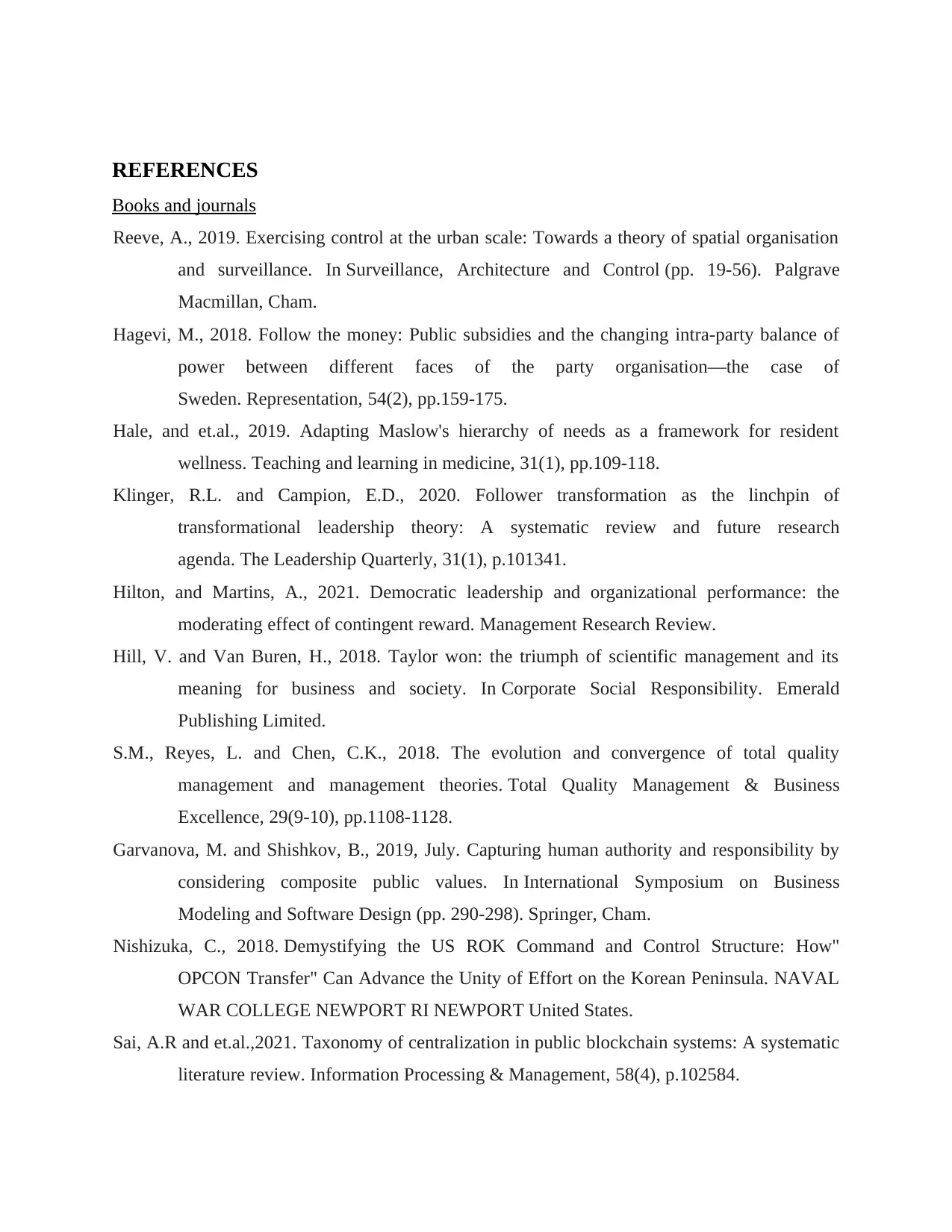
REFERENCES
Books and journals
Reeve, A., 2019. Exercising control at the urban scale: Towards a theory of spatial organisation
and surveillance. In Surveillance, Architecture and Control (pp. 19-56). Palgrave
Macmillan, Cham.
Hagevi, M., 2018. Follow the money: Public subsidies and the changing intra-party balance of
power between different faces of the party organisation—the case of
Sweden. Representation, 54(2), pp.159-175.
Hale, and et.al., 2019. Adapting Maslow's hierarchy of needs as a framework for resident
wellness. Teaching and learning in medicine, 31(1), pp.109-118.
Klinger, R.L. and Campion, E.D., 2020. Follower transformation as the linchpin of
transformational leadership theory: A systematic review and future research
agenda. The Leadership Quarterly, 31(1), p.101341.
Hilton, and Martins, A., 2021. Democratic leadership and organizational performance: the
moderating effect of contingent reward. Management Research Review.
Hill, V. and Van Buren, H., 2018. Taylor won: the triumph of scientific management and its
meaning for business and society. In Corporate Social Responsibility. Emerald
Publishing Limited.
S.M., Reyes, L. and Chen, C.K., 2018. The evolution and convergence of total quality
management and management theories. Total Quality Management & Business
Excellence, 29(9-10), pp.1108-1128.
Garvanova, M. and Shishkov, B., 2019, July. Capturing human authority and responsibility by
considering composite public values. In International Symposium on Business
Modeling and Software Design (pp. 290-298). Springer, Cham.
Nishizuka, C., 2018. Demystifying the US ROK Command and Control Structure: How"
OPCON Transfer" Can Advance the Unity of Effort on the Korean Peninsula. NAVAL
WAR COLLEGE NEWPORT RI NEWPORT United States.
Sai, A.R and et.al.,2021. Taxonomy of centralization in public blockchain systems: A systematic
literature review. Information Processing & Management, 58(4), p.102584.
Books and journals
Reeve, A., 2019. Exercising control at the urban scale: Towards a theory of spatial organisation
and surveillance. In Surveillance, Architecture and Control (pp. 19-56). Palgrave
Macmillan, Cham.
Hagevi, M., 2018. Follow the money: Public subsidies and the changing intra-party balance of
power between different faces of the party organisation—the case of
Sweden. Representation, 54(2), pp.159-175.
Hale, and et.al., 2019. Adapting Maslow's hierarchy of needs as a framework for resident
wellness. Teaching and learning in medicine, 31(1), pp.109-118.
Klinger, R.L. and Campion, E.D., 2020. Follower transformation as the linchpin of
transformational leadership theory: A systematic review and future research
agenda. The Leadership Quarterly, 31(1), p.101341.
Hilton, and Martins, A., 2021. Democratic leadership and organizational performance: the
moderating effect of contingent reward. Management Research Review.
Hill, V. and Van Buren, H., 2018. Taylor won: the triumph of scientific management and its
meaning for business and society. In Corporate Social Responsibility. Emerald
Publishing Limited.
S.M., Reyes, L. and Chen, C.K., 2018. The evolution and convergence of total quality
management and management theories. Total Quality Management & Business
Excellence, 29(9-10), pp.1108-1128.
Garvanova, M. and Shishkov, B., 2019, July. Capturing human authority and responsibility by
considering composite public values. In International Symposium on Business
Modeling and Software Design (pp. 290-298). Springer, Cham.
Nishizuka, C., 2018. Demystifying the US ROK Command and Control Structure: How"
OPCON Transfer" Can Advance the Unity of Effort on the Korean Peninsula. NAVAL
WAR COLLEGE NEWPORT RI NEWPORT United States.
Sai, A.R and et.al.,2021. Taxonomy of centralization in public blockchain systems: A systematic
literature review. Information Processing & Management, 58(4), p.102584.
⊘ This is a preview!⊘
Do you want full access?
Subscribe today to unlock all pages.
Trusted by 1+ million students worldwide


1 out of 10


Related Documents


Your All-in-One AI-Powered Toolkit for Academic Success.
+13062052269
info@desklib.com
Available 24*7 on WhatsApp / Email
![[object Object]](/_next/static/media/star-bottom.7253800d.svg)
Unlock your academic potential
Copyright © 2020–2025 A2Z Services. All Rights Reserved. Developed and managed by ZUCOL.