COMP2804 Discrete Structures II Assignment 3: Probability Problems

Verified

Added on  2022/08/23

|6
|1310
|19
Homework Assignment
AI Summary
This document provides solutions to Assignment 3 for COMP2804: Discrete Structures II, focusing on probability. The assignment covers several key areas, including calculating the probability of forming specific words in Scrabble based on the frequency of letters, determining probabilities related to events using conditional probability, and analyzing the probabilities of outcomes in sampling scenarios, such as drawing pellets and pills. Furthermore, it delves into binomial distributions, calculating probabilities of heads and tails in coin tosses and applying these concepts to seating arrangements and random number generation. The document includes detailed calculations and justifications for each problem, offering a comprehensive guide to understanding and solving probability-related questions within the context of discrete structures.
Document Page
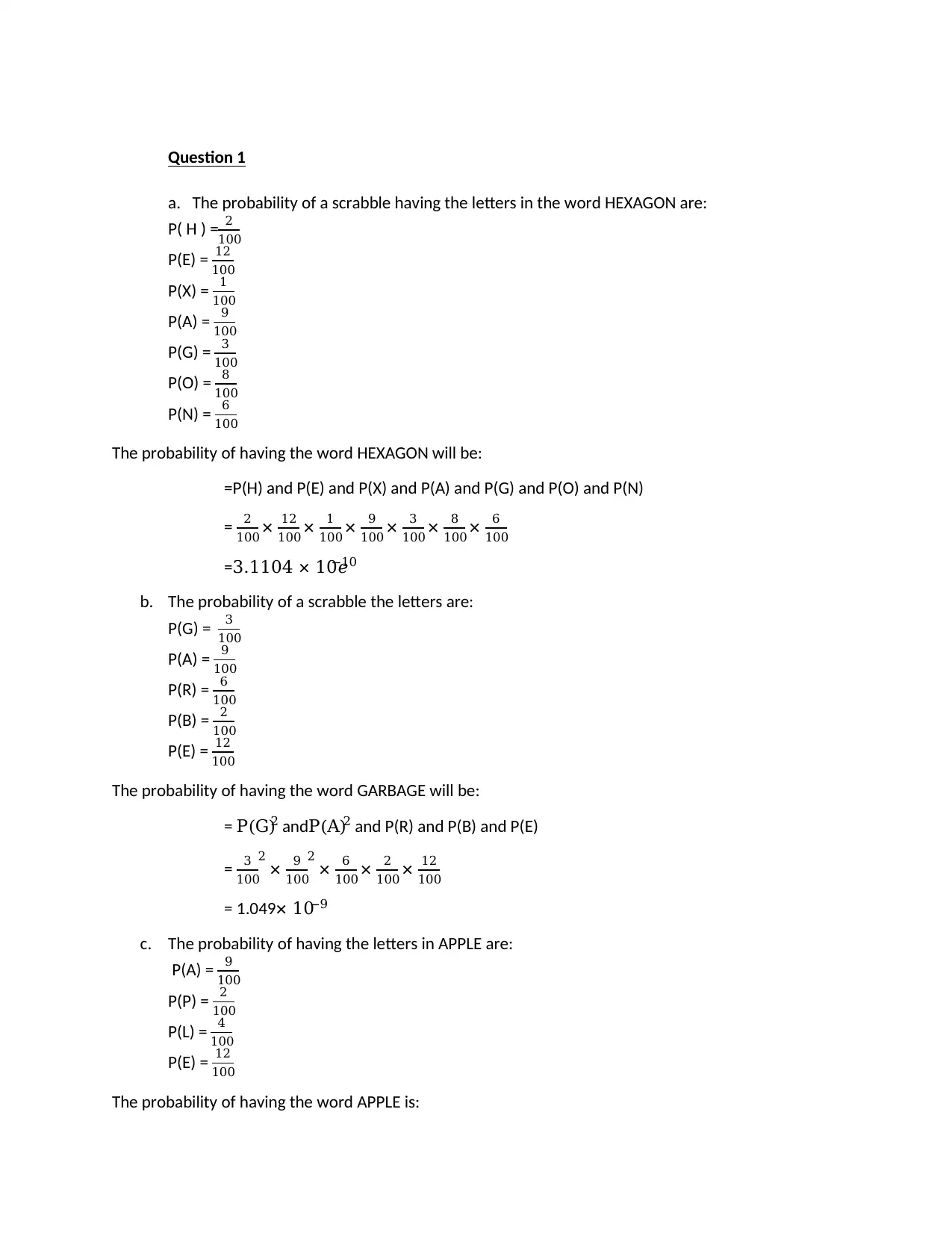
Question 1
a. The probability of a scrabble having the letters in the word HEXAGON are:
P( H ) = 2
100
P(E) = 12
100
P(X) = 1
100
P(A) = 9
100
P(G) = 3
100
P(O) = 8
100
P(N) = 6
100
The probability of having the word HEXAGON will be:
=P(H) and P(E) and P(X) and P(A) and P(G) and P(O) and P(N)
= 2
100 × 12
100 × 1
100 × 9
100 × 3
100 × 8
100 × 6
100
=3.1104 × 10𝑒10
b. The probability of a scrabble the letters are:
P(G) = 3
100
P(A) = 9
100
P(R) = 6
100
P(B) = 2
100
P(E) = 12
100
The probability of having the word GARBAGE will be:
= P(G)2 andP(A)2 and P(R) and P(B) and P(E)
= 3
100
2
× 9
100
2
× 6
100 × 2
100 × 12
100
= 1.049× 10⁹
c. The probability of having the letters in APPLE are:
P(A) = 9
100
P(P) = 2
100
P(L) = 4
100
P(E) = 12
100
The probability of having the word APPLE is:
tabler-icon-diamond-filled.svg

Paraphrase This Document

Need a fresh take? Get an instant paraphrase of this document with our AI Paraphraser
Document Page
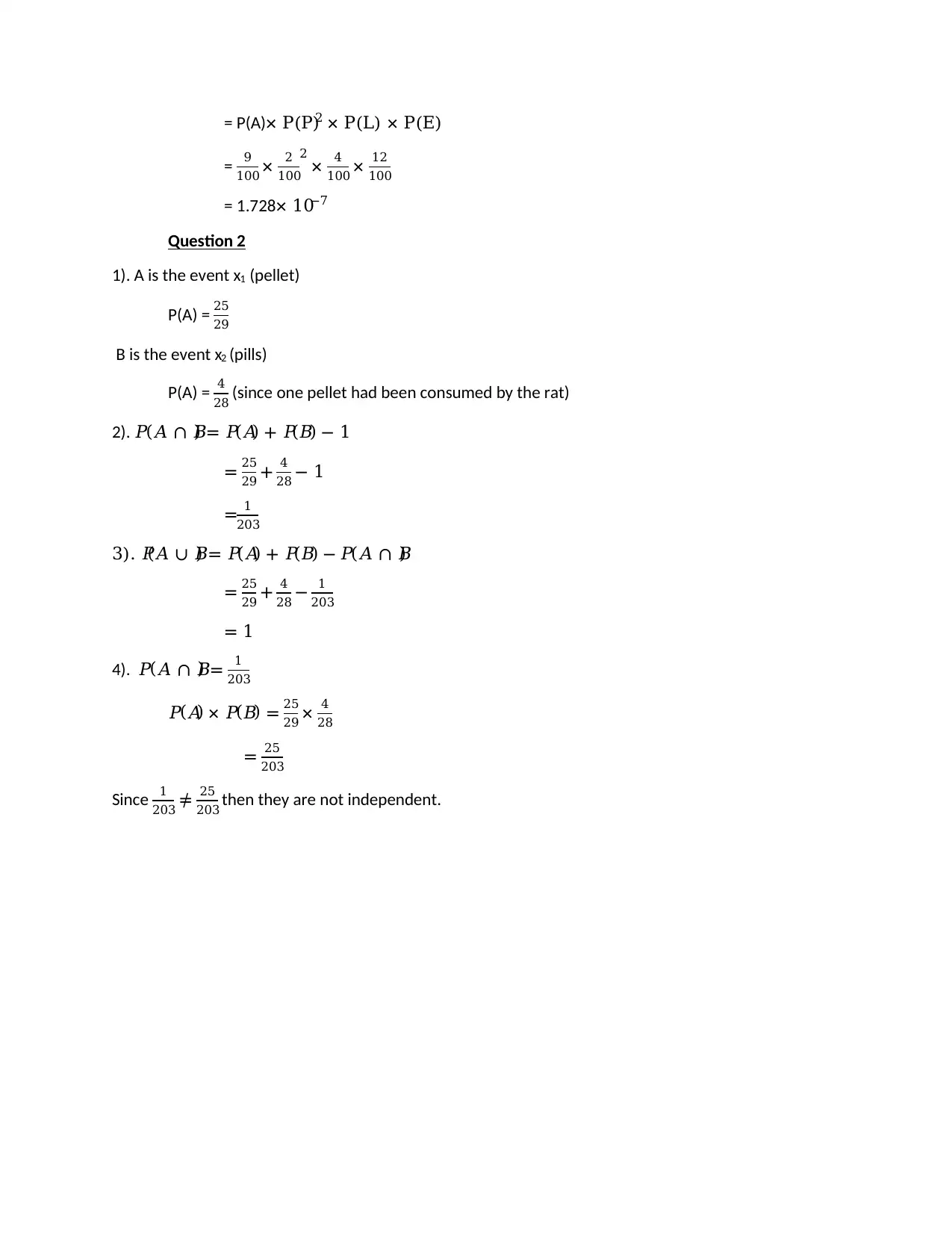
= P(A)× P(P)2 × P(L) × P(E)
= 9
100 × 2
100
2
× 4
100 × 12
100
= 1.728× 10⁷
Question 2
1). A is the event x1 (pellet)
P(A) = 25
29
B is the event x2 (pills)
P(A) = 4
28 (since one pellet had been consumed by the rat)
2). 𝑃(𝐴 ∩ 𝐵) = 𝑃(𝐴) + 𝑃(𝐵) 1
= 25
29 + 4
28 1
= 1
203
3). 𝑃(𝐴 ∪ 𝐵) = 𝑃(𝐴) + 𝑃(𝐵) 𝑃(𝐴 ∩ 𝐵)
= 25
29 + 4
28 1
203
= 1
4). 𝑃(𝐴 ∩ 𝐵) = 1
203
𝑃(𝐴) × 𝑃(𝐵) = 25
29 × 4
28
= 25
203
Since 1
203 25
203 then they are not independent.
Document Page
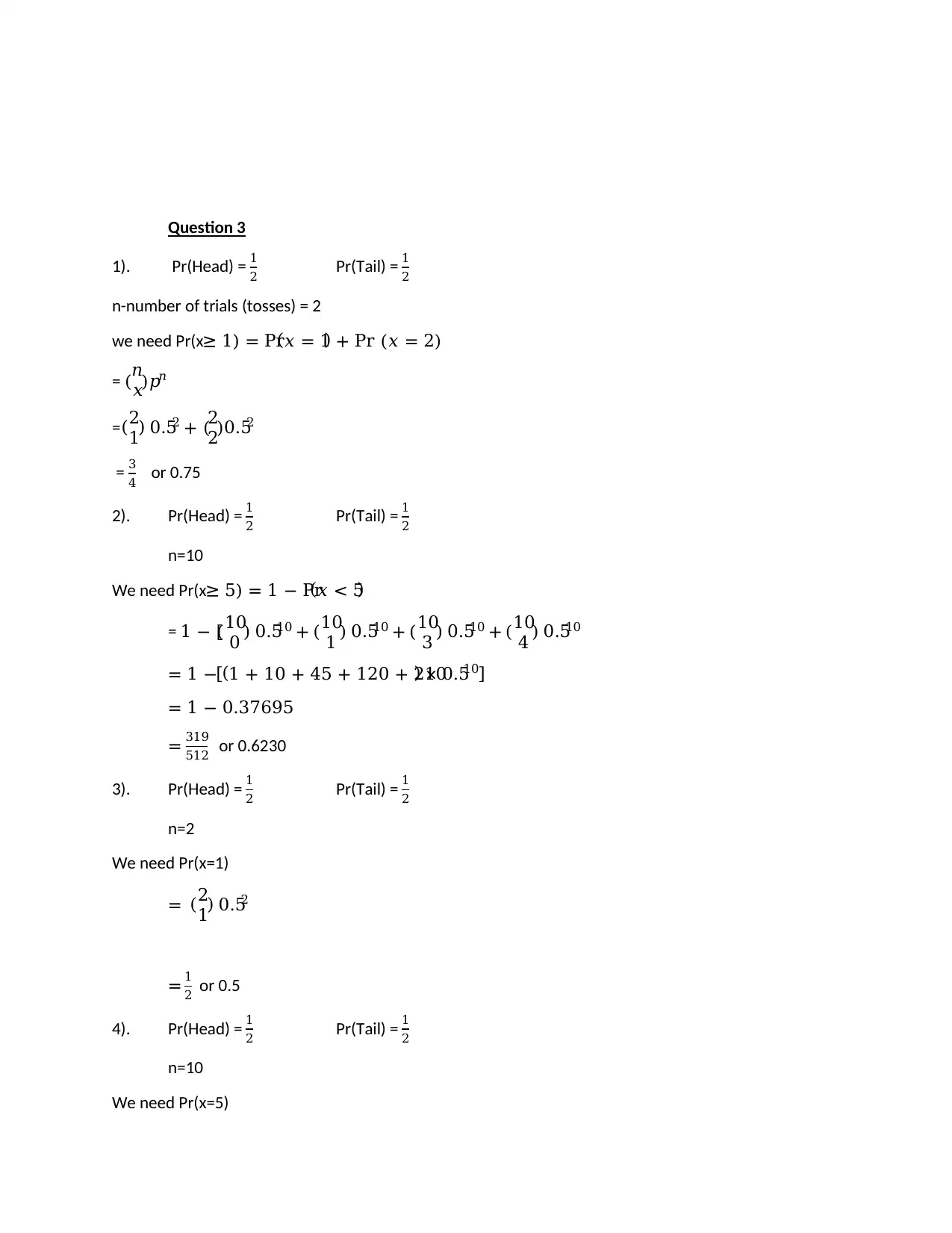
Question 3
1). Pr(Head) = 1
2 Pr(Tail) = 1
2
n-number of trials (tosses) = 2
we need Pr(x 1) = Pr(𝑥 = 1) + Pr (𝑥 = 2)
= (𝑛
𝑥)𝑝𝑛
=(2
1) 0.52 + (2
2)0.52
= 3
4 or 0.75
2). Pr(Head) = 1
2 Pr(Tail) = 1
2
n=10
We need Pr(x 5) = 1 − Pr(𝑥 < 5)
= 1 − [(10
0 ) 0.510 + (10
1 ) 0.510 + (10
3 ) 0.510 + (10
4 ) 0.510
= 1 −[(1 + 10 + 45 + 120 + 210) × 0.510]
= 1 − 0.37695
= 319
512 or 0.6230
3). Pr(Head) = 1
2 Pr(Tail) = 1
2
n=2
We need Pr(x=1)
= (2
1) 0.52
= 1
2 or 0.5
4). Pr(Head) = 1
2 Pr(Tail) = 1
2
n=10
We need Pr(x=5)
Document Page
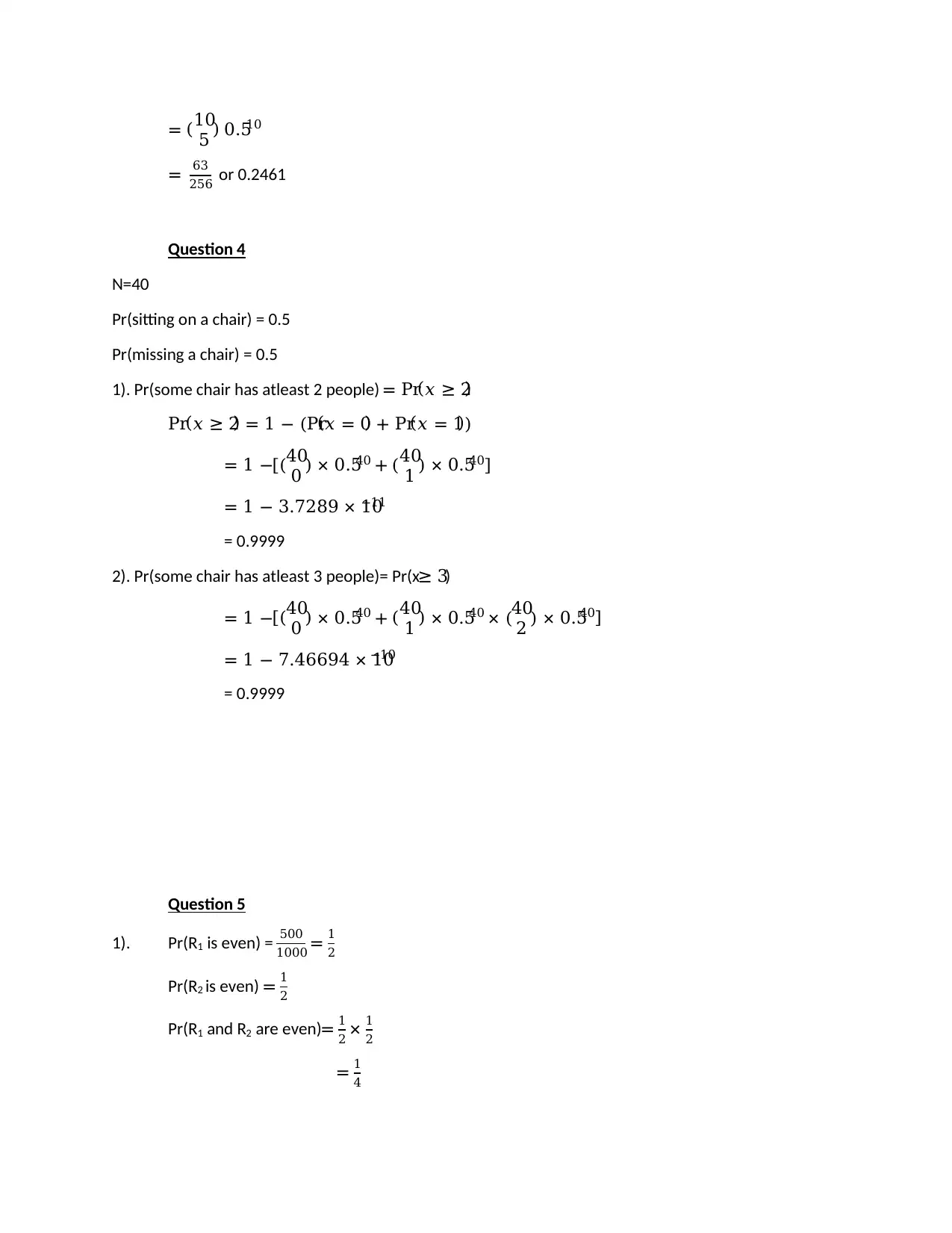
= (10
5 ) 0.510
= 63
256 or 0.2461
Question 4
N=40
Pr(sitting on a chair) = 0.5
Pr(missing a chair) = 0.5
1). Pr(some chair has atleast 2 people) = Pr(𝑥 ≥ 2)
Pr(𝑥 ≥ 2) = 1 − (Pr(𝑥 = 0) + Pr(𝑥 = 1))
= 1 −[(40
0 ) × 0.540 + (40
1 ) × 0.540]
= 1 − 3.7289 × 1011
= 0.9999
2). Pr(some chair has atleast 3 people)= Pr(x 3)
= 1 −[(40
0 ) × 0.540 + (40
1 ) × 0.540 × (40
2 ) × 0.540]
= 1 − 7.46694 × 1010
= 0.9999
Question 5
1). Pr(R1 is even) = 500
1000 = 1
2
Pr(R2 is even) = 1
2
Pr(R1 and R2 are even)= 1
2 × 1
2
= 1
4
tabler-icon-diamond-filled.svg

Paraphrase This Document

Need a fresh take? Get an instant paraphrase of this document with our AI Paraphraser
Document Page
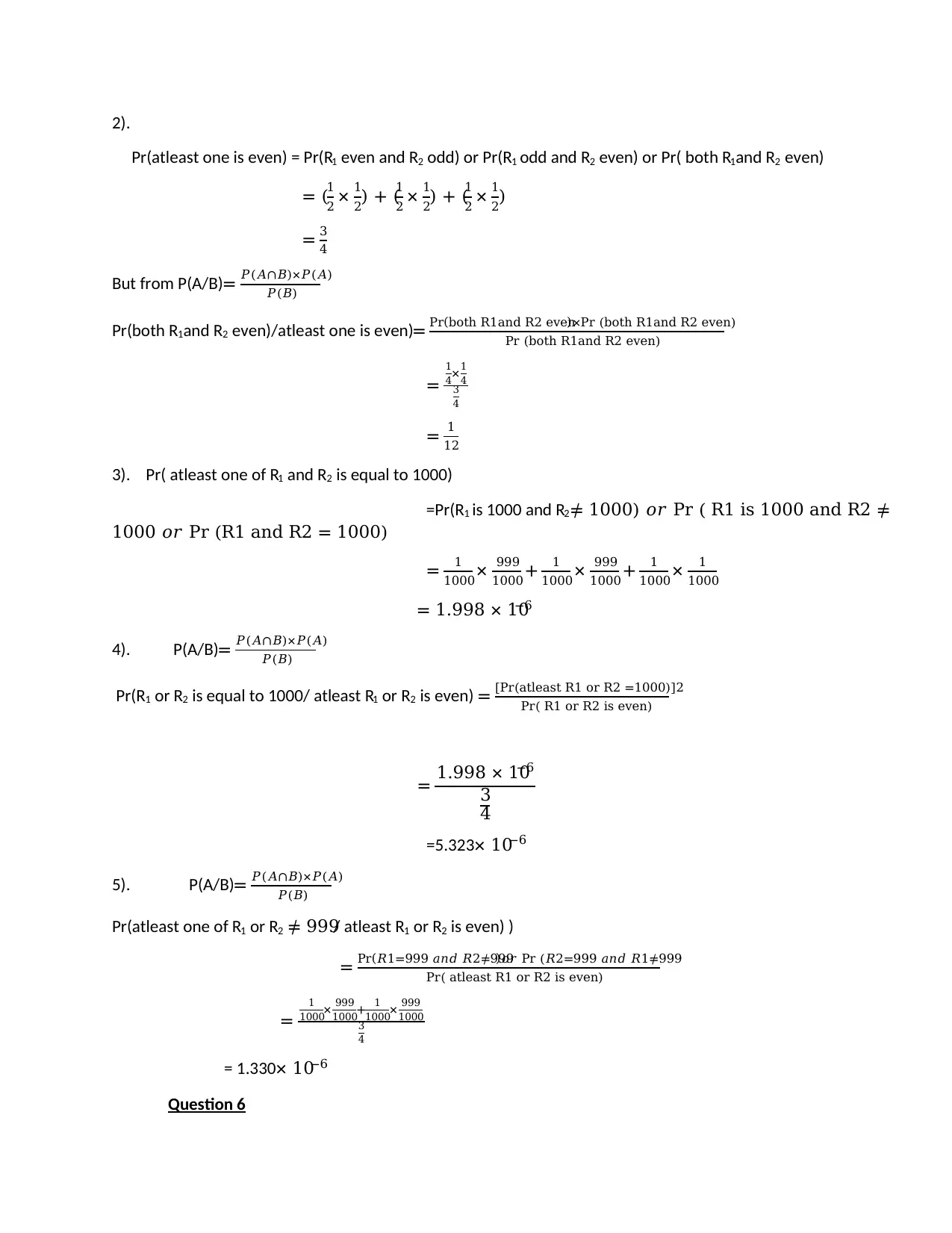
2).
Pr(atleast one is even) = Pr(R1 even and R2 odd) or Pr(R1 odd and R2 even) or Pr( both R1and R2 even)
= (1
2 × 1
2) + (
1
2 × 1
2) + (
1
2 × 1
2)
= 3
4
But from P(A/B)= 𝑃(𝐴∩𝐵)×𝑃(𝐴)
𝑃(𝐵)
Pr(both R1and R2 even)/atleast one is even)= Pr(both R1and R2 even)×Pr (both R1and R2 even)
Pr (both R1and R2 even)
=
1
4×1
4
3
4
= 1
12
3). Pr( atleast one of R1 and R2 is equal to 1000)
=Pr(R1 is 1000 and R2 1000) 𝑜𝑟 Pr ( R1 is 1000 and R2 ≠
1000 𝑜𝑟 Pr (R1 and R2 = 1000)
= 1
1000× 999
1000 + 1
1000× 999
1000 + 1
1000× 1
1000
= 1.998 × 10⁶
4). P(A/B)= 𝑃(𝐴∩𝐵)×𝑃(𝐴)
𝑃(𝐵)
Pr(R1 or R2 is equal to 1000/ atleast R1 or R2 is even) = [Pr(atleast R1 or R2 =1000)]2
Pr( R1 or R2 is even)
= 1.998 × 10⁶
3
4
=5.323× 10⁶
5). P(A/B)= 𝑃(𝐴∩𝐵)×𝑃(𝐴)
𝑃(𝐵)
Pr(atleast one of R1 or R2 999/ atleast R1 or R2 is even) )
= Pr(𝑅1=999 𝑎𝑛𝑑 𝑅2≠999)𝑜𝑟 Pr (𝑅2=999 𝑎𝑛𝑑 𝑅1≠999
Pr( atleast R1 or R2 is even)
=
1
1000× 999
1000+ 1
1000× 999
1000
3
4
= 1.330× 10⁶
Question 6
Document Page
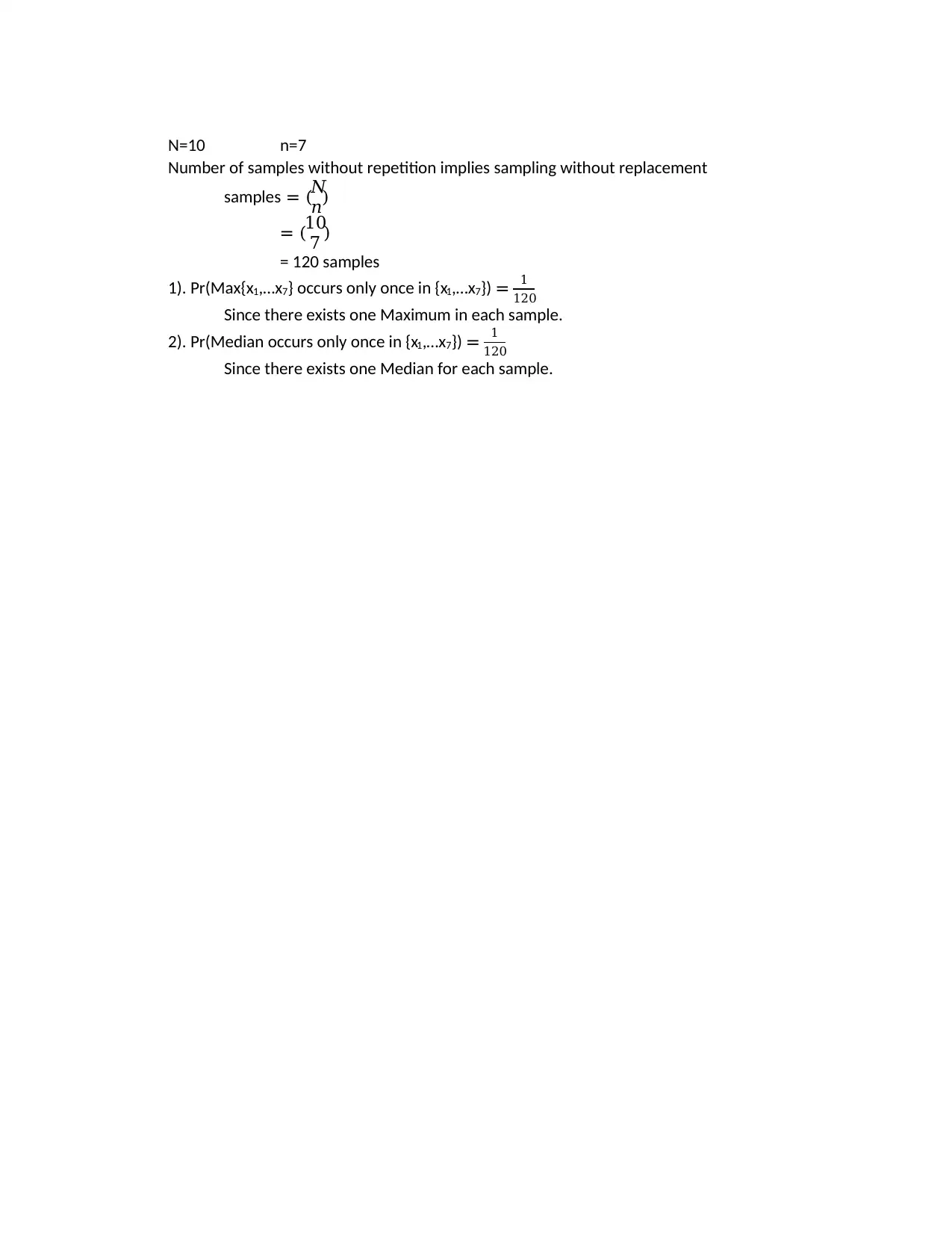
N=10 n=7
Number of samples without repetition implies sampling without replacement
samples = (𝑁
𝑛)
= (10
7 )
= 120 samples
1). Pr(Max{x1,…x7} occurs only once in {x1,…x7}) = 1
120
Since there exists one Maximum in each sample.
2). Pr(Median occurs only once in {x1,…x7}) = 1
120
Since there exists one Median for each sample.
chevron_up_icon
1 out of 6
circle_padding
hide_on_mobile
zoom_out_icon
[object Object]