The Developing Manager Report: Leadership, Culture, and Skills at TUI
VerifiedAdded on 2020/06/05
|15
|4473
|294
Report
AI Summary
This report examines the development of a manager within the context of Touristic Union International (TUI). It begins by comparing different management styles, discussing leadership characteristics, and analyzing the communication process and organizational culture within TUI. The report then assesses the author's own management skills, performs a SWOT analysis, and outlines objectives for personal development. Further, it explores leading and motivating a team, justifying managerial decisions, and explaining personal skills to support career advancement. The report highlights the importance of leadership in the travel and tourism sector, emphasizing the need for effective management practices to improve competitiveness. It uses contingency theory and other frameworks to evaluate TUI's practices, including its participative management style and internal and external communication methods. The analysis covers the impact of organizational culture, change management factors, and the author's strengths, weaknesses, opportunities, and threats (SWOT) to create a comprehensive overview of managerial development.
THE DEVELOPING MANAGER

Paraphrase This Document
Need a fresh take? Get an instant paraphrase of this document with our AI Paraphraser
CONTENTS
INTRODUCTION.........................................................................................................................................1
TASK – 1.......................................................................................................................................................1
1.1 Comparing the different management styles.................................................................................1
1.2 Discussing leadership characteristics.............................................................................................2
1.3 Evaluating communication process in TUI....................................................................................3
1.4 Analyze the organizational culture and change in TUI.................................................................4
TASK – 2.......................................................................................................................................................5
2.1 Assessing own management skills performance...................................................................................5
2.2 SWOT analysis.....................................................................................................................................6
2.3 Objectives and targets to develop own potential...................................................................................7
TASK – 3.......................................................................................................................................................8
3.1 Leading and motivating a team to achieve an agreed goal or objective..............................................8
3.2 Justifying managerial decisions to support achievement of goals.......................................................8
TASK – 4.......................................................................................................................................................9
4.1 Explaining the own managerial and personal skills to support career development...........................9
4.2 Reviewing personal and career developments needs.........................................................................10
CONCLUSION............................................................................................................................................10
REFERENCES............................................................................................................................................12
INTRODUCTION.........................................................................................................................................1
TASK – 1.......................................................................................................................................................1
1.1 Comparing the different management styles.................................................................................1
1.2 Discussing leadership characteristics.............................................................................................2
1.3 Evaluating communication process in TUI....................................................................................3
1.4 Analyze the organizational culture and change in TUI.................................................................4
TASK – 2.......................................................................................................................................................5
2.1 Assessing own management skills performance...................................................................................5
2.2 SWOT analysis.....................................................................................................................................6
2.3 Objectives and targets to develop own potential...................................................................................7
TASK – 3.......................................................................................................................................................8
3.1 Leading and motivating a team to achieve an agreed goal or objective..............................................8
3.2 Justifying managerial decisions to support achievement of goals.......................................................8
TASK – 4.......................................................................................................................................................9
4.1 Explaining the own managerial and personal skills to support career development...........................9
4.2 Reviewing personal and career developments needs.........................................................................10
CONCLUSION............................................................................................................................................10
REFERENCES............................................................................................................................................12
INTRODUCTION
Organizations need some direction to perform their business needs. Pertaining to this, the
most significant role is of the leaders. The leaders and managers guide the others in order to
develop the companies (Evans, 2008). Thus, organizations with the more qualified workforce and
management development program reap out better performance. It is important for the companies
related to travel and tourism to invest in leadership as well as management developments; however
they need to make sure that any investment finances activities must have practical application in
the workplace (Luthans, 2008). There are many researches which depicts that the productivity
level of UK are noticeably mid-table as per the international standards for the developed
economies. Bloom’s has used an interview based evaluation tool in order to measure the
international management practices and it was revealed that there is large productivity gap between
the UK’s major competitors (Effere, 2005). Further, when reasons behind this variation was
explored that it was found that management practice was one of the vital element behind this gap.
The travel and tourism sector in UK has deficit management and leadership qualities and need to
improve to increase the competitiveness.
The present research is being carried out to investigate the details in regards with the
management practices and various styles in an organization. In addition to this, various
communication techniques and process of the firm will be analyzed. The company taken under
consideration for the present research is Touristic Union International (TUI). It is one of the
leading Travel and Tourism Company being headquartered in Germany (TUI Touristik Union
International, 2018). The company offers services to their customers from a single source i.e.
flights are booked from their travel agency, accommodation from their own hotel and customer
care by their own travel guide. With this vertical integration strategy TUI covers the overall sales
market through value chain. The culture of the TUI will be evaluated in the present study.
1
Organizations need some direction to perform their business needs. Pertaining to this, the
most significant role is of the leaders. The leaders and managers guide the others in order to
develop the companies (Evans, 2008). Thus, organizations with the more qualified workforce and
management development program reap out better performance. It is important for the companies
related to travel and tourism to invest in leadership as well as management developments; however
they need to make sure that any investment finances activities must have practical application in
the workplace (Luthans, 2008). There are many researches which depicts that the productivity
level of UK are noticeably mid-table as per the international standards for the developed
economies. Bloom’s has used an interview based evaluation tool in order to measure the
international management practices and it was revealed that there is large productivity gap between
the UK’s major competitors (Effere, 2005). Further, when reasons behind this variation was
explored that it was found that management practice was one of the vital element behind this gap.
The travel and tourism sector in UK has deficit management and leadership qualities and need to
improve to increase the competitiveness.
The present research is being carried out to investigate the details in regards with the
management practices and various styles in an organization. In addition to this, various
communication techniques and process of the firm will be analyzed. The company taken under
consideration for the present research is Touristic Union International (TUI). It is one of the
leading Travel and Tourism Company being headquartered in Germany (TUI Touristik Union
International, 2018). The company offers services to their customers from a single source i.e.
flights are booked from their travel agency, accommodation from their own hotel and customer
care by their own travel guide. With this vertical integration strategy TUI covers the overall sales
market through value chain. The culture of the TUI will be evaluated in the present study.
1
⊘ This is a preview!⊘
Do you want full access?
Subscribe today to unlock all pages.

Trusted by 1+ million students worldwide
TASK – 1
1.1 Comparing the different management styles
In this modern business environment, the workplace and its environment vary with the
situation and behavior of the people working there. Thus, it becomes necessary to understand these
changes and adopt an appropriate management style. Talking in relation with the management
style, it influences the overall communication system within the organization as well as the process
to complete a particular task.
Contingency theory of management
This theory is based on the fact that there is no best way to carry out a task and lead the
organization. There are many external as well as internal factors that influences the right way of
leading the organization. In simple words, the course of action to be undertaken is dependent upon
the situation. There are majorly three main concepts of contingent theory i.e. there is not best way
of to manage the organization, leadership should possess an ability to determine and assess the best
suited management style so as to achieve the goals of the firm and lastly, the least preferred co-
worker scale that helps in measuring the manager’s leadership orientation (McGrath and Bates,
2017).
Touristic Union International (TUI) is one of the leading Travel and Tourism Company and
since, it is a service industry, and participation of customers and employees is bound to happen.
Pertaining to this, the company follows participative management style. The leaders of the TUI
have assessed this style by refereeing to the contingency model theory. The sub-ordinates within
the firm are invited to take decisions and also given range of opportunities of discretion in their
work.
1.2 Discussing leadership characteristics
Leadership is a technique through which the tasks are performed in order to achieve a
common goal. Moreover, it is a social influence process, wherein a person provides support to
another to achieve a common action by developing a path or way (Fairholm, 2004). In addition
to this, an effective leadership is that which helps in maximizing and integrating the available
resources. An organization can achieve the path of success, if the leaders are efficient. Therefore,
it is very vital for the firms to have good leaders that direct the business operations towards
2
1.1 Comparing the different management styles
In this modern business environment, the workplace and its environment vary with the
situation and behavior of the people working there. Thus, it becomes necessary to understand these
changes and adopt an appropriate management style. Talking in relation with the management
style, it influences the overall communication system within the organization as well as the process
to complete a particular task.
Contingency theory of management
This theory is based on the fact that there is no best way to carry out a task and lead the
organization. There are many external as well as internal factors that influences the right way of
leading the organization. In simple words, the course of action to be undertaken is dependent upon
the situation. There are majorly three main concepts of contingent theory i.e. there is not best way
of to manage the organization, leadership should possess an ability to determine and assess the best
suited management style so as to achieve the goals of the firm and lastly, the least preferred co-
worker scale that helps in measuring the manager’s leadership orientation (McGrath and Bates,
2017).
Touristic Union International (TUI) is one of the leading Travel and Tourism Company and
since, it is a service industry, and participation of customers and employees is bound to happen.
Pertaining to this, the company follows participative management style. The leaders of the TUI
have assessed this style by refereeing to the contingency model theory. The sub-ordinates within
the firm are invited to take decisions and also given range of opportunities of discretion in their
work.
1.2 Discussing leadership characteristics
Leadership is a technique through which the tasks are performed in order to achieve a
common goal. Moreover, it is a social influence process, wherein a person provides support to
another to achieve a common action by developing a path or way (Fairholm, 2004). In addition
to this, an effective leadership is that which helps in maximizing and integrating the available
resources. An organization can achieve the path of success, if the leaders are efficient. Therefore,
it is very vital for the firms to have good leaders that direct the business operations towards
2
Paraphrase This Document
Need a fresh take? Get an instant paraphrase of this document with our AI Paraphraser
achieving the efficiency. Below are the following traits a leader should have to be more effective
and efficient:
Leaders should be honest towards their work
He should be proactive and must think three step ahead
It is required that leaders must have good communication skills so that he can
communicate their direction effectively (Rowe, 2007)
Knowledge is power and thus, he should be educated
He should be a good evaluator, as through this the processes and operations can be
improved (Northouse, 2007)
Leadership characteristics in TUI
The managers in the company are flexible and adaptable
They are broad minded and consider all the aspects while making any decisions
They inspire others to work more efficiently
The managers are motivated and enthusiastic and influence the employee’s behavior at
work. Further, they are more inclined towards the employees
1.3 Evaluating communication process in TUI
Throwing light towards the communication, it is defined as the process through which the
ideas are exchanged from one individual to another either by visual, writing orally or body
language. In this competitive and globalized world, the effective communication is quite
important (Newman, 2015). The process of communication starts with the person sending the
information and comes to an end who receives the information. The perfect guide in relation with
the effective communication is its process. Nearly 75 percent of hours of human being are
engaged in transmitting information, knowledge, ideas and thoughts. Communication is divided
into two parts i.e. verbal and non-verbal communication (Morgan and Ranchhod, 2010).
Speaking in relation with the verbal communication, it means making use of sound and words to
transmit information. On the other hand, non-verbal communication includes transmitting
information by making use of facial expression, body language, motions and eye contact. In
addition to this, there are various styles of communication i.e. rational, intuitive and emotive.
The style being adopted by the leaders or managers changes with the change in situation and
goals of the company.
3
and efficient:
Leaders should be honest towards their work
He should be proactive and must think three step ahead
It is required that leaders must have good communication skills so that he can
communicate their direction effectively (Rowe, 2007)
Knowledge is power and thus, he should be educated
He should be a good evaluator, as through this the processes and operations can be
improved (Northouse, 2007)
Leadership characteristics in TUI
The managers in the company are flexible and adaptable
They are broad minded and consider all the aspects while making any decisions
They inspire others to work more efficiently
The managers are motivated and enthusiastic and influence the employee’s behavior at
work. Further, they are more inclined towards the employees
1.3 Evaluating communication process in TUI
Throwing light towards the communication, it is defined as the process through which the
ideas are exchanged from one individual to another either by visual, writing orally or body
language. In this competitive and globalized world, the effective communication is quite
important (Newman, 2015). The process of communication starts with the person sending the
information and comes to an end who receives the information. The perfect guide in relation with
the effective communication is its process. Nearly 75 percent of hours of human being are
engaged in transmitting information, knowledge, ideas and thoughts. Communication is divided
into two parts i.e. verbal and non-verbal communication (Morgan and Ranchhod, 2010).
Speaking in relation with the verbal communication, it means making use of sound and words to
transmit information. On the other hand, non-verbal communication includes transmitting
information by making use of facial expression, body language, motions and eye contact. In
addition to this, there are various styles of communication i.e. rational, intuitive and emotive.
The style being adopted by the leaders or managers changes with the change in situation and
goals of the company.
3
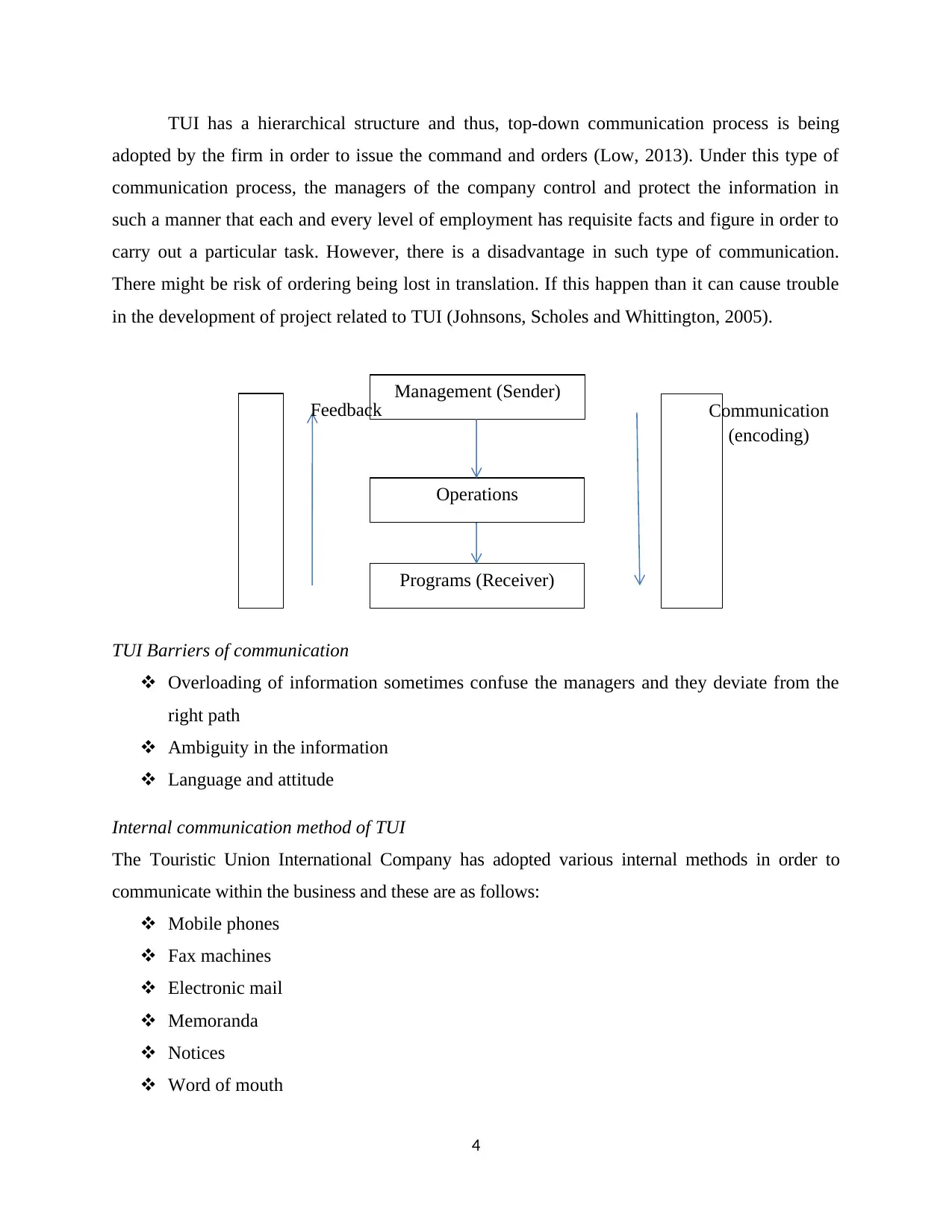
TUI has a hierarchical structure and thus, top-down communication process is being
adopted by the firm in order to issue the command and orders (Low, 2013). Under this type of
communication process, the managers of the company control and protect the information in
such a manner that each and every level of employment has requisite facts and figure in order to
carry out a particular task. However, there is a disadvantage in such type of communication.
There might be risk of ordering being lost in translation. If this happen than it can cause trouble
in the development of project related to TUI (Johnsons, Scholes and Whittington, 2005).
TUI Barriers of communication
Overloading of information sometimes confuse the managers and they deviate from the
right path
Ambiguity in the information
Language and attitude
Internal communication method of TUI
The Touristic Union International Company has adopted various internal methods in order to
communicate within the business and these are as follows:
Mobile phones
Fax machines
Electronic mail
Memoranda
Notices
Word of mouth
4
Management (Sender)
Operations
Communication
(encoding)
Programs (Receiver)
Feedback
adopted by the firm in order to issue the command and orders (Low, 2013). Under this type of
communication process, the managers of the company control and protect the information in
such a manner that each and every level of employment has requisite facts and figure in order to
carry out a particular task. However, there is a disadvantage in such type of communication.
There might be risk of ordering being lost in translation. If this happen than it can cause trouble
in the development of project related to TUI (Johnsons, Scholes and Whittington, 2005).
TUI Barriers of communication
Overloading of information sometimes confuse the managers and they deviate from the
right path
Ambiguity in the information
Language and attitude
Internal communication method of TUI
The Touristic Union International Company has adopted various internal methods in order to
communicate within the business and these are as follows:
Mobile phones
Fax machines
Electronic mail
Memoranda
Notices
Word of mouth
4
Management (Sender)
Operations
Communication
(encoding)
Programs (Receiver)
Feedback
⊘ This is a preview!⊘
Do you want full access?
Subscribe today to unlock all pages.
Trusted by 1+ million students worldwide
Letters
Reports
Meetings
Computers
External communication method of TUI
Other than internal methods, they have adopted various external communication methods such as
Billboards
Websites
Television and advertisements
Internet
Club-cards
Video conferencing
Forms
1.4 Analyze the organizational culture and change in TUI
The culture within the organization reflects the personality of the firm. It is nothing but
the fundamental belief, values and code of practice that builds up any business. Furthermore, the
culture of the company plays an important role. It helps increasing the level of profits, revenue
and value of the shareholders (Keyton, 2011). There are four major culture i.e. role, power,
person and task culture. Talking in relation with the culture of TUI, they mainly have task
oriented organizational culture. The main focus is on the completion of a particular task since it
is a service based industry and customers are of prime importance. In addition, the managers
with this culture develop a structured workplace where the workers have clear task and
assignments (Alvesson, 2012).
Articulating in relation with the change, it is considered as an inevitable and constant part
of any company. In order to run any business, it is important to interact with its external
environment and this in turn brings many changes that a firm needs to cope up. There are many
factors that influence change with in TUI such as:
Development in the technology (Schein, 2010)
Demand for the high quality products and services
Various economic factors and conditions
Due to global forces
5
Reports
Meetings
Computers
External communication method of TUI
Other than internal methods, they have adopted various external communication methods such as
Billboards
Websites
Television and advertisements
Internet
Club-cards
Video conferencing
Forms
1.4 Analyze the organizational culture and change in TUI
The culture within the organization reflects the personality of the firm. It is nothing but
the fundamental belief, values and code of practice that builds up any business. Furthermore, the
culture of the company plays an important role. It helps increasing the level of profits, revenue
and value of the shareholders (Keyton, 2011). There are four major culture i.e. role, power,
person and task culture. Talking in relation with the culture of TUI, they mainly have task
oriented organizational culture. The main focus is on the completion of a particular task since it
is a service based industry and customers are of prime importance. In addition, the managers
with this culture develop a structured workplace where the workers have clear task and
assignments (Alvesson, 2012).
Articulating in relation with the change, it is considered as an inevitable and constant part
of any company. In order to run any business, it is important to interact with its external
environment and this in turn brings many changes that a firm needs to cope up. There are many
factors that influence change with in TUI such as:
Development in the technology (Schein, 2010)
Demand for the high quality products and services
Various economic factors and conditions
Due to global forces
5
Paraphrase This Document
Need a fresh take? Get an instant paraphrase of this document with our AI Paraphraser
Changing nature of the workers in the company
Intervention of the government (Zarkos, Morgan and Kouropalatis, 2007)
TASK – 2
2.1 Assessing own management skills performance
According to Katz, in order to become an effective manager it is very important to have
managerial and technical skills. Without these skills no manager can perform better and
influence the behavior of other employees towards achievement of common goals (Dedina,
2013). In addition to this, the management skills also make sure that he or she can delegate the
responsibilities and can effectively direct and guide. Some of the important skills being
possessed by me as a manager of TUI are as follows:
Time-management skill – With this skill, manager can be able to control most of the
valuable resources of the firm. In addition to this, task can be delegated to others with
minimal time. A manager is required to create a schedule of day, month and week and
must allocate the resources and tasks as per the pre-determined schedule (O’Neil and
Drillings, 2012).
Project management skill – It encompasses abilities of a manager to plan, organize,
setting the budget and managing the resources at the workplace.
Stress management skill – Being a manager it is vital to monitor the performance and
evaluate it so that necessary stress can be prevented (Saac, Zerbe and Pitt, 2001).
People management skill – This is the most crucial skill of a manager. He should be able
to motivate people to work effectively and must handle the conflicts appropriately.
Change management – Due to global forces, business situations, culture and operations
tends to change. Thus, it becomes necessary on the part of managers to show passion
towards the change process and must motivate people to stay calm. Further, managers
should monitor and do critical thinking in the change management process.
2.2 SWOT analysis
It is important to carry out SWOT analysis so as to understand the weak points that needs to be
overcome as a manager of TUI.
Good communication skills
Creative and can impress clients with
6
Intervention of the government (Zarkos, Morgan and Kouropalatis, 2007)
TASK – 2
2.1 Assessing own management skills performance
According to Katz, in order to become an effective manager it is very important to have
managerial and technical skills. Without these skills no manager can perform better and
influence the behavior of other employees towards achievement of common goals (Dedina,
2013). In addition to this, the management skills also make sure that he or she can delegate the
responsibilities and can effectively direct and guide. Some of the important skills being
possessed by me as a manager of TUI are as follows:
Time-management skill – With this skill, manager can be able to control most of the
valuable resources of the firm. In addition to this, task can be delegated to others with
minimal time. A manager is required to create a schedule of day, month and week and
must allocate the resources and tasks as per the pre-determined schedule (O’Neil and
Drillings, 2012).
Project management skill – It encompasses abilities of a manager to plan, organize,
setting the budget and managing the resources at the workplace.
Stress management skill – Being a manager it is vital to monitor the performance and
evaluate it so that necessary stress can be prevented (Saac, Zerbe and Pitt, 2001).
People management skill – This is the most crucial skill of a manager. He should be able
to motivate people to work effectively and must handle the conflicts appropriately.
Change management – Due to global forces, business situations, culture and operations
tends to change. Thus, it becomes necessary on the part of managers to show passion
towards the change process and must motivate people to stay calm. Further, managers
should monitor and do critical thinking in the change management process.
2.2 SWOT analysis
It is important to carry out SWOT analysis so as to understand the weak points that needs to be
overcome as a manager of TUI.
Good communication skills
Creative and can impress clients with
6
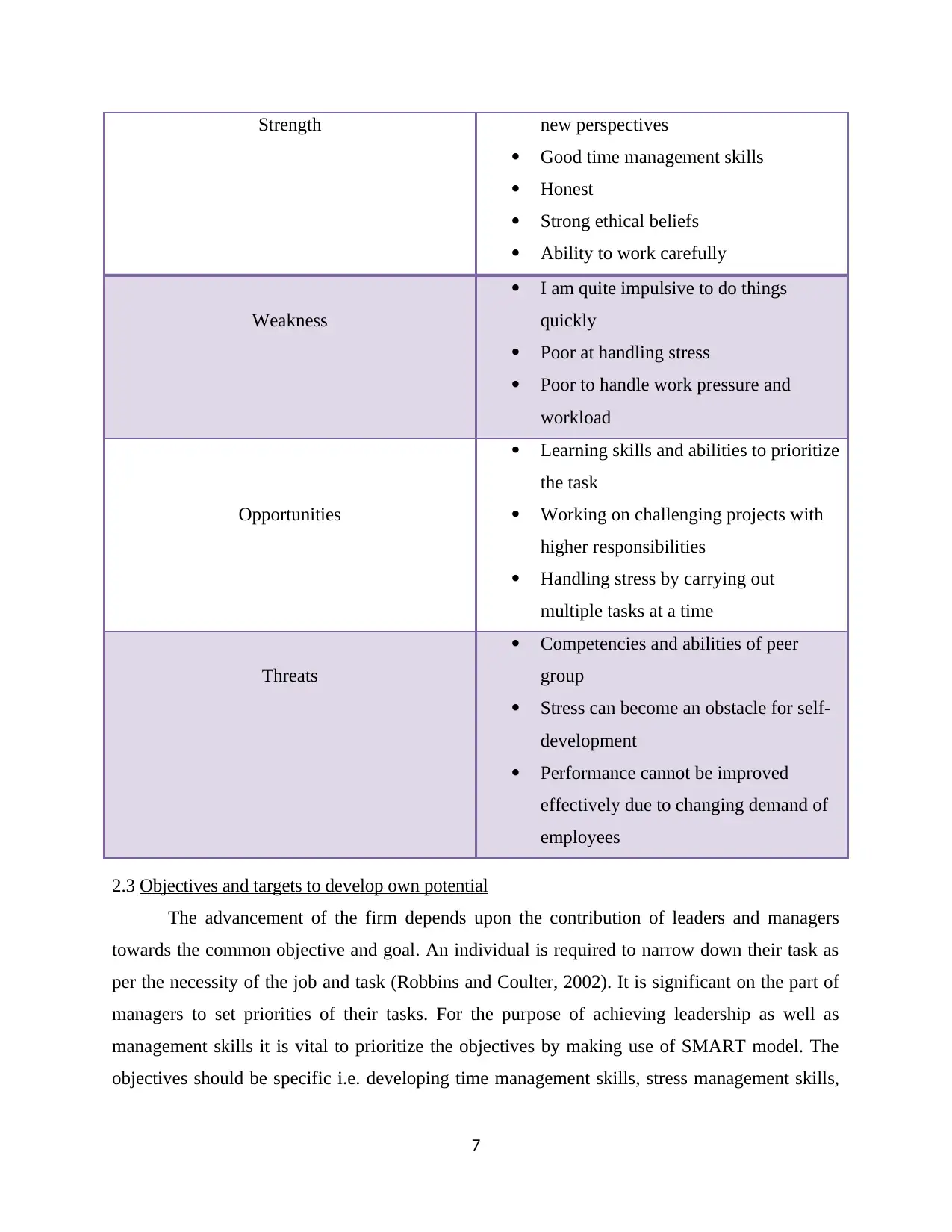
Strength new perspectives
Good time management skills
Honest
Strong ethical beliefs
Ability to work carefully
Weakness
I am quite impulsive to do things
quickly
Poor at handling stress
Poor to handle work pressure and
workload
Opportunities
Learning skills and abilities to prioritize
the task
Working on challenging projects with
higher responsibilities
Handling stress by carrying out
multiple tasks at a time
Threats
Competencies and abilities of peer
group
Stress can become an obstacle for self-
development
Performance cannot be improved
effectively due to changing demand of
employees
2.3 Objectives and targets to develop own potential
The advancement of the firm depends upon the contribution of leaders and managers
towards the common objective and goal. An individual is required to narrow down their task as
per the necessity of the job and task (Robbins and Coulter, 2002). It is significant on the part of
managers to set priorities of their tasks. For the purpose of achieving leadership as well as
management skills it is vital to prioritize the objectives by making use of SMART model. The
objectives should be specific i.e. developing time management skills, stress management skills,
7
Good time management skills
Honest
Strong ethical beliefs
Ability to work carefully
Weakness
I am quite impulsive to do things
quickly
Poor at handling stress
Poor to handle work pressure and
workload
Opportunities
Learning skills and abilities to prioritize
the task
Working on challenging projects with
higher responsibilities
Handling stress by carrying out
multiple tasks at a time
Threats
Competencies and abilities of peer
group
Stress can become an obstacle for self-
development
Performance cannot be improved
effectively due to changing demand of
employees
2.3 Objectives and targets to develop own potential
The advancement of the firm depends upon the contribution of leaders and managers
towards the common objective and goal. An individual is required to narrow down their task as
per the necessity of the job and task (Robbins and Coulter, 2002). It is significant on the part of
managers to set priorities of their tasks. For the purpose of achieving leadership as well as
management skills it is vital to prioritize the objectives by making use of SMART model. The
objectives should be specific i.e. developing time management skills, stress management skills,
7
⊘ This is a preview!⊘
Do you want full access?
Subscribe today to unlock all pages.
Trusted by 1+ million students worldwide
leadership and management skills. Next, the objectives being defined should be measurable in
numerical terms i.e. through time management skills, tasks can be completed on time and other
important task can be performed at that time. This will improve the performance of firm. Further,
the objectives should be achievable and must not be vague. They should be realistic that is the
results of the performance should be visible and finally, they should be achieved in a specified
time period. Urgent task should be the first priorities and so on.
Key functions as a training manager
Evaluating the requirements of the training in each department of the company
Developing training program for the professionals
Providing assistance to the HR department in order to design the performance appraisal
program (Binder, 2016)
Managing the cost of training as per the budget
Identifying the potential of training in relation with the future needs of the firm
To perform these tasks effectively, it is important to make sure that how much time will
be required to complete the task. The manager is also required to maintain a date of diary so as to
focus more. In addition to this, a complete of record of every task being completed should be
there so as to motivate the employees (Sangster, 2017). And finally, checking regularly that tasks
are performed as per the stipulated time frame or not.
TASK – 3
3.1 Leading and motivating a team to achieve an agreed goal or objective
In order to excel in the workplace, employees need some goals. However, there are some
members at the workplace who needs assistance or support in order to accomplish those goals.
The path of success initiates with the writing of the objectives. It is regarded as a challenging
task unless and until it is not achieved (Okpata, 2004). The objective which are non-specific,
irrelevant and out of reach creates a sense of de-motivation among the employees and they start
losing interest towards those targets. On the other hand, if effective goals are being placed,
workers are self-motivated and perform the task effectively. Through this it can be said that
leading and motivating team is essential to reach out toward the final goals (Urichuck, B. and
Urichuck, 2014). This is the major and crucial responsibility of a manager or leader.
8
numerical terms i.e. through time management skills, tasks can be completed on time and other
important task can be performed at that time. This will improve the performance of firm. Further,
the objectives should be achievable and must not be vague. They should be realistic that is the
results of the performance should be visible and finally, they should be achieved in a specified
time period. Urgent task should be the first priorities and so on.
Key functions as a training manager
Evaluating the requirements of the training in each department of the company
Developing training program for the professionals
Providing assistance to the HR department in order to design the performance appraisal
program (Binder, 2016)
Managing the cost of training as per the budget
Identifying the potential of training in relation with the future needs of the firm
To perform these tasks effectively, it is important to make sure that how much time will
be required to complete the task. The manager is also required to maintain a date of diary so as to
focus more. In addition to this, a complete of record of every task being completed should be
there so as to motivate the employees (Sangster, 2017). And finally, checking regularly that tasks
are performed as per the stipulated time frame or not.
TASK – 3
3.1 Leading and motivating a team to achieve an agreed goal or objective
In order to excel in the workplace, employees need some goals. However, there are some
members at the workplace who needs assistance or support in order to accomplish those goals.
The path of success initiates with the writing of the objectives. It is regarded as a challenging
task unless and until it is not achieved (Okpata, 2004). The objective which are non-specific,
irrelevant and out of reach creates a sense of de-motivation among the employees and they start
losing interest towards those targets. On the other hand, if effective goals are being placed,
workers are self-motivated and perform the task effectively. Through this it can be said that
leading and motivating team is essential to reach out toward the final goals (Urichuck, B. and
Urichuck, 2014). This is the major and crucial responsibility of a manager or leader.
8
Paraphrase This Document
Need a fresh take? Get an instant paraphrase of this document with our AI Paraphraser
Recognizing the positive results – Recognizing the positive results is the key to success.
When any member of the team performs well and achieves the positive result, the
manager needs to recognize his efforts promptly. This will motivate him and will work
even better to achieve more targets.
Respecting the team members – It is the duty of the managers to support their team
members as it is regarded as a positive activity. Supporting is not just sorting out their
problems, however it means allowing them to do task by their own (Yukl, 2010).
Understanding the requirements – The approach of the managers should be people
oriented i.e. they should be able to recognize the needs and wants of the employees so as
to make them satisfy.
Nurturing the potential – It is also quite vital to determine the abilities of the team
members and further, nurturing those skills and abilities to make them more productive
(Innovative E-business models in the travel industry, 2007).
3.2 Justifying managerial decisions to support achievement of goals
Constant planning and development is needed in order to manage the people effectively
in extension programs. In such type of programs managers have the formal authority over a firm.
In each and every organization, managers face the challenges in relation with managing the
objective, time as well as resources to achieve the task (Zarkos, Morgan and Kouropalatis, 2007).
The management of the organization has to perform various functions such as planning,
organizing, directing, controlling, coordinating, budgeting and reporting. These functions of the
management are based upon creation philosophies and approach:
Establishing and expounding the objective and policies
Developing the formal and in-formal structure of the organization
Setting the priorities and then reviewing the policies and objectives
Proper communication within the group or team
Training and motivating the staff members (Pathack, 2005)
Evaluating the cost and managing the budget
Furthermore, to carry out these responsibilities they need relevant information through books,
journals and people head’s being scattered within or outside the associations.
9
When any member of the team performs well and achieves the positive result, the
manager needs to recognize his efforts promptly. This will motivate him and will work
even better to achieve more targets.
Respecting the team members – It is the duty of the managers to support their team
members as it is regarded as a positive activity. Supporting is not just sorting out their
problems, however it means allowing them to do task by their own (Yukl, 2010).
Understanding the requirements – The approach of the managers should be people
oriented i.e. they should be able to recognize the needs and wants of the employees so as
to make them satisfy.
Nurturing the potential – It is also quite vital to determine the abilities of the team
members and further, nurturing those skills and abilities to make them more productive
(Innovative E-business models in the travel industry, 2007).
3.2 Justifying managerial decisions to support achievement of goals
Constant planning and development is needed in order to manage the people effectively
in extension programs. In such type of programs managers have the formal authority over a firm.
In each and every organization, managers face the challenges in relation with managing the
objective, time as well as resources to achieve the task (Zarkos, Morgan and Kouropalatis, 2007).
The management of the organization has to perform various functions such as planning,
organizing, directing, controlling, coordinating, budgeting and reporting. These functions of the
management are based upon creation philosophies and approach:
Establishing and expounding the objective and policies
Developing the formal and in-formal structure of the organization
Setting the priorities and then reviewing the policies and objectives
Proper communication within the group or team
Training and motivating the staff members (Pathack, 2005)
Evaluating the cost and managing the budget
Furthermore, to carry out these responsibilities they need relevant information through books,
journals and people head’s being scattered within or outside the associations.
9

TASK – 4
4.1 Explaining the own managerial and personal skills to support career development
In order to achieve success and growth in this competitive working environment,
management of the personal skill is very significant. This will help them to achieve success in
their career as well as in their personal lives (Schreiner, 2018). Managing the skills is nothing but
an ability to control the attitude, emotions, behavior and motivation. Some more insights on
personal and managerial skills are defined below:
Communication skills – This skill is in the top in the list of management skills.
Communication is needed in any woks of life, be it a personal or professional. Effective
communication is the key to success. The way we communicate with our fellows decides
and determines the quality of life.
Time management skills – This is also quite significant in both ways i.e. personal or
professional. It is important to set priorities of tasks. Through this tasks are better
accomplished and in an organized manner.
Organizing skills – In order to successful and efficient, each and every human has to be
organized. In everyone’s life be it a sportsman, actor, businessman or any other person,
staying organized is considered as a vital factor to achieve immense success.
Self-development skills – If the individual is not ready to accept the change and is not
self-motivated to achieve the path of growth, no one other individual can boost him up.
Personal management is regarded as incomplete without having self-development skills.
Thus, it becomes important on the part of individual to have the spirit and must be ready
to adapt as per the demand of the situation.
4.2 Reviewing personal and career developments needs
Articulating in regards with the development, it is generally a process to expand and
shape the knowledge. It also helps in improving the skills, knowledge and interests so as to
cultivate the abilities as well as effectiveness. Furthermore, the process encompasses developing
the skills and knowledge in such a manner so that an individual can move ahead to the next level
in career. Other than this, it is also necessary that a person also expands its breadth of skills as
well as competencies. With this an individual will be able to gain expertise in the current post
10
4.1 Explaining the own managerial and personal skills to support career development
In order to achieve success and growth in this competitive working environment,
management of the personal skill is very significant. This will help them to achieve success in
their career as well as in their personal lives (Schreiner, 2018). Managing the skills is nothing but
an ability to control the attitude, emotions, behavior and motivation. Some more insights on
personal and managerial skills are defined below:
Communication skills – This skill is in the top in the list of management skills.
Communication is needed in any woks of life, be it a personal or professional. Effective
communication is the key to success. The way we communicate with our fellows decides
and determines the quality of life.
Time management skills – This is also quite significant in both ways i.e. personal or
professional. It is important to set priorities of tasks. Through this tasks are better
accomplished and in an organized manner.
Organizing skills – In order to successful and efficient, each and every human has to be
organized. In everyone’s life be it a sportsman, actor, businessman or any other person,
staying organized is considered as a vital factor to achieve immense success.
Self-development skills – If the individual is not ready to accept the change and is not
self-motivated to achieve the path of growth, no one other individual can boost him up.
Personal management is regarded as incomplete without having self-development skills.
Thus, it becomes important on the part of individual to have the spirit and must be ready
to adapt as per the demand of the situation.
4.2 Reviewing personal and career developments needs
Articulating in regards with the development, it is generally a process to expand and
shape the knowledge. It also helps in improving the skills, knowledge and interests so as to
cultivate the abilities as well as effectiveness. Furthermore, the process encompasses developing
the skills and knowledge in such a manner so that an individual can move ahead to the next level
in career. Other than this, it is also necessary that a person also expands its breadth of skills as
well as competencies. With this an individual will be able to gain expertise in the current post
10
⊘ This is a preview!⊘
Do you want full access?
Subscribe today to unlock all pages.
Trusted by 1+ million students worldwide

1 out of 15


Related Documents


Your All-in-One AI-Powered Toolkit for Academic Success.
+13062052269
info@desklib.com
Available 24*7 on WhatsApp / Email
![[object Object]](/_next/static/media/star-bottom.7253800d.svg)
Unlock your academic potential
Copyright © 2020–2026 A2Z Services. All Rights Reserved. Developed and managed by ZUCOL.