HI6008 Report: Examining Female Employment, Fertility, and Growth
VerifiedAdded on 2024/07/29
|13
|3153
|66
Report
AI Summary
This report examines the relationship between female employment participation, fertility rates, and economic growth in Australia. It highlights the increasing female labor force participation and declining fertility rates in the Australian economy. The report explores the impact of female employment on fertility, gender participation in the economy, and overall economic development. It references various studies and reports, including those from the United Nations and OECD, to emphasize the potential positive impact of increased female participation on Australia's GDP. The report also discusses the importance of family planning, the use of contraceptives, and the potential benefits of reduced fertility rates, such as increased economic opportunities for women and better investment in children's education and nutrition. Ultimately, the report underscores the significance of addressing gender disparities and promoting female economic independence to foster sustainable economic growth in Australia.
HI6008: Assessment 1
Report into relationship between female employment participation and fertility
rates and economic growth.
1
Report into relationship between female employment participation and fertility
rates and economic growth.
1

Paraphrase This Document
Need a fresh take? Get an instant paraphrase of this document with our AI Paraphraser
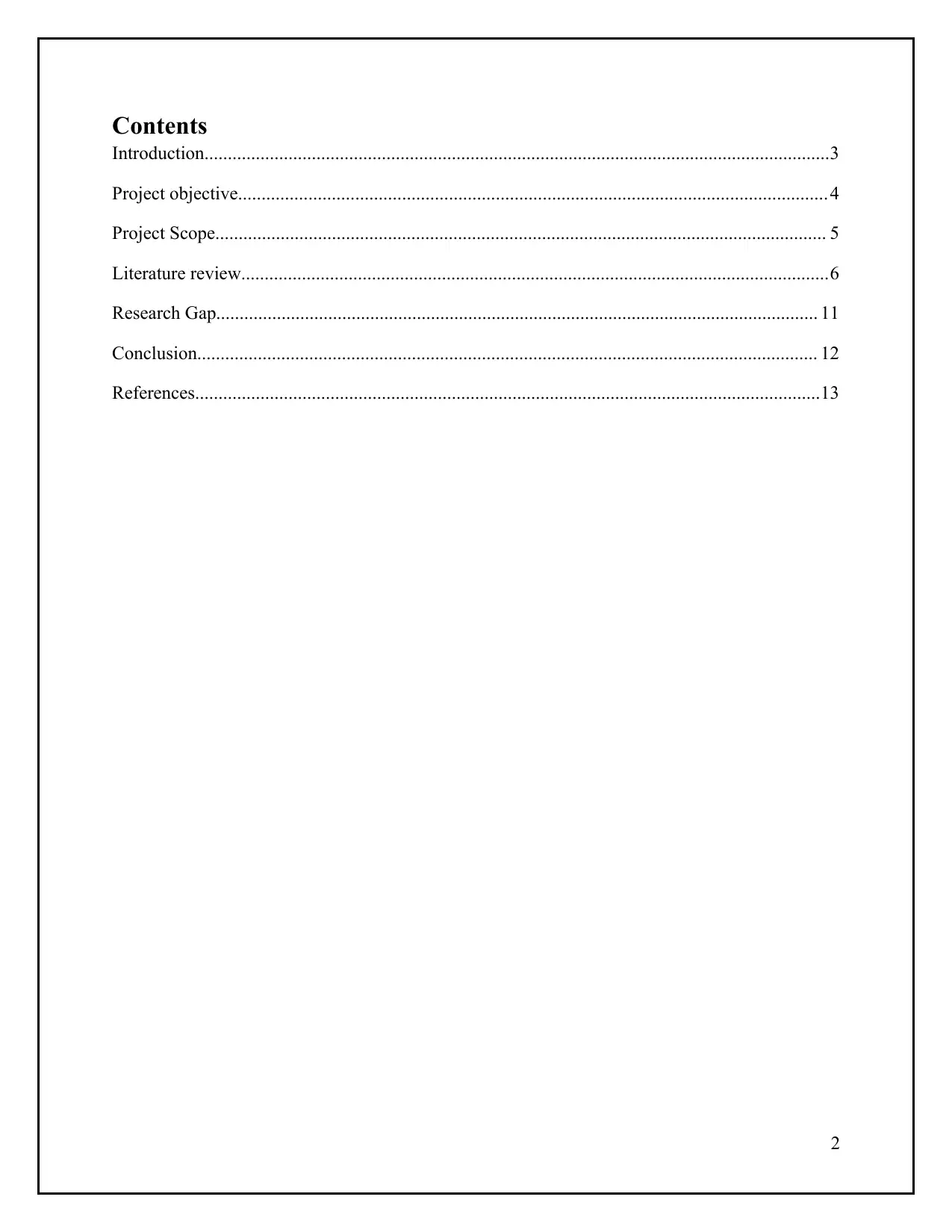
Contents
Introduction......................................................................................................................................3
Project objective..............................................................................................................................4
Project Scope................................................................................................................................... 5
Literature review..............................................................................................................................6
Research Gap................................................................................................................................. 11
Conclusion..................................................................................................................................... 12
References......................................................................................................................................13
2
Introduction......................................................................................................................................3
Project objective..............................................................................................................................4
Project Scope................................................................................................................................... 5
Literature review..............................................................................................................................6
Research Gap................................................................................................................................. 11
Conclusion..................................................................................................................................... 12
References......................................................................................................................................13
2
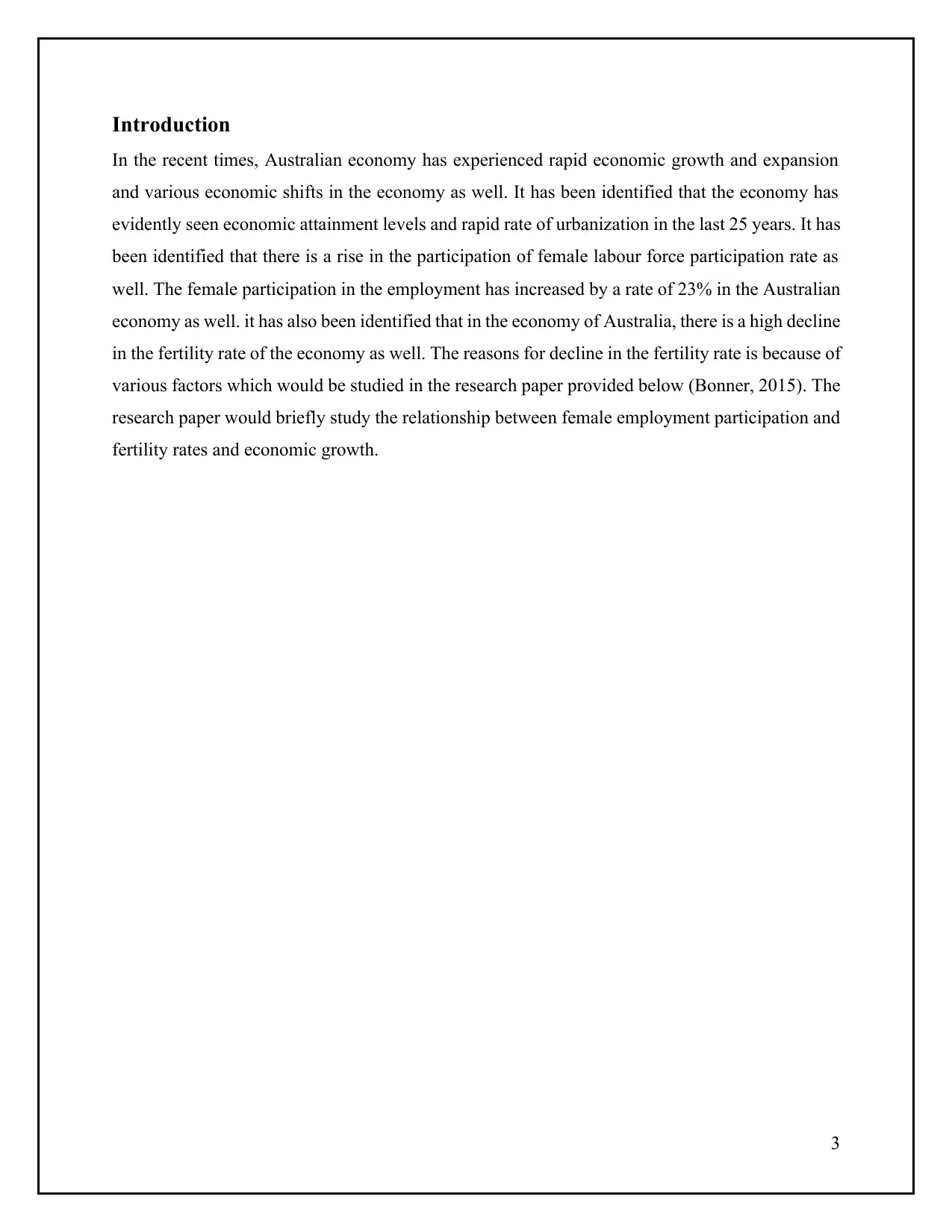
Introduction
In the recent times, Australian economy has experienced rapid economic growth and expansion
and various economic shifts in the economy as well. It has been identified that the economy has
evidently seen economic attainment levels and rapid rate of urbanization in the last 25 years. It has
been identified that there is a rise in the participation of female labour force participation rate as
well. The female participation in the employment has increased by a rate of 23% in the Australian
economy as well. it has also been identified that in the economy of Australia, there is a high decline
in the fertility rate of the economy as well. The reasons for decline in the fertility rate is because of
various factors which would be studied in the research paper provided below (Bonner, 2015). The
research paper would briefly study the relationship between female employment participation and
fertility rates and economic growth.
3
In the recent times, Australian economy has experienced rapid economic growth and expansion
and various economic shifts in the economy as well. It has been identified that the economy has
evidently seen economic attainment levels and rapid rate of urbanization in the last 25 years. It has
been identified that there is a rise in the participation of female labour force participation rate as
well. The female participation in the employment has increased by a rate of 23% in the Australian
economy as well. it has also been identified that in the economy of Australia, there is a high decline
in the fertility rate of the economy as well. The reasons for decline in the fertility rate is because of
various factors which would be studied in the research paper provided below (Bonner, 2015). The
research paper would briefly study the relationship between female employment participation and
fertility rates and economic growth.
3
⊘ This is a preview!⊘
Do you want full access?
Subscribe today to unlock all pages.

Trusted by 1+ million students worldwide
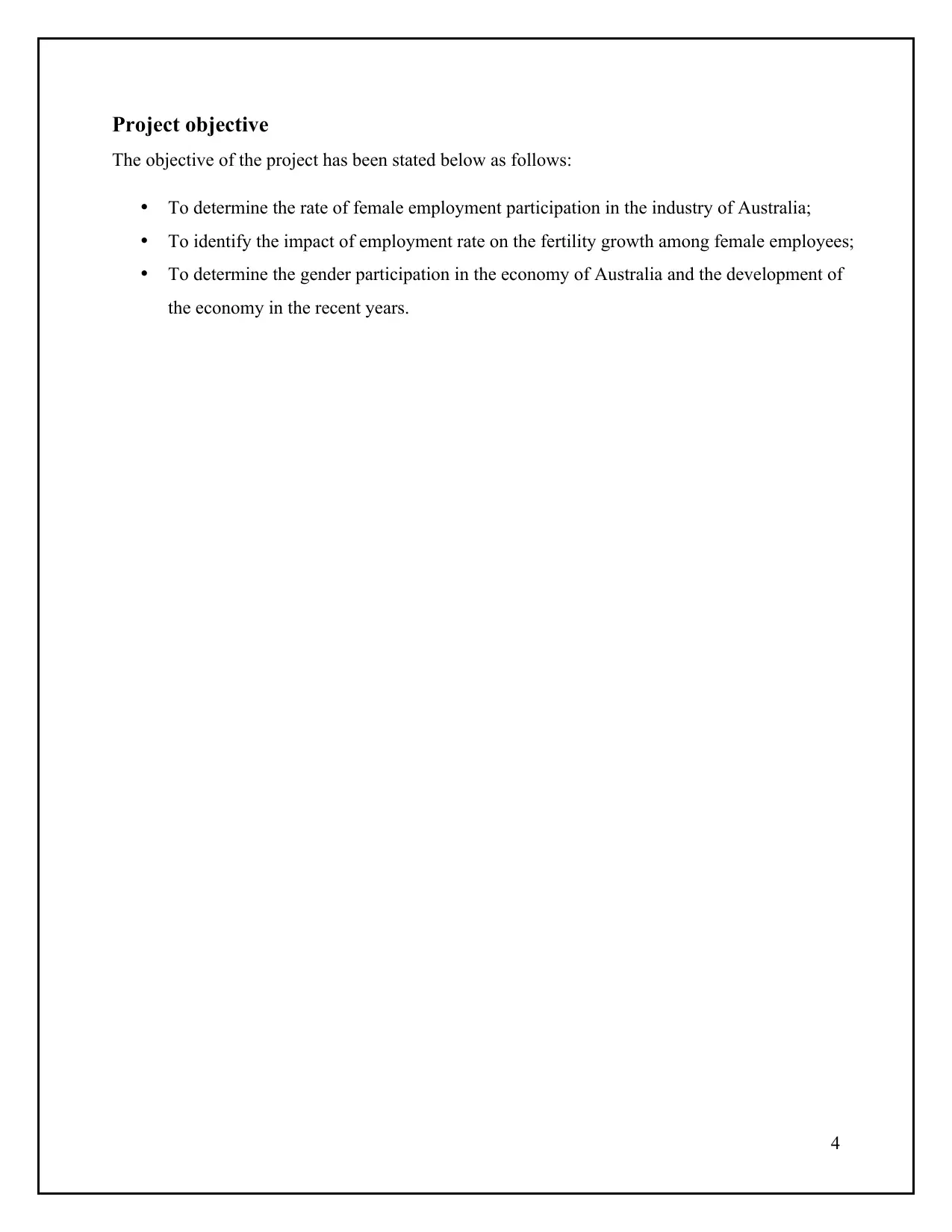
Project objective
The objective of the project has been stated below as follows:
To determine the rate of female employment participation in the industry of Australia;
To identify the impact of employment rate on the fertility growth among female employees;
To determine the gender participation in the economy of Australia and the development of
the economy in the recent years.
4
The objective of the project has been stated below as follows:
To determine the rate of female employment participation in the industry of Australia;
To identify the impact of employment rate on the fertility growth among female employees;
To determine the gender participation in the economy of Australia and the development of
the economy in the recent years.
4
Paraphrase This Document
Need a fresh take? Get an instant paraphrase of this document with our AI Paraphraser
Project Scope
It has been identified that the persistent decline in the rate of female employment is leading to
various issues in the economy which is also related to the decrease in the rate of development of the
country. This makes it important for the economy of the country to effectively and efficiently
consider the rate of female participation and the fertility rate in the country has declined in a
significant manner which makes it important for the economy of the country to effectively and
efficiently take determine this issues behind the same. Thus the report is focused on identifying the
issues and factors which are leading to the issue in the economy. It is also required here to take into
consideration the issues that are being faced by women in the industry which are leading to decline
in their fertility rate.
5
It has been identified that the persistent decline in the rate of female employment is leading to
various issues in the economy which is also related to the decrease in the rate of development of the
country. This makes it important for the economy of the country to effectively and efficiently
consider the rate of female participation and the fertility rate in the country has declined in a
significant manner which makes it important for the economy of the country to effectively and
efficiently take determine this issues behind the same. Thus the report is focused on identifying the
issues and factors which are leading to the issue in the economy. It is also required here to take into
consideration the issues that are being faced by women in the industry which are leading to decline
in their fertility rate.
5
Literature review
In this segment of the report, there is a brief description provided on the main topic of the report i.e.
to effectively determine the relationship between female employment participation and fertility
rates and economic growth. In order to conduct this literature review, the author has effectively
taken into consideration various sources such as journals, articles, books etc.
Relationship between female employment participation and fertility rates and economic
growth
The decline in the economic activity of women is a cause of concern especially for the people that
are interested in the wellbeing of women. It should be noted that the women are a valuable resource
for any country to consider irrespective of the rate of economic growth of the country. It is
important to realise that the female workforce can have a major contribution in the GDP of the
country as well which has the potential of fostering the economy towards rapid pace of
development. As per Dorn & Hanson (2015), the employment of women is also considered as an
indicator of the overall status of the society which makes it furthermore essential for the economy
of the country to effectively consider the development of women. It has been identified in the case
of Australia that there is presence of a gender gap in the society due to which the society is facing
various problems and issues regarding its social and economic development. The gender gap which
is being faced by the society of the country has various macroeconomic implications as well which
might imply a negative impact on the society. According to the report provided by the United
Nations it has been found that if the female force of Australia would engage actively in the
activities of employment and earnings, the GDP of the country will effectively increase at the rate
of 4.2 % which will lead the economy to enjoy an annual gain of around $ 20 billion (Dorn &
Hanson, 2015). With the increment in 10% of the female participation in the industry, it has been
found that it will lead to an increment in growth by the rate of around 0.3% per annum.
The paper is interested in examining the impact of participation of the female force in the growth
and development of the economy of the country. It has been identified that the economic
development and the economic activities undertaken by the women have shown a U-shaped
relationship in various studies. The participation of the female force has evidently declined with the
economic development in the initial phase and then the graph plateaus before rising again to give
graph a U shape. This is reflective of the structural shifts that have been witnessed by the economy
6
In this segment of the report, there is a brief description provided on the main topic of the report i.e.
to effectively determine the relationship between female employment participation and fertility
rates and economic growth. In order to conduct this literature review, the author has effectively
taken into consideration various sources such as journals, articles, books etc.
Relationship between female employment participation and fertility rates and economic
growth
The decline in the economic activity of women is a cause of concern especially for the people that
are interested in the wellbeing of women. It should be noted that the women are a valuable resource
for any country to consider irrespective of the rate of economic growth of the country. It is
important to realise that the female workforce can have a major contribution in the GDP of the
country as well which has the potential of fostering the economy towards rapid pace of
development. As per Dorn & Hanson (2015), the employment of women is also considered as an
indicator of the overall status of the society which makes it furthermore essential for the economy
of the country to effectively consider the development of women. It has been identified in the case
of Australia that there is presence of a gender gap in the society due to which the society is facing
various problems and issues regarding its social and economic development. The gender gap which
is being faced by the society of the country has various macroeconomic implications as well which
might imply a negative impact on the society. According to the report provided by the United
Nations it has been found that if the female force of Australia would engage actively in the
activities of employment and earnings, the GDP of the country will effectively increase at the rate
of 4.2 % which will lead the economy to enjoy an annual gain of around $ 20 billion (Dorn &
Hanson, 2015). With the increment in 10% of the female participation in the industry, it has been
found that it will lead to an increment in growth by the rate of around 0.3% per annum.
The paper is interested in examining the impact of participation of the female force in the growth
and development of the economy of the country. It has been identified that the economic
development and the economic activities undertaken by the women have shown a U-shaped
relationship in various studies. The participation of the female force has evidently declined with the
economic development in the initial phase and then the graph plateaus before rising again to give
graph a U shape. This is reflective of the structural shifts that have been witnessed by the economy
6
⊘ This is a preview!⊘
Do you want full access?
Subscribe today to unlock all pages.
Trusted by 1+ million students worldwide
of the country. There are various changes which have been seen in the industry of Australia which
impacts the women participation in the economic activities. There are majorly linked with the
changes in the influence of income and substitution effects and also the increment in the education
levels of women. It should be noted that the economic growth of Australia is generally
accompanied by the changes in the sector composition of the economy. The Australian economy is
constantly shifting its focus from manufacturing industries to service industry which is one of the
major factors that is promoting the female participation in the economic activities.it has been found
that the stages of industrialisation are not attractive to women which is major because of social
norms against their participation in the blue-collar activities (Vidal et. al., 2017). The prevalence of
this kind of culture in the society stands as the major factor towards the shift in preference of
women to the service industry.
According to Hakim (2016), the recent surveys and reports have reflected that the participation rate
of female workforce in the industry has raised effectively by 1.3% points to a record of total 60.6%.
In the year 2017, the economy of Australia has effectively and efficiently created around 400,000
jobs in the previous year. It should be noted that the economy of Australia is fairing in an effective
manner when it comes to the terms of increasing the workforce participation of the women. The
percentage of females that are now indulged in the employment and production related activities
are at a figure of 72%which implies that the women aged between the age group of 15-64 years are
a major part of the female workforce (Hakim, 2016).
In the G20 meeting of labour and Employment Ministers of the country, the main topic of
discussion was to decrease he gender discrimination and disparity in the context of Australia such
that economic development in the industry can be boosted in an effective and efficient manner.
Since the meeting, strong efforts are being made in order to achieve the Brisbane goals and to
address other issues which are contemplated from gender gaps which are also inclusive of the gaps
related to pay and career as well. The data that has been collected further states that it is important
for the Australian economy to progress towards the goal of female participation in the activities
related to economic growth and development. This can help in reduction of the gender participation
gap by around 10.4 points.
It should be noted that the economic independence is an enabler which goes in the case of both man
and women. According to Siah & Lee (2015), this helps them to exercise effective control over
7
impacts the women participation in the economic activities. There are majorly linked with the
changes in the influence of income and substitution effects and also the increment in the education
levels of women. It should be noted that the economic growth of Australia is generally
accompanied by the changes in the sector composition of the economy. The Australian economy is
constantly shifting its focus from manufacturing industries to service industry which is one of the
major factors that is promoting the female participation in the economic activities.it has been found
that the stages of industrialisation are not attractive to women which is major because of social
norms against their participation in the blue-collar activities (Vidal et. al., 2017). The prevalence of
this kind of culture in the society stands as the major factor towards the shift in preference of
women to the service industry.
According to Hakim (2016), the recent surveys and reports have reflected that the participation rate
of female workforce in the industry has raised effectively by 1.3% points to a record of total 60.6%.
In the year 2017, the economy of Australia has effectively and efficiently created around 400,000
jobs in the previous year. It should be noted that the economy of Australia is fairing in an effective
manner when it comes to the terms of increasing the workforce participation of the women. The
percentage of females that are now indulged in the employment and production related activities
are at a figure of 72%which implies that the women aged between the age group of 15-64 years are
a major part of the female workforce (Hakim, 2016).
In the G20 meeting of labour and Employment Ministers of the country, the main topic of
discussion was to decrease he gender discrimination and disparity in the context of Australia such
that economic development in the industry can be boosted in an effective and efficient manner.
Since the meeting, strong efforts are being made in order to achieve the Brisbane goals and to
address other issues which are contemplated from gender gaps which are also inclusive of the gaps
related to pay and career as well. The data that has been collected further states that it is important
for the Australian economy to progress towards the goal of female participation in the activities
related to economic growth and development. This can help in reduction of the gender participation
gap by around 10.4 points.
It should be noted that the economic independence is an enabler which goes in the case of both man
and women. According to Siah & Lee (2015), this helps them to exercise effective control over
7
Paraphrase This Document
Need a fresh take? Get an instant paraphrase of this document with our AI Paraphraser
their lives and also help them to make genuine choices as well. at the individual level, the benefits
that are enjoyed by the female workforce are linked with additional financial security, higher
lifetime earnings and increment in savings after the retirement purposes. These rewards end to
grow in the future as well as a job that is done today would mean that the opportunities and
potential would be enjoyed tomorrow. Apart from these, there are other benefits as well such as
health, social and wellbeing benefits for the family of the women. There are various researches that
also reflect that economic independence and employment opportunities also assist the decision
making of women and they might help them to leave violent relationships as well. It has been
identified that increase the participation of female workforce is one of the main priorities of
Australian economy. Successive Intergenerational reports have reflected the importance of high
female participation in the Australian industry which have led to an improvement in productivity
and prosperity of Australia (Siah & Lee, 2015). This has clearly helped the economy to reduce the
fiscal pressure and provide support for the welfare of ageing population of the country. In the year
2012, it was found by the Grattan Institute that the extra 6% of female workforce indulgence in
economic and production activities can help in adding around $25 billion to the GDP of the
country. It has also been recognised by OECD (Organisation for Economic Co-operation and
Development) that the decrement I the gender participation gap can help the Australian economy to
effectively and efficiently boost the growth of Australian GDP from 2% to annual 2.4%. this is one
of the main reason behind the focus of the government of the country to reduce the economic and
gender disparity.
Relationship between female participation and fertility rates
According to Rindfuss et. al., (2016), the relation between female participation in the economic
activities and fertility rate is one of the major factors that is required to be studied in order to
determine the state of female participation in the context of Australia. It should be noted that
various researches and data has shown that reducing the fertility rate is often proposed as an
effective strategy which might help in empowering the women and eradicating the poverty as well.
Family planning is one of the most important constraints that is required to be well considered by
both the mother and the father to ensure that the economic status of the household should be at
optimum levels (Rindfuss et. al., 2016). One of the major roles in determining the fertility rate of
the women is played by the usage of contraceptives which can effectively and efficiently help in
8
that are enjoyed by the female workforce are linked with additional financial security, higher
lifetime earnings and increment in savings after the retirement purposes. These rewards end to
grow in the future as well as a job that is done today would mean that the opportunities and
potential would be enjoyed tomorrow. Apart from these, there are other benefits as well such as
health, social and wellbeing benefits for the family of the women. There are various researches that
also reflect that economic independence and employment opportunities also assist the decision
making of women and they might help them to leave violent relationships as well. It has been
identified that increase the participation of female workforce is one of the main priorities of
Australian economy. Successive Intergenerational reports have reflected the importance of high
female participation in the Australian industry which have led to an improvement in productivity
and prosperity of Australia (Siah & Lee, 2015). This has clearly helped the economy to reduce the
fiscal pressure and provide support for the welfare of ageing population of the country. In the year
2012, it was found by the Grattan Institute that the extra 6% of female workforce indulgence in
economic and production activities can help in adding around $25 billion to the GDP of the
country. It has also been recognised by OECD (Organisation for Economic Co-operation and
Development) that the decrement I the gender participation gap can help the Australian economy to
effectively and efficiently boost the growth of Australian GDP from 2% to annual 2.4%. this is one
of the main reason behind the focus of the government of the country to reduce the economic and
gender disparity.
Relationship between female participation and fertility rates
According to Rindfuss et. al., (2016), the relation between female participation in the economic
activities and fertility rate is one of the major factors that is required to be studied in order to
determine the state of female participation in the context of Australia. It should be noted that
various researches and data has shown that reducing the fertility rate is often proposed as an
effective strategy which might help in empowering the women and eradicating the poverty as well.
Family planning is one of the most important constraints that is required to be well considered by
both the mother and the father to ensure that the economic status of the household should be at
optimum levels (Rindfuss et. al., 2016). One of the major roles in determining the fertility rate of
the women is played by the usage of contraceptives which can effectively and efficiently help in
8
reducing the high-risk pregnancies which can help in reducing the maternal and child’s mortality
rate in an effective and efficient manner (Hahn et. al, 2018).
As per Subramaniam et. al., (2015), high risks are associated with women in case they suffer from
young age pregnancy. Women with high parities and unwanted pregnancy might end up with
unsafe abortion which can lead to a decrease in the fertility rate as well. the usage of contraceptive
pills leads to space the births which can be beneficial for the health of both mothers as well as of the
children. Secondly, it has been identified that if the number of children reduces by a significant
amount, the women in the country will have extra time for other activities besides the reproductive
tasks such as contributing towards growth of the economy. This extra time and opportunity can
lead to the household and economic development as the females would be able to earn extra income
as well. third and the most important factor which can be enjoyed by the reduction in the fertility
rate would be the ability of parents to keep their focus and concentration on the single child. With
reduction in the number of stomachs to feed, the parents would be effectively able to spend more on
education and nutrition of a single child which would also imply less economic pressure and better
individual development (Subramaniam et. al., 2015). This can help in reflecting a good image of
the Australian society and it would also imply that the economy of the country will be able to show
good GDP figures. This will also mean that the individuals would be able to invest more in the
assets as well which might be helpful in increasing their lifestyle as well.
As per Gambro & Stewart (2014), it has been identified that despite the demonstrated benefits in
the reduction of fertility rates, the number of children per women in Australia is still high and
matches the figures of developing countries. The reason for a high number of children in context of
Australia is diverse which makes it important for the economy to effectively and efficiently take
into consideration various strategies such that the economy might be able to cope up with the issue.
In countries where there is a lack of public and private pension systems, parents require children as
helping hands such that they might be able to contribute in the economic activities in order to
improve the living standards of the family (Gambro & Stewart, 2014). In this case, one of the major
roles is played by the religion of the person as well as this might help in modern family planning
methods which might be helpful for the family in the long run. It has been identified that in the case
of Australia, only 45% of the fertile women are using a contraceptive. Various initiatives have been
taken by the government of the country to increase the prevalence of contraceptive and protection
9
rate in an effective and efficient manner (Hahn et. al, 2018).
As per Subramaniam et. al., (2015), high risks are associated with women in case they suffer from
young age pregnancy. Women with high parities and unwanted pregnancy might end up with
unsafe abortion which can lead to a decrease in the fertility rate as well. the usage of contraceptive
pills leads to space the births which can be beneficial for the health of both mothers as well as of the
children. Secondly, it has been identified that if the number of children reduces by a significant
amount, the women in the country will have extra time for other activities besides the reproductive
tasks such as contributing towards growth of the economy. This extra time and opportunity can
lead to the household and economic development as the females would be able to earn extra income
as well. third and the most important factor which can be enjoyed by the reduction in the fertility
rate would be the ability of parents to keep their focus and concentration on the single child. With
reduction in the number of stomachs to feed, the parents would be effectively able to spend more on
education and nutrition of a single child which would also imply less economic pressure and better
individual development (Subramaniam et. al., 2015). This can help in reflecting a good image of
the Australian society and it would also imply that the economy of the country will be able to show
good GDP figures. This will also mean that the individuals would be able to invest more in the
assets as well which might be helpful in increasing their lifestyle as well.
As per Gambro & Stewart (2014), it has been identified that despite the demonstrated benefits in
the reduction of fertility rates, the number of children per women in Australia is still high and
matches the figures of developing countries. The reason for a high number of children in context of
Australia is diverse which makes it important for the economy to effectively and efficiently take
into consideration various strategies such that the economy might be able to cope up with the issue.
In countries where there is a lack of public and private pension systems, parents require children as
helping hands such that they might be able to contribute in the economic activities in order to
improve the living standards of the family (Gambro & Stewart, 2014). In this case, one of the major
roles is played by the religion of the person as well as this might help in modern family planning
methods which might be helpful for the family in the long run. It has been identified that in the case
of Australia, only 45% of the fertile women are using a contraceptive. Various initiatives have been
taken by the government of the country to increase the prevalence of contraceptive and protection
9
⊘ This is a preview!⊘
Do you want full access?
Subscribe today to unlock all pages.
Trusted by 1+ million students worldwide

techniques to around 60% (Craig et. al., 2017). This will mean that the women would be more
indulged in the activities that are in relation with the economic prosperity and development of their
own household as well as of the economy as well.
10
indulged in the activities that are in relation with the economic prosperity and development of their
own household as well as of the economy as well.
10
Paraphrase This Document
Need a fresh take? Get an instant paraphrase of this document with our AI Paraphraser
Research Gap
It should be noted that in order to conduct the research the main reliance was paid on the secondary
sources of data collection. There are various gaps in the development of the research which might
have a negative impact on the outcome of the research as well. The main gap that has been
identified in the research is related with the lack of a primary source of data. the research is mainly
completed with the use of secondary data techniques which states that the research data is not
unique and is also present on the internet sources. Apart from this, another gap is that the research
data is not entirely in according to the research.
11
It should be noted that in order to conduct the research the main reliance was paid on the secondary
sources of data collection. There are various gaps in the development of the research which might
have a negative impact on the outcome of the research as well. The main gap that has been
identified in the research is related with the lack of a primary source of data. the research is mainly
completed with the use of secondary data techniques which states that the research data is not
unique and is also present on the internet sources. Apart from this, another gap is that the research
data is not entirely in according to the research.
11
Conclusion
Thus from the analysis of the literature presented above it can be concluded that it is important for
the economy of the country to reduce the gender disparity such that the economy might be
effectively and efficiently be able to foster individual and social development. In rode to do the
same, one of the most appropriate technique would be to empower the female in the society. One of
the major issues which are faced in the employment of women is the high fertility rate due to which
the women are unable to practice various employment activities which also impacts the economic
growth and development of the economy.
12
Thus from the analysis of the literature presented above it can be concluded that it is important for
the economy of the country to reduce the gender disparity such that the economy might be
effectively and efficiently be able to foster individual and social development. In rode to do the
same, one of the most appropriate technique would be to empower the female in the society. One of
the major issues which are faced in the employment of women is the high fertility rate due to which
the women are unable to practice various employment activities which also impacts the economic
growth and development of the economy.
12
⊘ This is a preview!⊘
Do you want full access?
Subscribe today to unlock all pages.
Trusted by 1+ million students worldwide

1 out of 13


Related Documents


Your All-in-One AI-Powered Toolkit for Academic Success.
+13062052269
info@desklib.com
Available 24*7 on WhatsApp / Email
![[object Object]](/_next/static/media/star-bottom.7253800d.svg)
Unlock your academic potential
Copyright © 2020–2026 A2Z Services. All Rights Reserved. Developed and managed by ZUCOL.