An Analysis of Traditional versus Activity Based Costing Methods
VerifiedAdded on 2021/04/21
|7
|1239
|82
Essay
AI Summary
This essay provides a comprehensive comparison of traditional and activity-based costing methods. It begins by introducing the context of cost allocation in manufacturing and service industries, emphasizing the need to distribute costs like raw materials, labor, and overhead to determine the overall cost of goods. The essay then delves into the specifics of both costing methods, highlighting the simplicity of traditional costing, which uses a single cost driver like direct labor hours or machine hours, and its limitations in modern manufacturing environments. The activity-based costing method is presented as a more accurate approach that divides the manufacturing process into stages, using multiple cost drivers linked to specific activities. The essay includes a detailed comparison table and a numerical example to illustrate the differences in cost allocation between the two methods, and concludes by emphasizing the value of activity-based costing for performance measurement and improved business decision-making. References from Cooper and Kaplan, Bromwich and Bhimani, and Hayden are provided.
1
Traditional versus Activity Based Costing
Paraphrase This Document
Need a fresh take? Get an instant paraphrase of this document with our AI Paraphraser

2
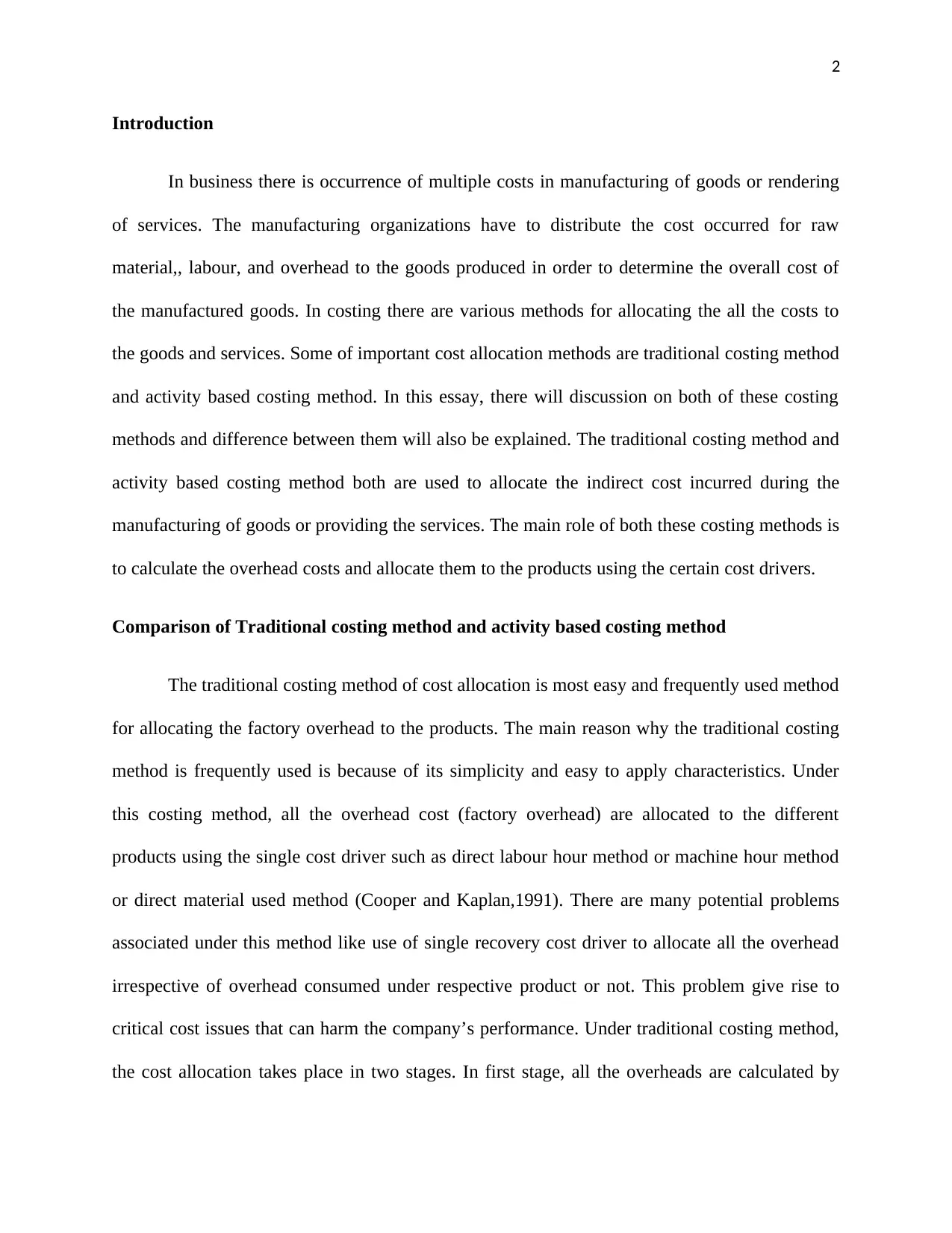
Introduction
In business there is occurrence of multiple costs in manufacturing of goods or rendering
of services. The manufacturing organizations have to distribute the cost occurred for raw
material,, labour, and overhead to the goods produced in order to determine the overall cost of
the manufactured goods. In costing there are various methods for allocating the all the costs to
the goods and services. Some of important cost allocation methods are traditional costing method
and activity based costing method. In this essay, there will discussion on both of these costing
methods and difference between them will also be explained. The traditional costing method and
activity based costing method both are used to allocate the indirect cost incurred during the
manufacturing of goods or providing the services. The main role of both these costing methods is
to calculate the overhead costs and allocate them to the products using the certain cost drivers.
Comparison of Traditional costing method and activity based costing method
The traditional costing method of cost allocation is most easy and frequently used method
for allocating the factory overhead to the products. The main reason why the traditional costing
method is frequently used is because of its simplicity and easy to apply characteristics. Under
this costing method, all the overhead cost (factory overhead) are allocated to the different
products using the single cost driver such as direct labour hour method or machine hour method
or direct material used method (Cooper and Kaplan,1991). There are many potential problems
associated under this method like use of single recovery cost driver to allocate all the overhead
irrespective of overhead consumed under respective product or not. This problem give rise to
critical cost issues that can harm the company’s performance. Under traditional costing method,
the cost allocation takes place in two stages. In first stage, all the overheads are calculated by
Introduction
In business there is occurrence of multiple costs in manufacturing of goods or rendering
of services. The manufacturing organizations have to distribute the cost occurred for raw
material,, labour, and overhead to the goods produced in order to determine the overall cost of
the manufactured goods. In costing there are various methods for allocating the all the costs to
the goods and services. Some of important cost allocation methods are traditional costing method
and activity based costing method. In this essay, there will discussion on both of these costing
methods and difference between them will also be explained. The traditional costing method and
activity based costing method both are used to allocate the indirect cost incurred during the
manufacturing of goods or providing the services. The main role of both these costing methods is
to calculate the overhead costs and allocate them to the products using the certain cost drivers.
Comparison of Traditional costing method and activity based costing method
The traditional costing method of cost allocation is most easy and frequently used method
for allocating the factory overhead to the products. The main reason why the traditional costing
method is frequently used is because of its simplicity and easy to apply characteristics. Under
this costing method, all the overhead cost (factory overhead) are allocated to the different
products using the single cost driver such as direct labour hour method or machine hour method
or direct material used method (Cooper and Kaplan,1991). There are many potential problems
associated under this method like use of single recovery cost driver to allocate all the overhead
irrespective of overhead consumed under respective product or not. This problem give rise to
critical cost issues that can harm the company’s performance. Under traditional costing method,
the cost allocation takes place in two stages. In first stage, all the overheads are calculated by

3
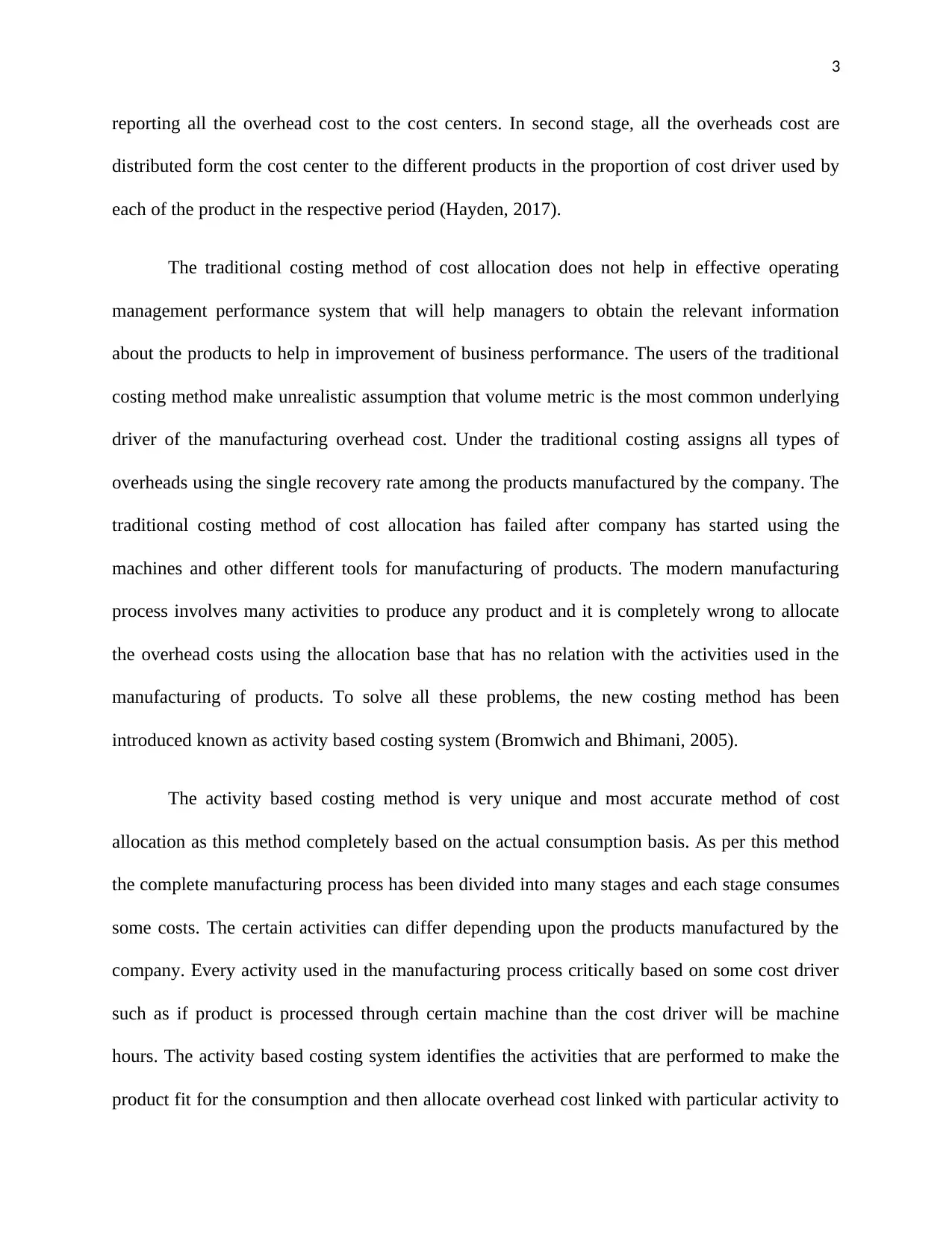
reporting all the overhead cost to the cost centers. In second stage, all the overheads cost are
distributed form the cost center to the different products in the proportion of cost driver used by
each of the product in the respective period (Hayden, 2017).
The traditional costing method of cost allocation does not help in effective operating
management performance system that will help managers to obtain the relevant information
about the products to help in improvement of business performance. The users of the traditional
costing method make unrealistic assumption that volume metric is the most common underlying
driver of the manufacturing overhead cost. Under the traditional costing assigns all types of
overheads using the single recovery rate among the products manufactured by the company. The
traditional costing method of cost allocation has failed after company has started using the
machines and other different tools for manufacturing of products. The modern manufacturing
process involves many activities to produce any product and it is completely wrong to allocate
the overhead costs using the allocation base that has no relation with the activities used in the
manufacturing of products. To solve all these problems, the new costing method has been
introduced known as activity based costing system (Bromwich and Bhimani, 2005).
The activity based costing method is very unique and most accurate method of cost
allocation as this method completely based on the actual consumption basis. As per this method
the complete manufacturing process has been divided into many stages and each stage consumes
some costs. The certain activities can differ depending upon the products manufactured by the
company. Every activity used in the manufacturing process critically based on some cost driver
such as if product is processed through certain machine than the cost driver will be machine
hours. The activity based costing system identifies the activities that are performed to make the
product fit for the consumption and then allocate overhead cost linked with particular activity to
reporting all the overhead cost to the cost centers. In second stage, all the overheads cost are
distributed form the cost center to the different products in the proportion of cost driver used by
each of the product in the respective period (Hayden, 2017).
The traditional costing method of cost allocation does not help in effective operating
management performance system that will help managers to obtain the relevant information
about the products to help in improvement of business performance. The users of the traditional
costing method make unrealistic assumption that volume metric is the most common underlying
driver of the manufacturing overhead cost. Under the traditional costing assigns all types of
overheads using the single recovery rate among the products manufactured by the company. The
traditional costing method of cost allocation has failed after company has started using the
machines and other different tools for manufacturing of products. The modern manufacturing
process involves many activities to produce any product and it is completely wrong to allocate
the overhead costs using the allocation base that has no relation with the activities used in the
manufacturing of products. To solve all these problems, the new costing method has been
introduced known as activity based costing system (Bromwich and Bhimani, 2005).
The activity based costing method is very unique and most accurate method of cost
allocation as this method completely based on the actual consumption basis. As per this method
the complete manufacturing process has been divided into many stages and each stage consumes
some costs. The certain activities can differ depending upon the products manufactured by the
company. Every activity used in the manufacturing process critically based on some cost driver
such as if product is processed through certain machine than the cost driver will be machine
hours. The activity based costing system identifies the activities that are performed to make the
product fit for the consumption and then allocate overhead cost linked with particular activity to
⊘ This is a preview!⊘
Do you want full access?
Subscribe today to unlock all pages.

Trusted by 1+ million students worldwide

4
the products using the recovery rate that define cost driver in respective activity. For example,
the overhead cost associated with the use of machines will be apportioned among the products
using the machine hour rate recovery rate not by the labor hour recovery rate (Cooper and
Kaplan, 1991). The major advantage of this method is that it recognizes the relationship between
the costs, activities and products, and by using this relationship it allocate the all the overhead
costs to the products using the most real allocation method which helps he manager in improving
the business performance and eliminate any non-value added activities (Hayden, 2017).
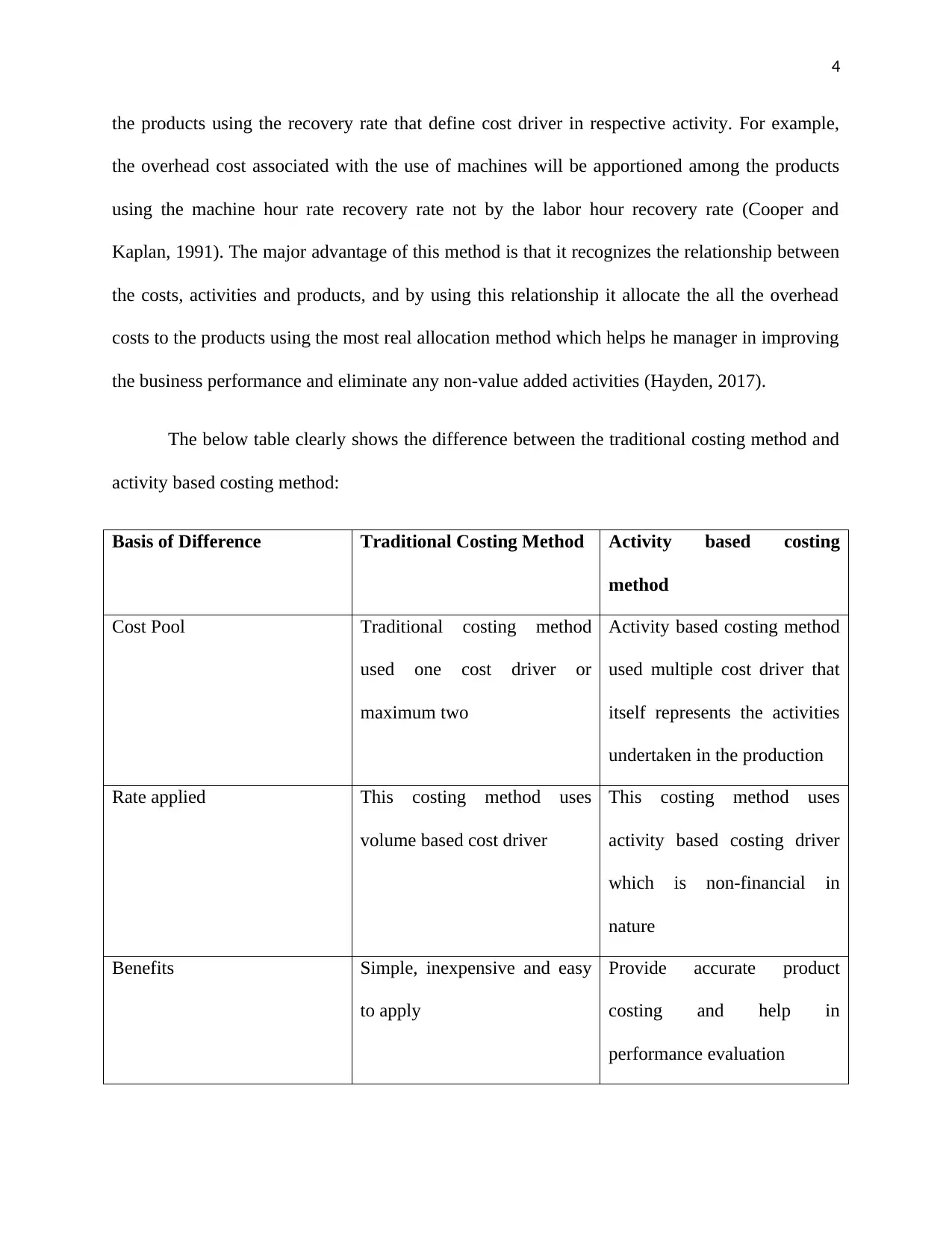
The below table clearly shows the difference between the traditional costing method and
activity based costing method:
Basis of Difference Traditional Costing Method Activity based costing
method
Cost Pool Traditional costing method
used one cost driver or
maximum two
Activity based costing method
used multiple cost driver that
itself represents the activities
undertaken in the production
Rate applied This costing method uses
volume based cost driver
This costing method uses
activity based costing driver
which is non-financial in
nature
Benefits Simple, inexpensive and easy
to apply
Provide accurate product
costing and help in
performance evaluation
the products using the recovery rate that define cost driver in respective activity. For example,
the overhead cost associated with the use of machines will be apportioned among the products
using the machine hour rate recovery rate not by the labor hour recovery rate (Cooper and
Kaplan, 1991). The major advantage of this method is that it recognizes the relationship between
the costs, activities and products, and by using this relationship it allocate the all the overhead
costs to the products using the most real allocation method which helps he manager in improving
the business performance and eliminate any non-value added activities (Hayden, 2017).
The below table clearly shows the difference between the traditional costing method and
activity based costing method:
Basis of Difference Traditional Costing Method Activity based costing
method
Cost Pool Traditional costing method
used one cost driver or
maximum two
Activity based costing method
used multiple cost driver that
itself represents the activities
undertaken in the production
Rate applied This costing method uses
volume based cost driver
This costing method uses
activity based costing driver
which is non-financial in
nature
Benefits Simple, inexpensive and easy
to apply
Provide accurate product
costing and help in
performance evaluation
Paraphrase This Document
Need a fresh take? Get an instant paraphrase of this document with our AI Paraphraser

5
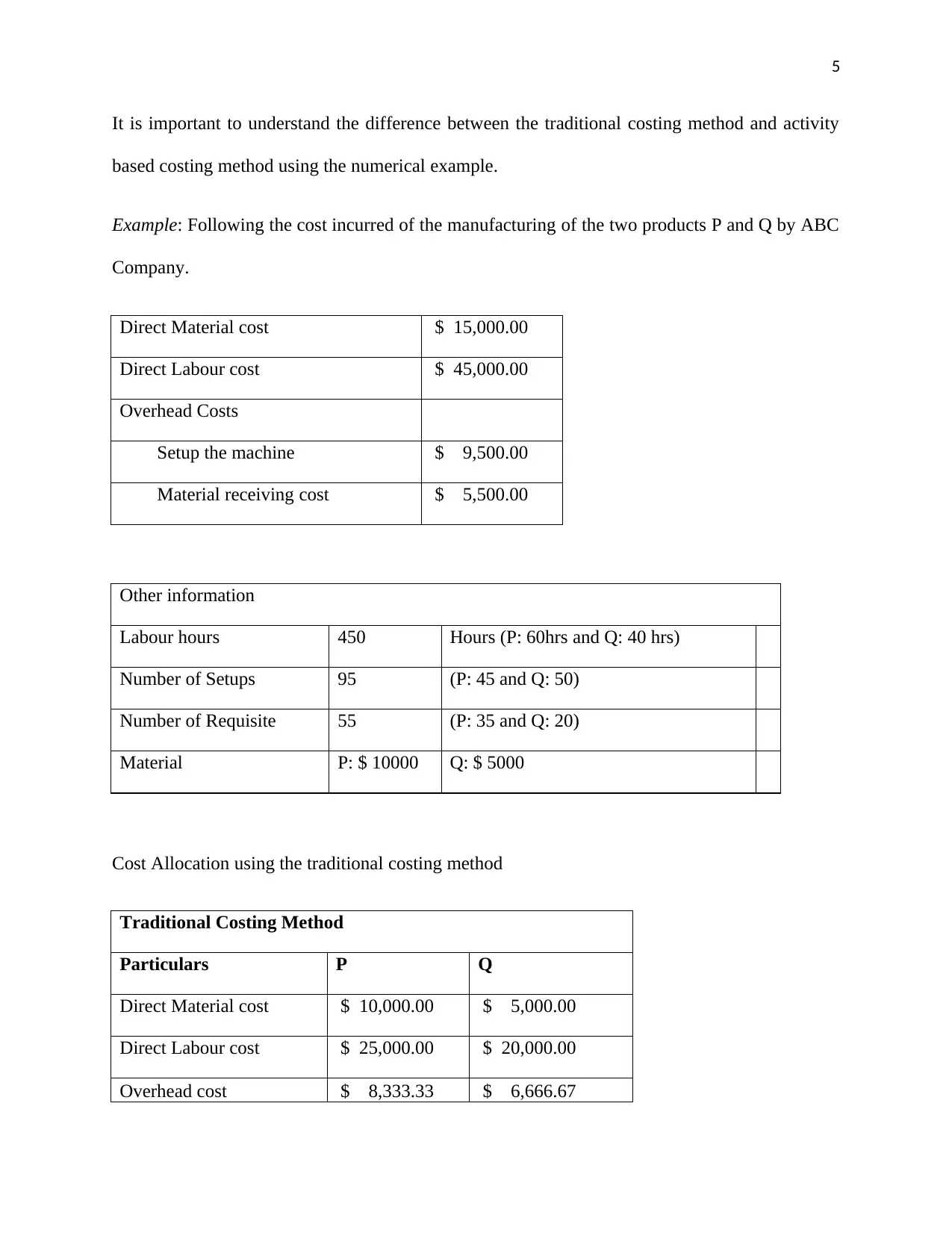
It is important to understand the difference between the traditional costing method and activity
based costing method using the numerical example.
Example: Following the cost incurred of the manufacturing of the two products P and Q by ABC
Company.
Direct Material cost $ 15,000.00
Direct Labour cost $ 45,000.00
Overhead Costs
Setup the machine $ 9,500.00
Material receiving cost $ 5,500.00
Other information
Labour hours 450 Hours (P: 60hrs and Q: 40 hrs)
Number of Setups 95 (P: 45 and Q: 50)
Number of Requisite 55 (P: 35 and Q: 20)
Material P: $ 10000 Q: $ 5000
Cost Allocation using the traditional costing method
Traditional Costing Method
Particulars P Q
Direct Material cost $ 10,000.00 $ 5,000.00
Direct Labour cost $ 25,000.00 $ 20,000.00
Overhead cost $ 8,333.33 $ 6,666.67
It is important to understand the difference between the traditional costing method and activity
based costing method using the numerical example.
Example: Following the cost incurred of the manufacturing of the two products P and Q by ABC
Company.
Direct Material cost $ 15,000.00
Direct Labour cost $ 45,000.00
Overhead Costs
Setup the machine $ 9,500.00
Material receiving cost $ 5,500.00
Other information
Labour hours 450 Hours (P: 60hrs and Q: 40 hrs)
Number of Setups 95 (P: 45 and Q: 50)
Number of Requisite 55 (P: 35 and Q: 20)
Material P: $ 10000 Q: $ 5000
Cost Allocation using the traditional costing method
Traditional Costing Method
Particulars P Q
Direct Material cost $ 10,000.00 $ 5,000.00
Direct Labour cost $ 25,000.00 $ 20,000.00
Overhead cost $ 8,333.33 $ 6,666.67

6
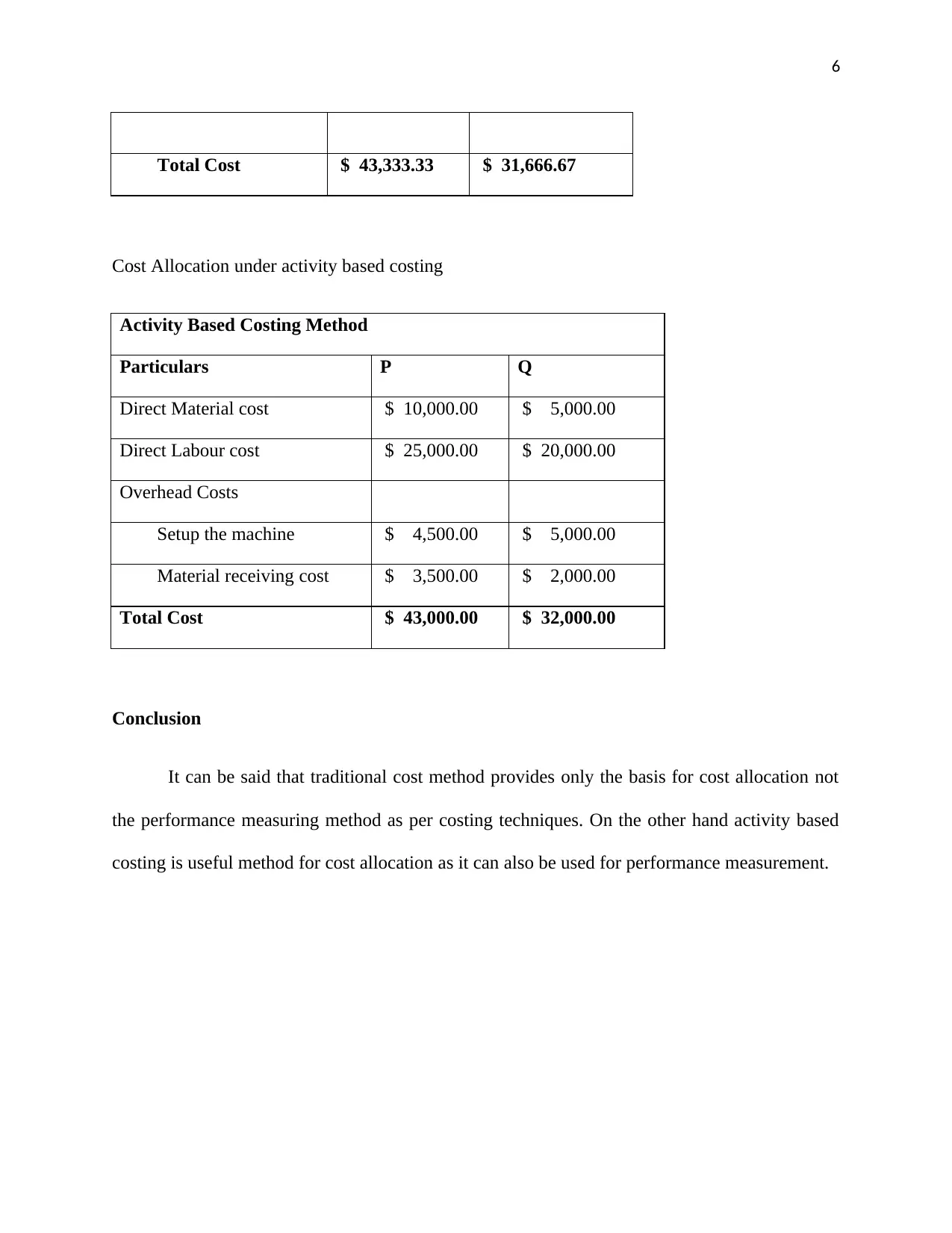
Total Cost $ 43,333.33 $ 31,666.67
Cost Allocation under activity based costing
Activity Based Costing Method
Particulars P Q
Direct Material cost $ 10,000.00 $ 5,000.00
Direct Labour cost $ 25,000.00 $ 20,000.00
Overhead Costs
Setup the machine $ 4,500.00 $ 5,000.00
Material receiving cost $ 3,500.00 $ 2,000.00
Total Cost $ 43,000.00 $ 32,000.00
Conclusion
It can be said that traditional cost method provides only the basis for cost allocation not
the performance measuring method as per costing techniques. On the other hand activity based
costing is useful method for cost allocation as it can also be used for performance measurement.
Total Cost $ 43,333.33 $ 31,666.67
Cost Allocation under activity based costing
Activity Based Costing Method
Particulars P Q
Direct Material cost $ 10,000.00 $ 5,000.00
Direct Labour cost $ 25,000.00 $ 20,000.00
Overhead Costs
Setup the machine $ 4,500.00 $ 5,000.00
Material receiving cost $ 3,500.00 $ 2,000.00
Total Cost $ 43,000.00 $ 32,000.00
Conclusion
It can be said that traditional cost method provides only the basis for cost allocation not
the performance measuring method as per costing techniques. On the other hand activity based
costing is useful method for cost allocation as it can also be used for performance measurement.
⊘ This is a preview!⊘
Do you want full access?
Subscribe today to unlock all pages.

Trusted by 1+ million students worldwide

7
References
Bromwich, M. and Bhimani, A., 2005. Management accounting: Pathways to progress. Cima
publishing.
Cooper, R. and Kaplan, R.S. 1991. Profit Priorities from Activity-Based Costing. [Online].
Available from: https://hbr.org/1991/05/profit-priorities-from-activity-based-costing [Accessed
on: 28 February, 2018].
Hayden, A. 2017. Activity-Based vs. Traditional Costing. [Online]. Available from:
https://quickbooks.intuit.com/r/pricing-strategy/activity-based-vs-traditional-costing/ [Accessed
on: 28 February, 2018].
References
Bromwich, M. and Bhimani, A., 2005. Management accounting: Pathways to progress. Cima
publishing.
Cooper, R. and Kaplan, R.S. 1991. Profit Priorities from Activity-Based Costing. [Online].
Available from: https://hbr.org/1991/05/profit-priorities-from-activity-based-costing [Accessed
on: 28 February, 2018].
Hayden, A. 2017. Activity-Based vs. Traditional Costing. [Online]. Available from:
https://quickbooks.intuit.com/r/pricing-strategy/activity-based-vs-traditional-costing/ [Accessed
on: 28 February, 2018].
1 out of 7
Related Documents
Your All-in-One AI-Powered Toolkit for Academic Success.
+13062052269
info@desklib.com
Available 24*7 on WhatsApp / Email
Unlock your academic potential
Copyright © 2020–2026 A2Z Services. All Rights Reserved. Developed and managed by ZUCOL.