MB222 Business Project Report: Consultant Comparison Analysis
VerifiedAdded on 2023/03/20
|9
|2201
|72
Report
AI Summary
This business project report examines the comparative roles of internal managers and external consultants in addressing organizational challenges. It explores the advantages and disadvantages of each approach, highlighting the expertise and independence of external consultants versus the in-depth knowledge and cost-effectiveness of internal managers. The report delves into the key considerations for selecting either an internal manager or external consultant for problem-solving, research, or project planning. It also addresses the challenges associated with each alternative, such as the potential for increased costs, integration issues with external consultants, and the lack of specialized expertise or resource constraints when relying on internal managers. The report concludes by suggesting that the most suitable choice depends on factors like the size and complexity of the business, with larger organizations potentially benefiting more from external consultancy, while smaller businesses may find internal managers more appropriate.
Running Head: BUSINESS PROJECT 0
BUSINESS PROJECT
Student name
5/13/2019
BUSINESS PROJECT
Student name
5/13/2019
Paraphrase This Document
Need a fresh take? Get an instant paraphrase of this document with our AI Paraphraser

BUSINESS PROJECT 1
Business Project
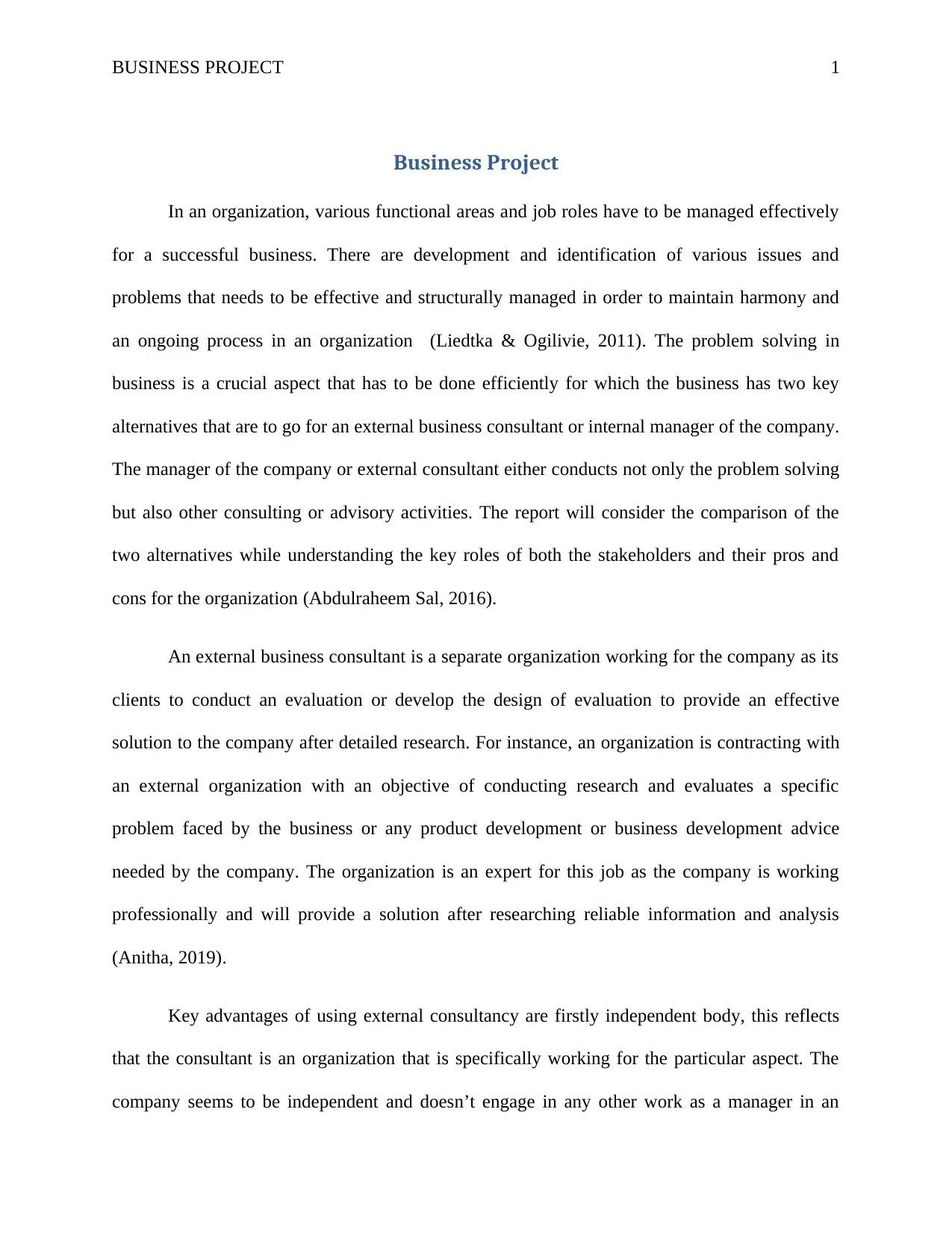
In an organization, various functional areas and job roles have to be managed effectively
for a successful business. There are development and identification of various issues and
problems that needs to be effective and structurally managed in order to maintain harmony and
an ongoing process in an organization (Liedtka & Ogilivie, 2011). The problem solving in
business is a crucial aspect that has to be done efficiently for which the business has two key
alternatives that are to go for an external business consultant or internal manager of the company.
The manager of the company or external consultant either conducts not only the problem solving
but also other consulting or advisory activities. The report will consider the comparison of the
two alternatives while understanding the key roles of both the stakeholders and their pros and
cons for the organization (Abdulraheem Sal, 2016).
An external business consultant is a separate organization working for the company as its
clients to conduct an evaluation or develop the design of evaluation to provide an effective
solution to the company after detailed research. For instance, an organization is contracting with
an external organization with an objective of conducting research and evaluates a specific
problem faced by the business or any product development or business development advice
needed by the company. The organization is an expert for this job as the company is working
professionally and will provide a solution after researching reliable information and analysis
(Anitha, 2019).
Key advantages of using external consultancy are firstly independent body, this reflects
that the consultant is an organization that is specifically working for the particular aspect. The
company seems to be independent and doesn’t engage in any other work as a manager in an
Business Project
In an organization, various functional areas and job roles have to be managed effectively
for a successful business. There are development and identification of various issues and
problems that needs to be effective and structurally managed in order to maintain harmony and
an ongoing process in an organization (Liedtka & Ogilivie, 2011). The problem solving in
business is a crucial aspect that has to be done efficiently for which the business has two key
alternatives that are to go for an external business consultant or internal manager of the company.
The manager of the company or external consultant either conducts not only the problem solving
but also other consulting or advisory activities. The report will consider the comparison of the
two alternatives while understanding the key roles of both the stakeholders and their pros and
cons for the organization (Abdulraheem Sal, 2016).
An external business consultant is a separate organization working for the company as its
clients to conduct an evaluation or develop the design of evaluation to provide an effective
solution to the company after detailed research. For instance, an organization is contracting with
an external organization with an objective of conducting research and evaluates a specific
problem faced by the business or any product development or business development advice
needed by the company. The organization is an expert for this job as the company is working
professionally and will provide a solution after researching reliable information and analysis
(Anitha, 2019).
Key advantages of using external consultancy are firstly independent body, this reflects
that the consultant is an organization that is specifically working for the particular aspect. The
company seems to be independent and doesn’t engage in any other work as a manager in an

BUSINESS PROJECT 2
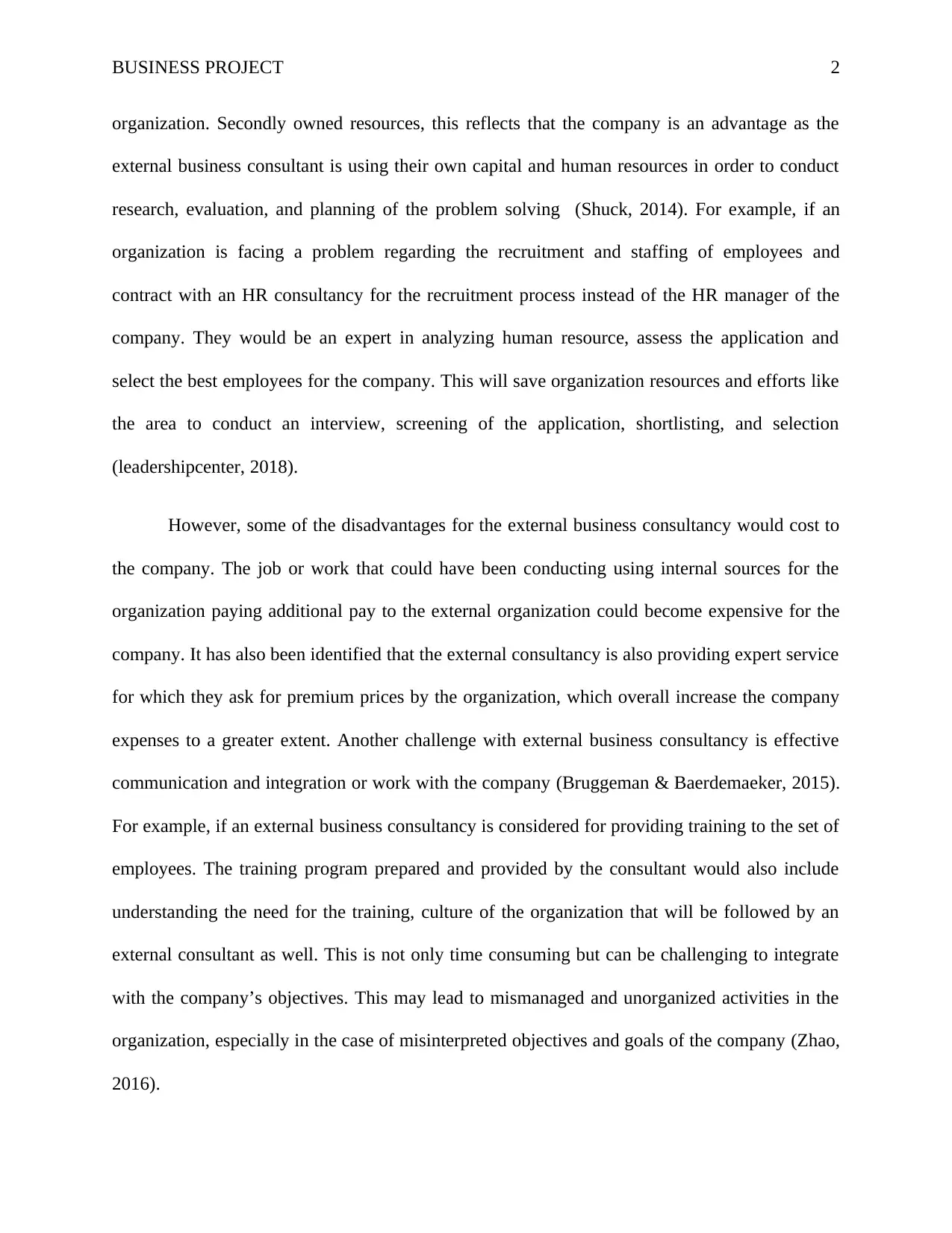
organization. Secondly owned resources, this reflects that the company is an advantage as the
external business consultant is using their own capital and human resources in order to conduct
research, evaluation, and planning of the problem solving (Shuck, 2014). For example, if an
organization is facing a problem regarding the recruitment and staffing of employees and
contract with an HR consultancy for the recruitment process instead of the HR manager of the
company. They would be an expert in analyzing human resource, assess the application and
select the best employees for the company. This will save organization resources and efforts like
the area to conduct an interview, screening of the application, shortlisting, and selection
(leadershipcenter, 2018).
However, some of the disadvantages for the external business consultancy would cost to
the company. The job or work that could have been conducting using internal sources for the
organization paying additional pay to the external organization could become expensive for the
company. It has also been identified that the external consultancy is also providing expert service
for which they ask for premium prices by the organization, which overall increase the company
expenses to a greater extent. Another challenge with external business consultancy is effective
communication and integration or work with the company (Bruggeman & Baerdemaeker, 2015).
For example, if an external business consultancy is considered for providing training to the set of
employees. The training program prepared and provided by the consultant would also include
understanding the need for the training, culture of the organization that will be followed by an
external consultant as well. This is not only time consuming but can be challenging to integrate
with the company’s objectives. This may lead to mismanaged and unorganized activities in the
organization, especially in the case of misinterpreted objectives and goals of the company (Zhao,
2016).
organization. Secondly owned resources, this reflects that the company is an advantage as the
external business consultant is using their own capital and human resources in order to conduct
research, evaluation, and planning of the problem solving (Shuck, 2014). For example, if an
organization is facing a problem regarding the recruitment and staffing of employees and
contract with an HR consultancy for the recruitment process instead of the HR manager of the
company. They would be an expert in analyzing human resource, assess the application and
select the best employees for the company. This will save organization resources and efforts like
the area to conduct an interview, screening of the application, shortlisting, and selection
(leadershipcenter, 2018).
However, some of the disadvantages for the external business consultancy would cost to
the company. The job or work that could have been conducting using internal sources for the
organization paying additional pay to the external organization could become expensive for the
company. It has also been identified that the external consultancy is also providing expert service
for which they ask for premium prices by the organization, which overall increase the company
expenses to a greater extent. Another challenge with external business consultancy is effective
communication and integration or work with the company (Bruggeman & Baerdemaeker, 2015).
For example, if an external business consultancy is considered for providing training to the set of
employees. The training program prepared and provided by the consultant would also include
understanding the need for the training, culture of the organization that will be followed by an
external consultant as well. This is not only time consuming but can be challenging to integrate
with the company’s objectives. This may lead to mismanaged and unorganized activities in the
organization, especially in the case of misinterpreted objectives and goals of the company (Zhao,
2016).
⊘ This is a preview!⊘
Do you want full access?
Subscribe today to unlock all pages.

Trusted by 1+ million students worldwide

BUSINESS PROJECT 3
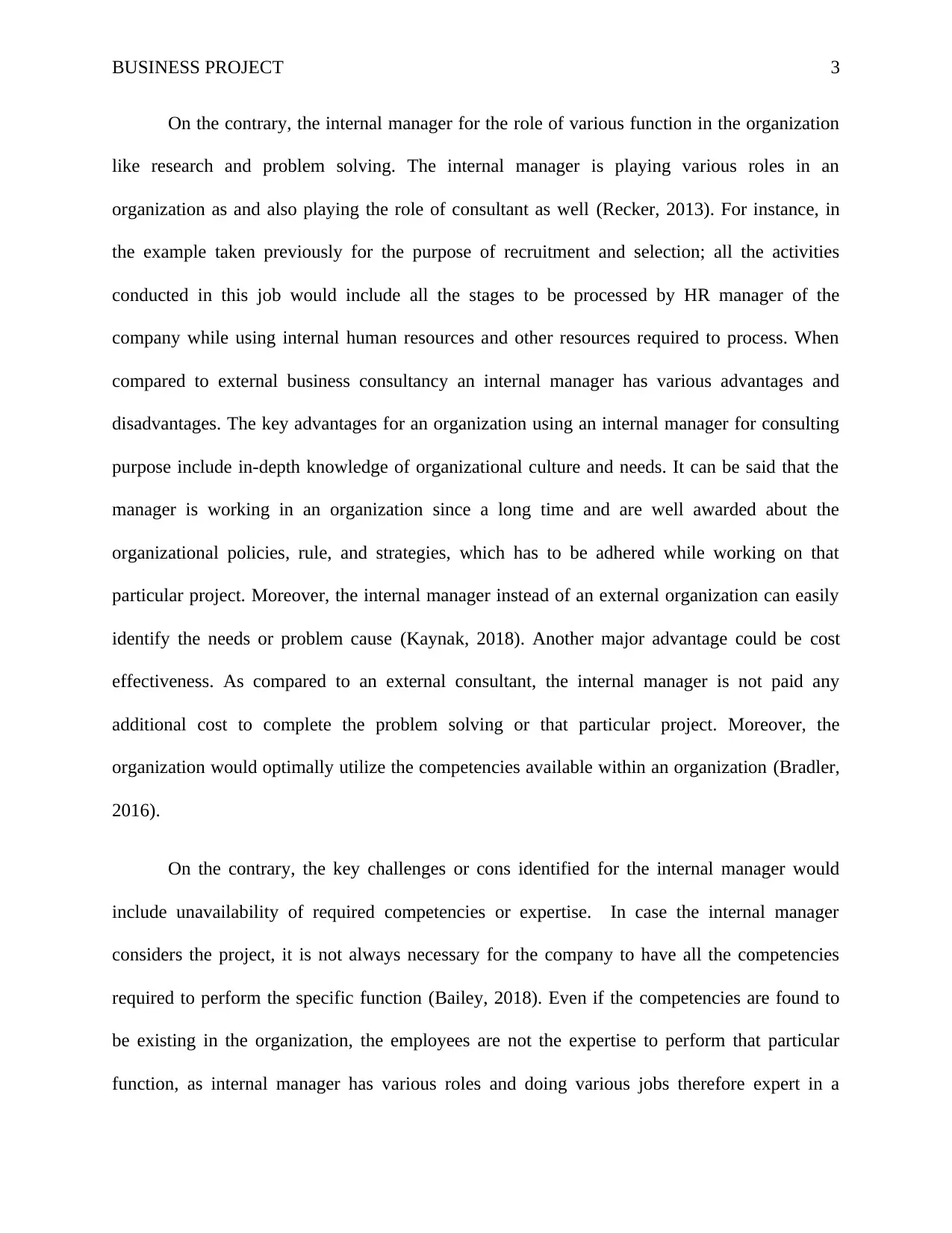
On the contrary, the internal manager for the role of various function in the organization
like research and problem solving. The internal manager is playing various roles in an
organization as and also playing the role of consultant as well (Recker, 2013). For instance, in
the example taken previously for the purpose of recruitment and selection; all the activities
conducted in this job would include all the stages to be processed by HR manager of the
company while using internal human resources and other resources required to process. When
compared to external business consultancy an internal manager has various advantages and
disadvantages. The key advantages for an organization using an internal manager for consulting
purpose include in-depth knowledge of organizational culture and needs. It can be said that the
manager is working in an organization since a long time and are well awarded about the
organizational policies, rule, and strategies, which has to be adhered while working on that
particular project. Moreover, the internal manager instead of an external organization can easily
identify the needs or problem cause (Kaynak, 2018). Another major advantage could be cost
effectiveness. As compared to an external consultant, the internal manager is not paid any
additional cost to complete the problem solving or that particular project. Moreover, the
organization would optimally utilize the competencies available within an organization (Bradler,
2016).
On the contrary, the key challenges or cons identified for the internal manager would
include unavailability of required competencies or expertise. In case the internal manager
considers the project, it is not always necessary for the company to have all the competencies
required to perform the specific function (Bailey, 2018). Even if the competencies are found to
be existing in the organization, the employees are not the expertise to perform that particular
function, as internal manager has various roles and doing various jobs therefore expert in a
On the contrary, the internal manager for the role of various function in the organization
like research and problem solving. The internal manager is playing various roles in an
organization as and also playing the role of consultant as well (Recker, 2013). For instance, in
the example taken previously for the purpose of recruitment and selection; all the activities
conducted in this job would include all the stages to be processed by HR manager of the
company while using internal human resources and other resources required to process. When
compared to external business consultancy an internal manager has various advantages and
disadvantages. The key advantages for an organization using an internal manager for consulting
purpose include in-depth knowledge of organizational culture and needs. It can be said that the
manager is working in an organization since a long time and are well awarded about the
organizational policies, rule, and strategies, which has to be adhered while working on that
particular project. Moreover, the internal manager instead of an external organization can easily
identify the needs or problem cause (Kaynak, 2018). Another major advantage could be cost
effectiveness. As compared to an external consultant, the internal manager is not paid any
additional cost to complete the problem solving or that particular project. Moreover, the
organization would optimally utilize the competencies available within an organization (Bradler,
2016).
On the contrary, the key challenges or cons identified for the internal manager would
include unavailability of required competencies or expertise. In case the internal manager
considers the project, it is not always necessary for the company to have all the competencies
required to perform the specific function (Bailey, 2018). Even if the competencies are found to
be existing in the organization, the employees are not the expertise to perform that particular
function, as internal manager has various roles and doing various jobs therefore expert in a
Paraphrase This Document
Need a fresh take? Get an instant paraphrase of this document with our AI Paraphraser

BUSINESS PROJECT 4
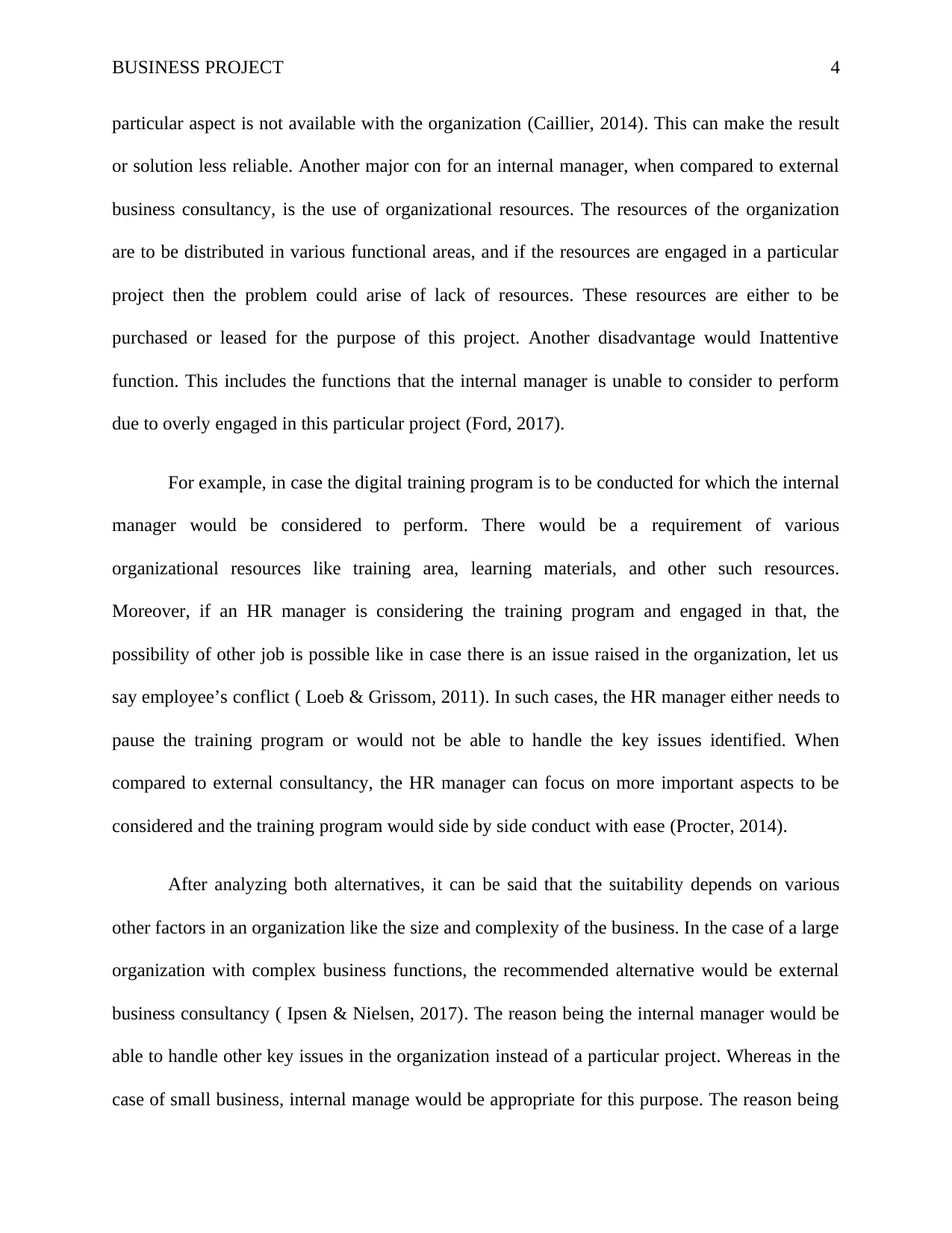
particular aspect is not available with the organization (Caillier, 2014). This can make the result
or solution less reliable. Another major con for an internal manager, when compared to external
business consultancy, is the use of organizational resources. The resources of the organization
are to be distributed in various functional areas, and if the resources are engaged in a particular
project then the problem could arise of lack of resources. These resources are either to be
purchased or leased for the purpose of this project. Another disadvantage would Inattentive
function. This includes the functions that the internal manager is unable to consider to perform
due to overly engaged in this particular project (Ford, 2017).
For example, in case the digital training program is to be conducted for which the internal
manager would be considered to perform. There would be a requirement of various
organizational resources like training area, learning materials, and other such resources.
Moreover, if an HR manager is considering the training program and engaged in that, the
possibility of other job is possible like in case there is an issue raised in the organization, let us
say employee’s conflict ( Loeb & Grissom, 2011). In such cases, the HR manager either needs to
pause the training program or would not be able to handle the key issues identified. When
compared to external consultancy, the HR manager can focus on more important aspects to be
considered and the training program would side by side conduct with ease (Procter, 2014).
After analyzing both alternatives, it can be said that the suitability depends on various
other factors in an organization like the size and complexity of the business. In the case of a large
organization with complex business functions, the recommended alternative would be external
business consultancy ( Ipsen & Nielsen, 2017). The reason being the internal manager would be
able to handle other key issues in the organization instead of a particular project. Whereas in the
case of small business, internal manage would be appropriate for this purpose. The reason being
particular aspect is not available with the organization (Caillier, 2014). This can make the result
or solution less reliable. Another major con for an internal manager, when compared to external
business consultancy, is the use of organizational resources. The resources of the organization
are to be distributed in various functional areas, and if the resources are engaged in a particular
project then the problem could arise of lack of resources. These resources are either to be
purchased or leased for the purpose of this project. Another disadvantage would Inattentive
function. This includes the functions that the internal manager is unable to consider to perform
due to overly engaged in this particular project (Ford, 2017).
For example, in case the digital training program is to be conducted for which the internal
manager would be considered to perform. There would be a requirement of various
organizational resources like training area, learning materials, and other such resources.
Moreover, if an HR manager is considering the training program and engaged in that, the
possibility of other job is possible like in case there is an issue raised in the organization, let us
say employee’s conflict ( Loeb & Grissom, 2011). In such cases, the HR manager either needs to
pause the training program or would not be able to handle the key issues identified. When
compared to external consultancy, the HR manager can focus on more important aspects to be
considered and the training program would side by side conduct with ease (Procter, 2014).
After analyzing both alternatives, it can be said that the suitability depends on various
other factors in an organization like the size and complexity of the business. In the case of a large
organization with complex business functions, the recommended alternative would be external
business consultancy ( Ipsen & Nielsen, 2017). The reason being the internal manager would be
able to handle other key issues in the organization instead of a particular project. Whereas in the
case of small business, internal manage would be appropriate for this purpose. The reason being

BUSINESS PROJECT 5
the company would not prefer to increase the cost to greater extends for any particular problem
solving or project (Pansari & Kumar, 2016).
From the discussion, it can be concluded that the business has two key alternatives that
are to go for an external business consultant or internal manager of the company for various
purposes like problem solving, research, a specific project or program planning and execution.
Both alternatives have their own advantages and challenges. Key advantages of using external
consultancy are firstly independent body, owned resources, and organization is an expert for this
job as the company is working professionally and will provide a solution after researching
reliable information and analysis. The key advantages for an organization using internal
manager for consulting purpose include in depth knowledge of organizational culture and needs,
and cost effectiveness. There are challenges for both alternatives as if for external consultant key
disadvantage is increased the cost to the company and challenging integration of both
organization and may lead to conflicts. On the other hand, the internal manager for this purpose
lack at expertise, or availability of required resources and competencies.
the company would not prefer to increase the cost to greater extends for any particular problem
solving or project (Pansari & Kumar, 2016).
From the discussion, it can be concluded that the business has two key alternatives that
are to go for an external business consultant or internal manager of the company for various
purposes like problem solving, research, a specific project or program planning and execution.
Both alternatives have their own advantages and challenges. Key advantages of using external
consultancy are firstly independent body, owned resources, and organization is an expert for this
job as the company is working professionally and will provide a solution after researching
reliable information and analysis. The key advantages for an organization using internal
manager for consulting purpose include in depth knowledge of organizational culture and needs,
and cost effectiveness. There are challenges for both alternatives as if for external consultant key
disadvantage is increased the cost to the company and challenging integration of both
organization and may lead to conflicts. On the other hand, the internal manager for this purpose
lack at expertise, or availability of required resources and competencies.
⊘ This is a preview!⊘
Do you want full access?
Subscribe today to unlock all pages.

Trusted by 1+ million students worldwide

BUSINESS PROJECT 6
References
Ipsen, C., & Nielsen, K. (2017). he role of managers in organizational interventions and non-
interventions–at intra and inter-organizational work places. In Work, Stress and Health
2017.
Loeb, S., & Grissom, J. A. (2011). Triangulating Principal Effectiveness: How Perspectives of
Parents, Teachers, and Assistant Principals Identify the Central Importance of Managerial
Skills. American Educational Research Journal, 48(5), 1091-1123.
Abdulraheem Sal, M. (2016). The Impact of Training and Development on Employees
Performance and Productivity. International Journal of Management Sciences and
Business Research, 5(7), 2226-8235.
Anitha, J. (2019). Role of Organisational Culture and Employee Commitment in Employee
Retention. ASBM Journal of Management, 9(1).
Bailey, C. (2018). Strategic human resource management. Oxford University Press,.
Bradler, C. (2016). Employee recognition and performance: A field experiment. Management
Science, 62(11), 3085-3099.
Bruggeman, W., & Baerdemaeker, J. (2015). The impact of participation in strategic planning on
managers’ creation of budgetary slack: The mediating role of autonomous motivation and
affective organisational commitment. Management Accounting Research, 29, 1-2.
Caillier, J. (2014). Toward a better understanding of the relationship between transformational
leadership, public service motivation, mission valence, and employee performance: A
References
Ipsen, C., & Nielsen, K. (2017). he role of managers in organizational interventions and non-
interventions–at intra and inter-organizational work places. In Work, Stress and Health
2017.
Loeb, S., & Grissom, J. A. (2011). Triangulating Principal Effectiveness: How Perspectives of
Parents, Teachers, and Assistant Principals Identify the Central Importance of Managerial
Skills. American Educational Research Journal, 48(5), 1091-1123.
Abdulraheem Sal, M. (2016). The Impact of Training and Development on Employees
Performance and Productivity. International Journal of Management Sciences and
Business Research, 5(7), 2226-8235.
Anitha, J. (2019). Role of Organisational Culture and Employee Commitment in Employee
Retention. ASBM Journal of Management, 9(1).
Bailey, C. (2018). Strategic human resource management. Oxford University Press,.
Bradler, C. (2016). Employee recognition and performance: A field experiment. Management
Science, 62(11), 3085-3099.
Bruggeman, W., & Baerdemaeker, J. (2015). The impact of participation in strategic planning on
managers’ creation of budgetary slack: The mediating role of autonomous motivation and
affective organisational commitment. Management Accounting Research, 29, 1-2.
Caillier, J. (2014). Toward a better understanding of the relationship between transformational
leadership, public service motivation, mission valence, and employee performance: A
Paraphrase This Document
Need a fresh take? Get an instant paraphrase of this document with our AI Paraphraser

BUSINESS PROJECT 7
preliminary study. Public Personnel Management, , 43(2), 218-239.
Ford, J. (2017). Employee perceptions regarding an organizational change initiative in a state
wildlife agency. Human Dimensions of Wildlife, 22(5), 422-437.
Kaynak, H. (2018). The role of human resource-related quality management practices in new
product development: A dynamic capability perspective. International Journal of
Operations & Production Management, 38(1), 43.
leadershipcenter. (2018). Collaborative Creativity: Leading High Performance through Theatre.
Retrieved from https://leadershipcenter.wharton.upenn.edu/uncategorized/collaborative-
creativity-leading-high-performance-theatre/
Liedtka, J., & Ogilivie, T. (2011). Designing for growth: a design thinking toolkit for managers.
New York: Colombia Business School Publishing.
Pansari, A., & Kumar, V. (2016). Competitive advantage through engagement. Journal of
Marketing Research, 497.
Procter, T. (2014). Creative Problem Solving for Managers: Developing skills for decision
making and innovation (4th ed.). Abingdon: Routledge .
Recker, J. (2013). The Effect of Strategic Human Resource Management on Organizational
Performance: The Mediating Role of High & Performance Human Resource Practices.
Human Resource Management,, 52(6), 899-921.
Shuck, B. (2014). Employee engagement and well-being: A moderation model and implications
for practice. Journal of Leadership & Organizational Studies, 21(1), 43-58.
preliminary study. Public Personnel Management, , 43(2), 218-239.
Ford, J. (2017). Employee perceptions regarding an organizational change initiative in a state
wildlife agency. Human Dimensions of Wildlife, 22(5), 422-437.
Kaynak, H. (2018). The role of human resource-related quality management practices in new
product development: A dynamic capability perspective. International Journal of
Operations & Production Management, 38(1), 43.
leadershipcenter. (2018). Collaborative Creativity: Leading High Performance through Theatre.
Retrieved from https://leadershipcenter.wharton.upenn.edu/uncategorized/collaborative-
creativity-leading-high-performance-theatre/
Liedtka, J., & Ogilivie, T. (2011). Designing for growth: a design thinking toolkit for managers.
New York: Colombia Business School Publishing.
Pansari, A., & Kumar, V. (2016). Competitive advantage through engagement. Journal of
Marketing Research, 497.
Procter, T. (2014). Creative Problem Solving for Managers: Developing skills for decision
making and innovation (4th ed.). Abingdon: Routledge .
Recker, J. (2013). The Effect of Strategic Human Resource Management on Organizational
Performance: The Mediating Role of High & Performance Human Resource Practices.
Human Resource Management,, 52(6), 899-921.
Shuck, B. (2014). Employee engagement and well-being: A moderation model and implications
for practice. Journal of Leadership & Organizational Studies, 21(1), 43-58.

BUSINESS PROJECT 8
Zhao, X. (2016). Identifying critical leadership styles of project managers for green building
projects. International Journal of Construction Management, , 16(2), 150-160.
Zhao, X. (2016). Identifying critical leadership styles of project managers for green building
projects. International Journal of Construction Management, , 16(2), 150-160.
⊘ This is a preview!⊘
Do you want full access?
Subscribe today to unlock all pages.

Trusted by 1+ million students worldwide
1 out of 9
Related Documents
Your All-in-One AI-Powered Toolkit for Academic Success.
+13062052269
info@desklib.com
Available 24*7 on WhatsApp / Email
Unlock your academic potential
Copyright © 2020–2025 A2Z Services. All Rights Reserved. Developed and managed by ZUCOL.