Financial Resource Management and Analysis for Sweet Menu Restaurant
VerifiedAdded on 2020/01/28
|16
|5425
|200
Report
AI Summary
This report provides a comprehensive financial analysis of Sweet Menu Restaurant, focusing on its expansion plans and resource management. It begins by identifying available financial resources, including bank loans, capital markets, retained earnings, and franchising, while also considering short-term options like bank overdrafts and trade credit. The report delves into the legal, financial, and ownership implications of each financing source. It then evaluates the most appropriate sources for the restaurant's needs, considering both long-term and short-term options, including a bank loan and trade credit. The report analyzes the costs associated with different financing options, emphasizing the importance of financial planning within the business. It also assesses the information needs of decision-makers and the impact of finance on financial statements. Furthermore, the report includes a discussion on budgeting, unit cost calculations, pricing decisions, and investment appraisal techniques. Finally, it examines financial statements, compares financial formats used by different businesses, and provides a ratio analysis to evaluate the financial performance of Sweet Menu Restaurant.

MFRD

Paraphrase This Document
Need a fresh take? Get an instant paraphrase of this document with our AI Paraphraser
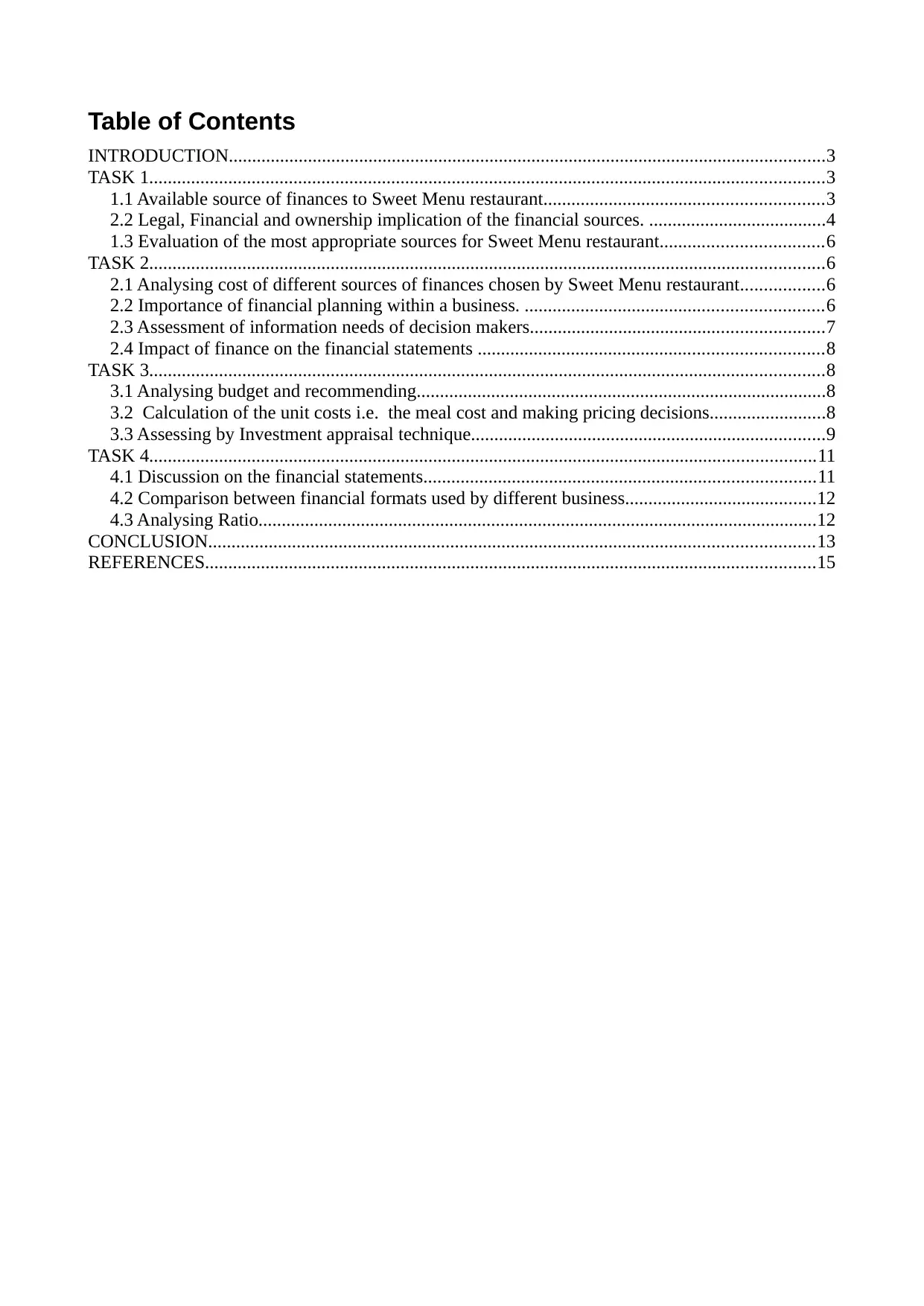
Table of Contents
INTRODUCTION................................................................................................................................3
TASK 1.................................................................................................................................................3
1.1 Available source of finances to Sweet Menu restaurant............................................................3
2.2 Legal, Financial and ownership implication of the financial sources. ......................................4
1.3 Evaluation of the most appropriate sources for Sweet Menu restaurant...................................6
TASK 2.................................................................................................................................................6
2.1 Analysing cost of different sources of finances chosen by Sweet Menu restaurant..................6
2.2 Importance of financial planning within a business. ................................................................6
2.3 Assessment of information needs of decision makers...............................................................7
2.4 Impact of finance on the financial statements ..........................................................................8
TASK 3.................................................................................................................................................8
3.1 Analysing budget and recommending........................................................................................8
3.2 Calculation of the unit costs i.e. the meal cost and making pricing decisions.........................8
3.3 Assessing by Investment appraisal technique............................................................................9
TASK 4...............................................................................................................................................11
4.1 Discussion on the financial statements....................................................................................11
4.2 Comparison between financial formats used by different business.........................................12
4.3 Analysing Ratio........................................................................................................................12
CONCLUSION..................................................................................................................................13
REFERENCES...................................................................................................................................15
INTRODUCTION................................................................................................................................3
TASK 1.................................................................................................................................................3
1.1 Available source of finances to Sweet Menu restaurant............................................................3
2.2 Legal, Financial and ownership implication of the financial sources. ......................................4
1.3 Evaluation of the most appropriate sources for Sweet Menu restaurant...................................6
TASK 2.................................................................................................................................................6
2.1 Analysing cost of different sources of finances chosen by Sweet Menu restaurant..................6
2.2 Importance of financial planning within a business. ................................................................6
2.3 Assessment of information needs of decision makers...............................................................7
2.4 Impact of finance on the financial statements ..........................................................................8
TASK 3.................................................................................................................................................8
3.1 Analysing budget and recommending........................................................................................8
3.2 Calculation of the unit costs i.e. the meal cost and making pricing decisions.........................8
3.3 Assessing by Investment appraisal technique............................................................................9
TASK 4...............................................................................................................................................11
4.1 Discussion on the financial statements....................................................................................11
4.2 Comparison between financial formats used by different business.........................................12
4.3 Analysing Ratio........................................................................................................................12
CONCLUSION..................................................................................................................................13
REFERENCES...................................................................................................................................15

Index of Tables
Table 1: Unit Cost...............................................................................................................................10
Table 2: Proposal 1, Table 1................................................................................................................11
Table 3: Proposal 1, Table 2................................................................................................................11
Table 4: Proposal 2, Table 1...............................................................................................................12
Table 5: Proposal 2, Table 2...............................................................................................................12
Table 6: Ratio Analysis.......................................................................................................................14
Table 1: Unit Cost...............................................................................................................................10
Table 2: Proposal 1, Table 1................................................................................................................11
Table 3: Proposal 1, Table 2................................................................................................................11
Table 4: Proposal 2, Table 1...............................................................................................................12
Table 5: Proposal 2, Table 2...............................................................................................................12
Table 6: Ratio Analysis.......................................................................................................................14
⊘ This is a preview!⊘
Do you want full access?
Subscribe today to unlock all pages.

Trusted by 1+ million students worldwide
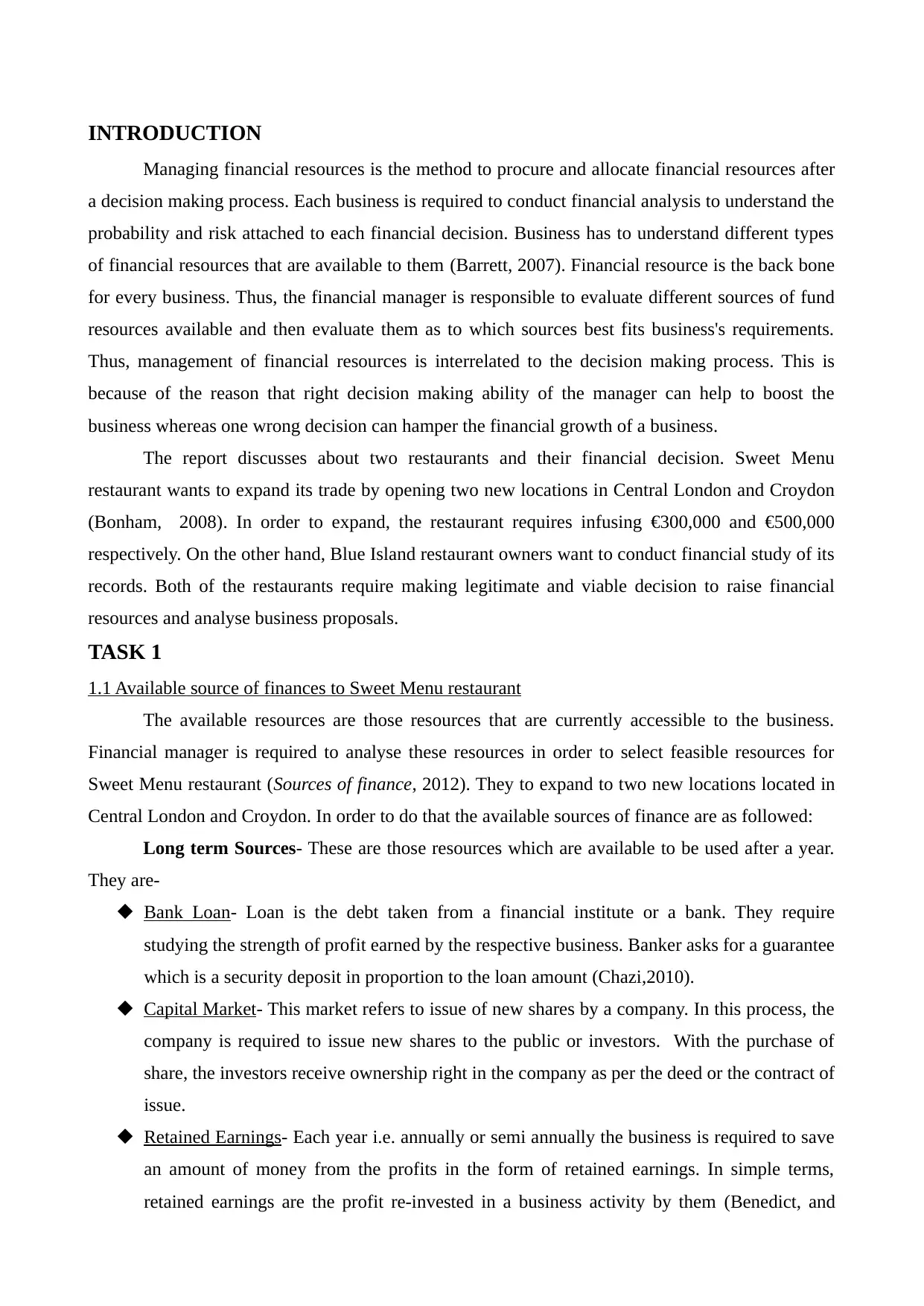
INTRODUCTION
Managing financial resources is the method to procure and allocate financial resources after
a decision making process. Each business is required to conduct financial analysis to understand the
probability and risk attached to each financial decision. Business has to understand different types
of financial resources that are available to them (Barrett, 2007). Financial resource is the back bone
for every business. Thus, the financial manager is responsible to evaluate different sources of fund
resources available and then evaluate them as to which sources best fits business's requirements.
Thus, management of financial resources is interrelated to the decision making process. This is
because of the reason that right decision making ability of the manager can help to boost the
business whereas one wrong decision can hamper the financial growth of a business.
The report discusses about two restaurants and their financial decision. Sweet Menu
restaurant wants to expand its trade by opening two new locations in Central London and Croydon
(Bonham, 2008). In order to expand, the restaurant requires infusing €300,000 and €500,000
respectively. On the other hand, Blue Island restaurant owners want to conduct financial study of its
records. Both of the restaurants require making legitimate and viable decision to raise financial
resources and analyse business proposals.
TASK 1
1.1 Available source of finances to Sweet Menu restaurant
The available resources are those resources that are currently accessible to the business.
Financial manager is required to analyse these resources in order to select feasible resources for
Sweet Menu restaurant (Sources of finance, 2012). They to expand to two new locations located in
Central London and Croydon. In order to do that the available sources of finance are as followed:
Long term Sources- These are those resources which are available to be used after a year.
They are-
Bank Loan- Loan is the debt taken from a financial institute or a bank. They require
studying the strength of profit earned by the respective business. Banker asks for a guarantee
which is a security deposit in proportion to the loan amount (Chazi,2010).
Capital Market- This market refers to issue of new shares by a company. In this process, the
company is required to issue new shares to the public or investors. With the purchase of
share, the investors receive ownership right in the company as per the deed or the contract of
issue.
Retained Earnings- Each year i.e. annually or semi annually the business is required to save
an amount of money from the profits in the form of retained earnings. In simple terms,
retained earnings are the profit re-invested in a business activity by them (Benedict, and
Managing financial resources is the method to procure and allocate financial resources after
a decision making process. Each business is required to conduct financial analysis to understand the
probability and risk attached to each financial decision. Business has to understand different types
of financial resources that are available to them (Barrett, 2007). Financial resource is the back bone
for every business. Thus, the financial manager is responsible to evaluate different sources of fund
resources available and then evaluate them as to which sources best fits business's requirements.
Thus, management of financial resources is interrelated to the decision making process. This is
because of the reason that right decision making ability of the manager can help to boost the
business whereas one wrong decision can hamper the financial growth of a business.
The report discusses about two restaurants and their financial decision. Sweet Menu
restaurant wants to expand its trade by opening two new locations in Central London and Croydon
(Bonham, 2008). In order to expand, the restaurant requires infusing €300,000 and €500,000
respectively. On the other hand, Blue Island restaurant owners want to conduct financial study of its
records. Both of the restaurants require making legitimate and viable decision to raise financial
resources and analyse business proposals.
TASK 1
1.1 Available source of finances to Sweet Menu restaurant
The available resources are those resources that are currently accessible to the business.
Financial manager is required to analyse these resources in order to select feasible resources for
Sweet Menu restaurant (Sources of finance, 2012). They to expand to two new locations located in
Central London and Croydon. In order to do that the available sources of finance are as followed:
Long term Sources- These are those resources which are available to be used after a year.
They are-
Bank Loan- Loan is the debt taken from a financial institute or a bank. They require
studying the strength of profit earned by the respective business. Banker asks for a guarantee
which is a security deposit in proportion to the loan amount (Chazi,2010).
Capital Market- This market refers to issue of new shares by a company. In this process, the
company is required to issue new shares to the public or investors. With the purchase of
share, the investors receive ownership right in the company as per the deed or the contract of
issue.
Retained Earnings- Each year i.e. annually or semi annually the business is required to save
an amount of money from the profits in the form of retained earnings. In simple terms,
retained earnings are the profit re-invested in a business activity by them (Benedict, and
Paraphrase This Document
Need a fresh take? Get an instant paraphrase of this document with our AI Paraphraser
Elliott, 2008).
Franchising- In this method, the business pays the right to the franchisor to operate the
business. He/she is also entitled to bear establishment cost, marketing and day–to-day
expense of the business. This way the business is operated on the responsibility of the
franchisor (Davies and Drexler, 2010).
Short term sources- These sources are available to the business to be used within the
financial year. They are as follow:
Bank overdraft- It is a facility provided by the bank or a financial institution. The business
can withdraw or overdraft money in excess of the balance available in the current account of
the business (Benedict, and Elliott, 2008).
Trade credit- This is the purchasing of services or goods from a trader on credit basis.
Businesses that have goodwill in the market are provided with trade credit facility to pay the
amount after a period of 90 days.
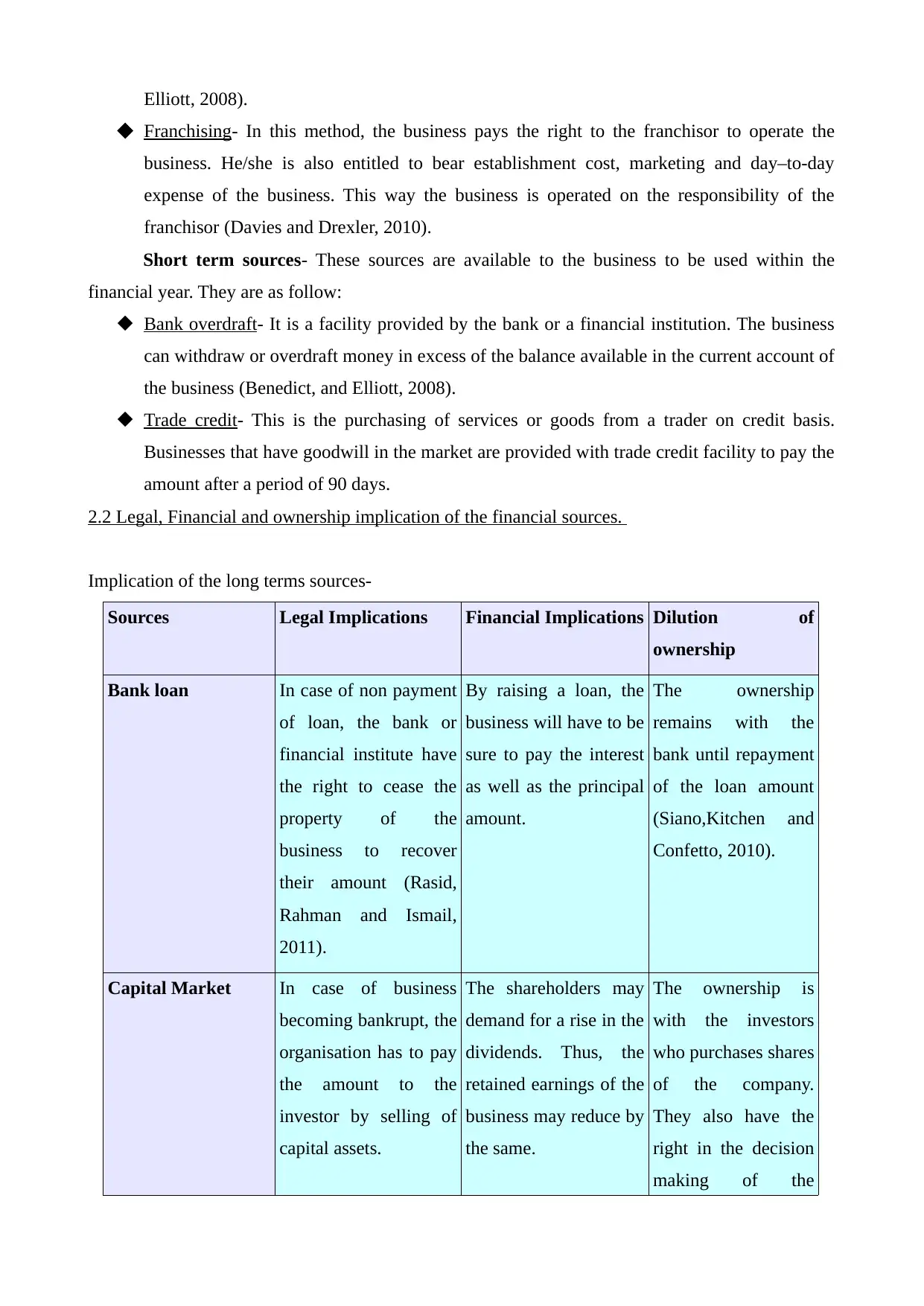
2.2 Legal, Financial and ownership implication of the financial sources.
Implication of the long terms sources-
Sources Legal Implications Financial Implications Dilution of
ownership
Bank loan In case of non payment
of loan, the bank or
financial institute have
the right to cease the
property of the
business to recover
their amount (Rasid,
Rahman and Ismail,
2011).
By raising a loan, the
business will have to be
sure to pay the interest
as well as the principal
amount.
The ownership
remains with the
bank until repayment
of the loan amount
(Siano,Kitchen and
Confetto, 2010).
Capital Market In case of business
becoming bankrupt, the
organisation has to pay
the amount to the
investor by selling of
capital assets.
The shareholders may
demand for a rise in the
dividends. Thus, the
retained earnings of the
business may reduce by
the same.
The ownership is
with the investors
who purchases shares
of the company.
They also have the
right in the decision
making of the
Franchising- In this method, the business pays the right to the franchisor to operate the
business. He/she is also entitled to bear establishment cost, marketing and day–to-day
expense of the business. This way the business is operated on the responsibility of the
franchisor (Davies and Drexler, 2010).
Short term sources- These sources are available to the business to be used within the
financial year. They are as follow:
Bank overdraft- It is a facility provided by the bank or a financial institution. The business
can withdraw or overdraft money in excess of the balance available in the current account of
the business (Benedict, and Elliott, 2008).
Trade credit- This is the purchasing of services or goods from a trader on credit basis.
Businesses that have goodwill in the market are provided with trade credit facility to pay the
amount after a period of 90 days.
2.2 Legal, Financial and ownership implication of the financial sources.
Implication of the long terms sources-
Sources Legal Implications Financial Implications Dilution of
ownership
Bank loan In case of non payment
of loan, the bank or
financial institute have
the right to cease the
property of the
business to recover
their amount (Rasid,
Rahman and Ismail,
2011).
By raising a loan, the
business will have to be
sure to pay the interest
as well as the principal
amount.
The ownership
remains with the
bank until repayment
of the loan amount
(Siano,Kitchen and
Confetto, 2010).
Capital Market In case of business
becoming bankrupt, the
organisation has to pay
the amount to the
investor by selling of
capital assets.
The shareholders may
demand for a rise in the
dividends. Thus, the
retained earnings of the
business may reduce by
the same.
The ownership is
with the investors
who purchases shares
of the company.
They also have the
right in the decision
making of the
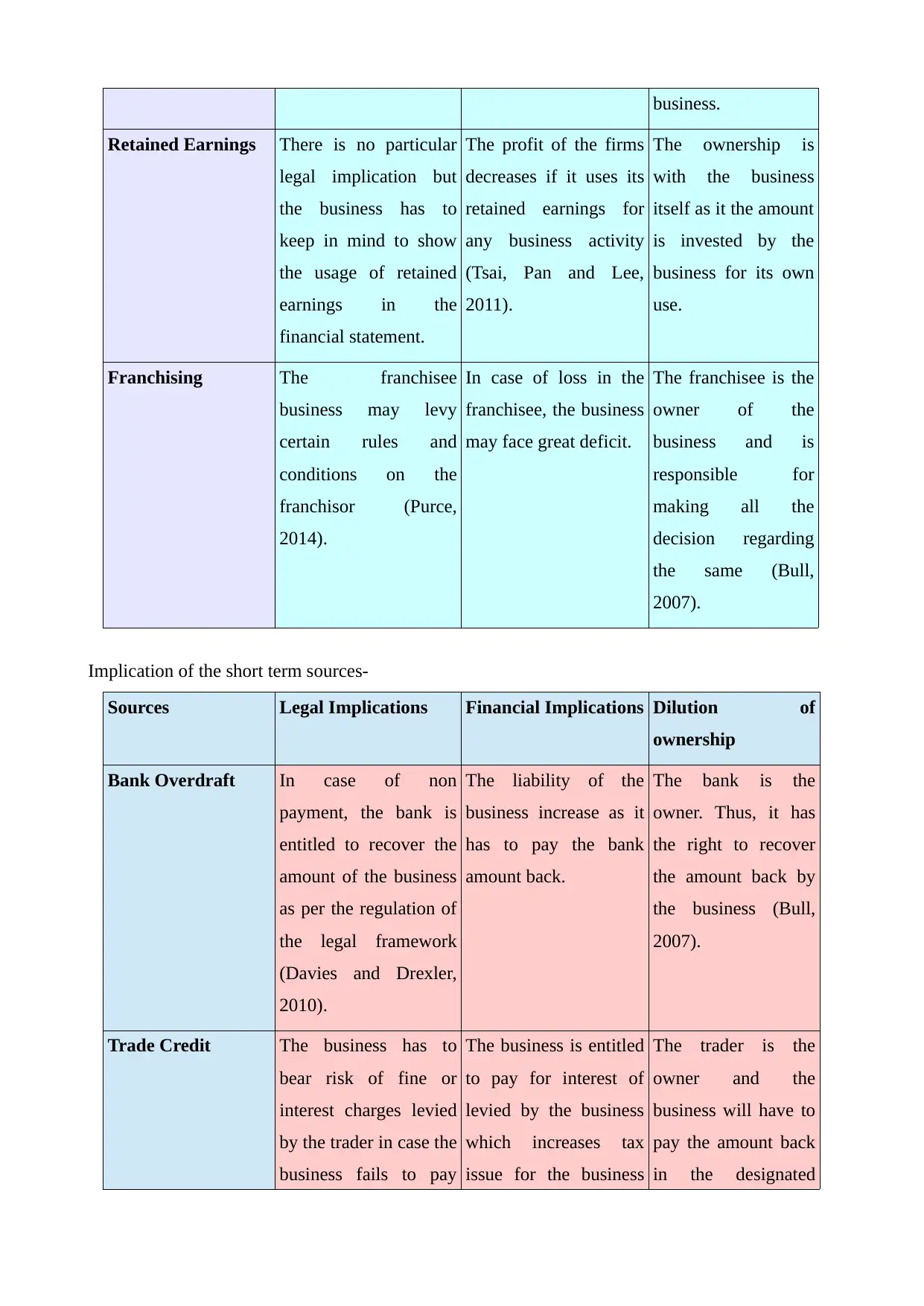
business.
Retained Earnings There is no particular
legal implication but
the business has to
keep in mind to show
the usage of retained
earnings in the
financial statement.
The profit of the firms
decreases if it uses its
retained earnings for
any business activity
(Tsai, Pan and Lee,
2011).
The ownership is
with the business
itself as it the amount
is invested by the
business for its own
use.
Franchising The franchisee
business may levy
certain rules and
conditions on the
franchisor (Purce,
2014).
In case of loss in the
franchisee, the business
may face great deficit.
The franchisee is the
owner of the
business and is
responsible for
making all the
decision regarding
the same (Bull,
2007).
Implication of the short term sources-
Sources Legal Implications Financial Implications Dilution of
ownership
Bank Overdraft In case of non
payment, the bank is
entitled to recover the
amount of the business
as per the regulation of
the legal framework
(Davies and Drexler,
2010).
The liability of the
business increase as it
has to pay the bank
amount back.
The bank is the
owner. Thus, it has
the right to recover
the amount back by
the business (Bull,
2007).
Trade Credit The business has to
bear risk of fine or
interest charges levied
by the trader in case the
business fails to pay
The business is entitled
to pay for interest of
levied by the business
which increases tax
issue for the business
The trader is the
owner and the
business will have to
pay the amount back
in the designated
Retained Earnings There is no particular
legal implication but
the business has to
keep in mind to show
the usage of retained
earnings in the
financial statement.
The profit of the firms
decreases if it uses its
retained earnings for
any business activity
(Tsai, Pan and Lee,
2011).
The ownership is
with the business
itself as it the amount
is invested by the
business for its own
use.
Franchising The franchisee
business may levy
certain rules and
conditions on the
franchisor (Purce,
2014).
In case of loss in the
franchisee, the business
may face great deficit.
The franchisee is the
owner of the
business and is
responsible for
making all the
decision regarding
the same (Bull,
2007).
Implication of the short term sources-
Sources Legal Implications Financial Implications Dilution of
ownership
Bank Overdraft In case of non
payment, the bank is
entitled to recover the
amount of the business
as per the regulation of
the legal framework
(Davies and Drexler,
2010).
The liability of the
business increase as it
has to pay the bank
amount back.
The bank is the
owner. Thus, it has
the right to recover
the amount back by
the business (Bull,
2007).
Trade Credit The business has to
bear risk of fine or
interest charges levied
by the trader in case the
business fails to pay
The business is entitled
to pay for interest of
levied by the business
which increases tax
issue for the business
The trader is the
owner and the
business will have to
pay the amount back
in the designated
⊘ This is a preview!⊘
Do you want full access?
Subscribe today to unlock all pages.
Trusted by 1+ million students worldwide
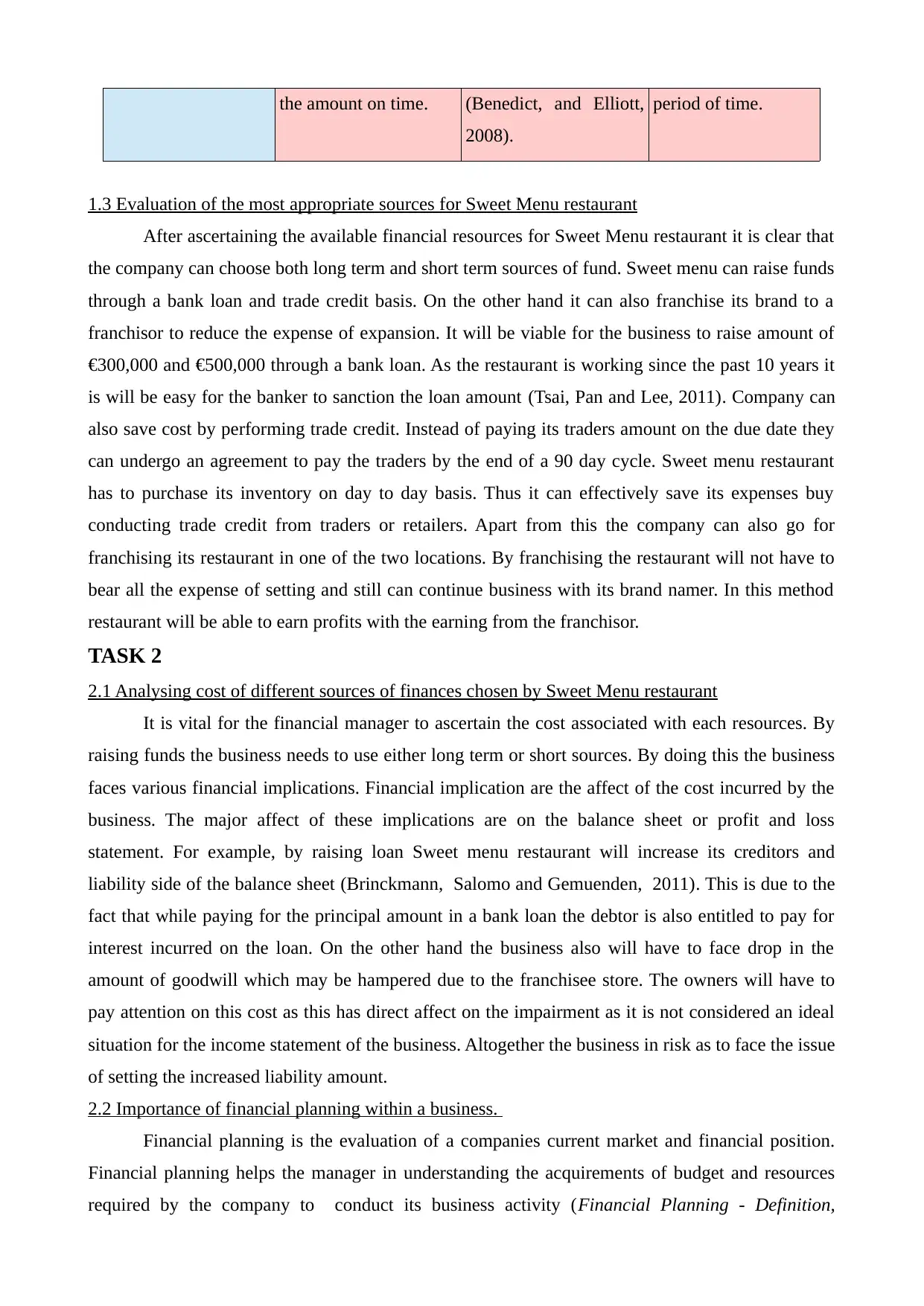
the amount on time. (Benedict, and Elliott,
2008).
period of time.
1.3 Evaluation of the most appropriate sources for Sweet Menu restaurant
After ascertaining the available financial resources for Sweet Menu restaurant it is clear that
the company can choose both long term and short term sources of fund. Sweet menu can raise funds
through a bank loan and trade credit basis. On the other hand it can also franchise its brand to a
franchisor to reduce the expense of expansion. It will be viable for the business to raise amount of
€300,000 and €500,000 through a bank loan. As the restaurant is working since the past 10 years it
is will be easy for the banker to sanction the loan amount (Tsai, Pan and Lee, 2011). Company can
also save cost by performing trade credit. Instead of paying its traders amount on the due date they
can undergo an agreement to pay the traders by the end of a 90 day cycle. Sweet menu restaurant
has to purchase its inventory on day to day basis. Thus it can effectively save its expenses buy
conducting trade credit from traders or retailers. Apart from this the company can also go for
franchising its restaurant in one of the two locations. By franchising the restaurant will not have to
bear all the expense of setting and still can continue business with its brand namer. In this method
restaurant will be able to earn profits with the earning from the franchisor.
TASK 2
2.1 Analysing cost of different sources of finances chosen by Sweet Menu restaurant
It is vital for the financial manager to ascertain the cost associated with each resources. By
raising funds the business needs to use either long term or short sources. By doing this the business
faces various financial implications. Financial implication are the affect of the cost incurred by the
business. The major affect of these implications are on the balance sheet or profit and loss
statement. For example, by raising loan Sweet menu restaurant will increase its creditors and
liability side of the balance sheet (Brinckmann, Salomo and Gemuenden, 2011). This is due to the
fact that while paying for the principal amount in a bank loan the debtor is also entitled to pay for
interest incurred on the loan. On the other hand the business also will have to face drop in the
amount of goodwill which may be hampered due to the franchisee store. The owners will have to
pay attention on this cost as this has direct affect on the impairment as it is not considered an ideal
situation for the income statement of the business. Altogether the business in risk as to face the issue
of setting the increased liability amount.
2.2 Importance of financial planning within a business.
Financial planning is the evaluation of a companies current market and financial position.
Financial planning helps the manager in understanding the acquirements of budget and resources
required by the company to conduct its business activity (Financial Planning - Definition,
2008).
period of time.
1.3 Evaluation of the most appropriate sources for Sweet Menu restaurant
After ascertaining the available financial resources for Sweet Menu restaurant it is clear that
the company can choose both long term and short term sources of fund. Sweet menu can raise funds
through a bank loan and trade credit basis. On the other hand it can also franchise its brand to a
franchisor to reduce the expense of expansion. It will be viable for the business to raise amount of
€300,000 and €500,000 through a bank loan. As the restaurant is working since the past 10 years it
is will be easy for the banker to sanction the loan amount (Tsai, Pan and Lee, 2011). Company can
also save cost by performing trade credit. Instead of paying its traders amount on the due date they
can undergo an agreement to pay the traders by the end of a 90 day cycle. Sweet menu restaurant
has to purchase its inventory on day to day basis. Thus it can effectively save its expenses buy
conducting trade credit from traders or retailers. Apart from this the company can also go for
franchising its restaurant in one of the two locations. By franchising the restaurant will not have to
bear all the expense of setting and still can continue business with its brand namer. In this method
restaurant will be able to earn profits with the earning from the franchisor.
TASK 2
2.1 Analysing cost of different sources of finances chosen by Sweet Menu restaurant
It is vital for the financial manager to ascertain the cost associated with each resources. By
raising funds the business needs to use either long term or short sources. By doing this the business
faces various financial implications. Financial implication are the affect of the cost incurred by the
business. The major affect of these implications are on the balance sheet or profit and loss
statement. For example, by raising loan Sweet menu restaurant will increase its creditors and
liability side of the balance sheet (Brinckmann, Salomo and Gemuenden, 2011). This is due to the
fact that while paying for the principal amount in a bank loan the debtor is also entitled to pay for
interest incurred on the loan. On the other hand the business also will have to face drop in the
amount of goodwill which may be hampered due to the franchisee store. The owners will have to
pay attention on this cost as this has direct affect on the impairment as it is not considered an ideal
situation for the income statement of the business. Altogether the business in risk as to face the issue
of setting the increased liability amount.
2.2 Importance of financial planning within a business.
Financial planning is the evaluation of a companies current market and financial position.
Financial planning helps the manager in understanding the acquirements of budget and resources
required by the company to conduct its business activity (Financial Planning - Definition,
Paraphrase This Document
Need a fresh take? Get an instant paraphrase of this document with our AI Paraphraser
Objectives and Importance, 2016). With the help of planning the company can allocate financial
resources to various types of expenses that incur in the business. The importance of financial
planning is described as below-
Financial planning is an effective tool in identifying the flow of cash. The manager is able to
make a balance between outflow and inflow of cash in the organisation. This assists the
manager in maintaining the stability of the business activities (Lusardi and Mitchell, 2011).
By properly planning the financial requirements of the business. The manager can ensure
about the current availability of funds for the organisation. It can only be done by pre
planning and finding activities that may require financial help in the near future.
Allocation and procurement of resources can be evaluated with the help of financial
planning. The business can identify proper utilisation of its financial resource by the
employees through financial planning (Bonham, 2008).
Financial planning provides various tools and techniques to assist the business in making
right choices while investing. The business at many times is required to invest its money
internally as well as externally. By planning the manager can ascertain ass to where return in
investment will be higher.
Financial planning helps in making the right decision for the business. The manager is able
to effectively understand the financial position of the business by proper planning (Shaoul,
Stafford and Stapleton, 2010). This helps the business in achieving better results and
increase the performance of the activities.
2.3 Assessment of information needs of decision makers
Decision makers are this individual or parties who have a superior authority over the
decision making process of the company. Stakeholders like the employees, suppliers, customer's
and competitors are the major stakeholders. They are as followed.
Employee's- The employees or the staff working at the Sweet menu restaurant among the
key decision makers. They provide various suggestions and ideas to the management (Boyd,
Dyhr Ulrich and Hollensen, S2012). The brand image of the business depends on the
customer service employee's generate. The restaurant responsible to provide with the
financial information to the employees in order to motivate them and increase their loyalty
with the business.
Supplier's- The restaurant must maintain cordial relationship with the suppliers. They must
be given information regarding their payment on timely basis. It is important for the
business to make timely payments to them so as to maintain trust worthiness among the
suppliers like the itinerary items of Sweet menu.
Customer's- They are among the most important decision makers (Jara and Ebrero, Zapata,
resources to various types of expenses that incur in the business. The importance of financial
planning is described as below-
Financial planning is an effective tool in identifying the flow of cash. The manager is able to
make a balance between outflow and inflow of cash in the organisation. This assists the
manager in maintaining the stability of the business activities (Lusardi and Mitchell, 2011).
By properly planning the financial requirements of the business. The manager can ensure
about the current availability of funds for the organisation. It can only be done by pre
planning and finding activities that may require financial help in the near future.
Allocation and procurement of resources can be evaluated with the help of financial
planning. The business can identify proper utilisation of its financial resource by the
employees through financial planning (Bonham, 2008).
Financial planning provides various tools and techniques to assist the business in making
right choices while investing. The business at many times is required to invest its money
internally as well as externally. By planning the manager can ascertain ass to where return in
investment will be higher.
Financial planning helps in making the right decision for the business. The manager is able
to effectively understand the financial position of the business by proper planning (Shaoul,
Stafford and Stapleton, 2010). This helps the business in achieving better results and
increase the performance of the activities.
2.3 Assessment of information needs of decision makers
Decision makers are this individual or parties who have a superior authority over the
decision making process of the company. Stakeholders like the employees, suppliers, customer's
and competitors are the major stakeholders. They are as followed.
Employee's- The employees or the staff working at the Sweet menu restaurant among the
key decision makers. They provide various suggestions and ideas to the management (Boyd,
Dyhr Ulrich and Hollensen, S2012). The brand image of the business depends on the
customer service employee's generate. The restaurant responsible to provide with the
financial information to the employees in order to motivate them and increase their loyalty
with the business.
Supplier's- The restaurant must maintain cordial relationship with the suppliers. They must
be given information regarding their payment on timely basis. It is important for the
business to make timely payments to them so as to maintain trust worthiness among the
suppliers like the itinerary items of Sweet menu.
Customer's- They are among the most important decision makers (Jara and Ebrero, Zapata,
2011). The business must highlight in media about its goodwill and achievement and
financial information like profit earned by the restaurant. This way Sweet Menu can raise
customers interest and increase its customer support in two new locations.
Competitor's- They are the external factors that affect the decision making of the
restaurant. The management at Sweet menu restaurant is required to make alterations in its
pricing policies s per its competitors.
2.4 Impact of finance on the financial statements
Financial decision have an impact on the ability of the business to get finances for its
business activities. The finances accessible to Sweet menu restaurant also created an impact on the
financial statement of the business. In order to expand business to two new locations the business
requires to raise finances. This shows that the company has dis-balance in its capital structure as it
has to raise money through bank loan (Mayne and Zapico-Goni, 2007). The liability of the company
rises due to taking credit from the bank as well as the trader. The goodwill of the company also
hampers as it has to take credit from its suppliers and traders. It shows that the company is short in
finance and also this can destroy the cordial relationship with the traders of Sweet menu restaurant.
Due to high interest levied on the loan the profit of the company reduces. This is not considered as
an ideal for any business. The business brand image depletes due to low earning and profit. As the
restaurant is in liability to pat for the interest and creditors its balance sheet also looks disoriented.
TASK 3
3.1 Analysing budget and recommending
Budget analysis is to evaluate the budget generated by the financial manager of the
company. Budget analysis helps in identifying the loopholes faced by expenses and deficits in the
business. From the budget made by the accountant it is clear that the business is doing good while
making cash in sale. This shows that the business is not facing any issue through credit sales
(Nickel, Saldanha-da-Gama and Ziegler, 2012). On the other hand the expenses of the business are
more then the income earned by the business. This is evident that in the month of December
specifically business had to face greatest negative net balance. Apart from this each month
company is facing losses instead of making profits, the Blue Island restaurant needs to reduce its
expenses. It was observed that the restaurant has to expend money on furnitures and fittings which
is considered as a huge wastage of money. Despite of this company can purchase furniture made of
plastic which does not deplete and last longer. Apart from this the restaurant can also improve its
infrastructure by introducing more natural light in the restaurant. This will help in reducing the
expense incurred on the lighting bills. From the trade payables statement it is clear that the company
can reduce cost on purchasing inventory from its suppliers (Davies and Drexler, 2010). The
company can find new wholesaler who provide quality product in a lower cost in comparison to the
financial information like profit earned by the restaurant. This way Sweet Menu can raise
customers interest and increase its customer support in two new locations.
Competitor's- They are the external factors that affect the decision making of the
restaurant. The management at Sweet menu restaurant is required to make alterations in its
pricing policies s per its competitors.
2.4 Impact of finance on the financial statements
Financial decision have an impact on the ability of the business to get finances for its
business activities. The finances accessible to Sweet menu restaurant also created an impact on the
financial statement of the business. In order to expand business to two new locations the business
requires to raise finances. This shows that the company has dis-balance in its capital structure as it
has to raise money through bank loan (Mayne and Zapico-Goni, 2007). The liability of the company
rises due to taking credit from the bank as well as the trader. The goodwill of the company also
hampers as it has to take credit from its suppliers and traders. It shows that the company is short in
finance and also this can destroy the cordial relationship with the traders of Sweet menu restaurant.
Due to high interest levied on the loan the profit of the company reduces. This is not considered as
an ideal for any business. The business brand image depletes due to low earning and profit. As the
restaurant is in liability to pat for the interest and creditors its balance sheet also looks disoriented.
TASK 3
3.1 Analysing budget and recommending
Budget analysis is to evaluate the budget generated by the financial manager of the
company. Budget analysis helps in identifying the loopholes faced by expenses and deficits in the
business. From the budget made by the accountant it is clear that the business is doing good while
making cash in sale. This shows that the business is not facing any issue through credit sales
(Nickel, Saldanha-da-Gama and Ziegler, 2012). On the other hand the expenses of the business are
more then the income earned by the business. This is evident that in the month of December
specifically business had to face greatest negative net balance. Apart from this each month
company is facing losses instead of making profits, the Blue Island restaurant needs to reduce its
expenses. It was observed that the restaurant has to expend money on furnitures and fittings which
is considered as a huge wastage of money. Despite of this company can purchase furniture made of
plastic which does not deplete and last longer. Apart from this the restaurant can also improve its
infrastructure by introducing more natural light in the restaurant. This will help in reducing the
expense incurred on the lighting bills. From the trade payables statement it is clear that the company
can reduce cost on purchasing inventory from its suppliers (Davies and Drexler, 2010). The
company can find new wholesaler who provide quality product in a lower cost in comparison to the
⊘ This is a preview!⊘
Do you want full access?
Subscribe today to unlock all pages.
Trusted by 1+ million students worldwide
other suppliers.
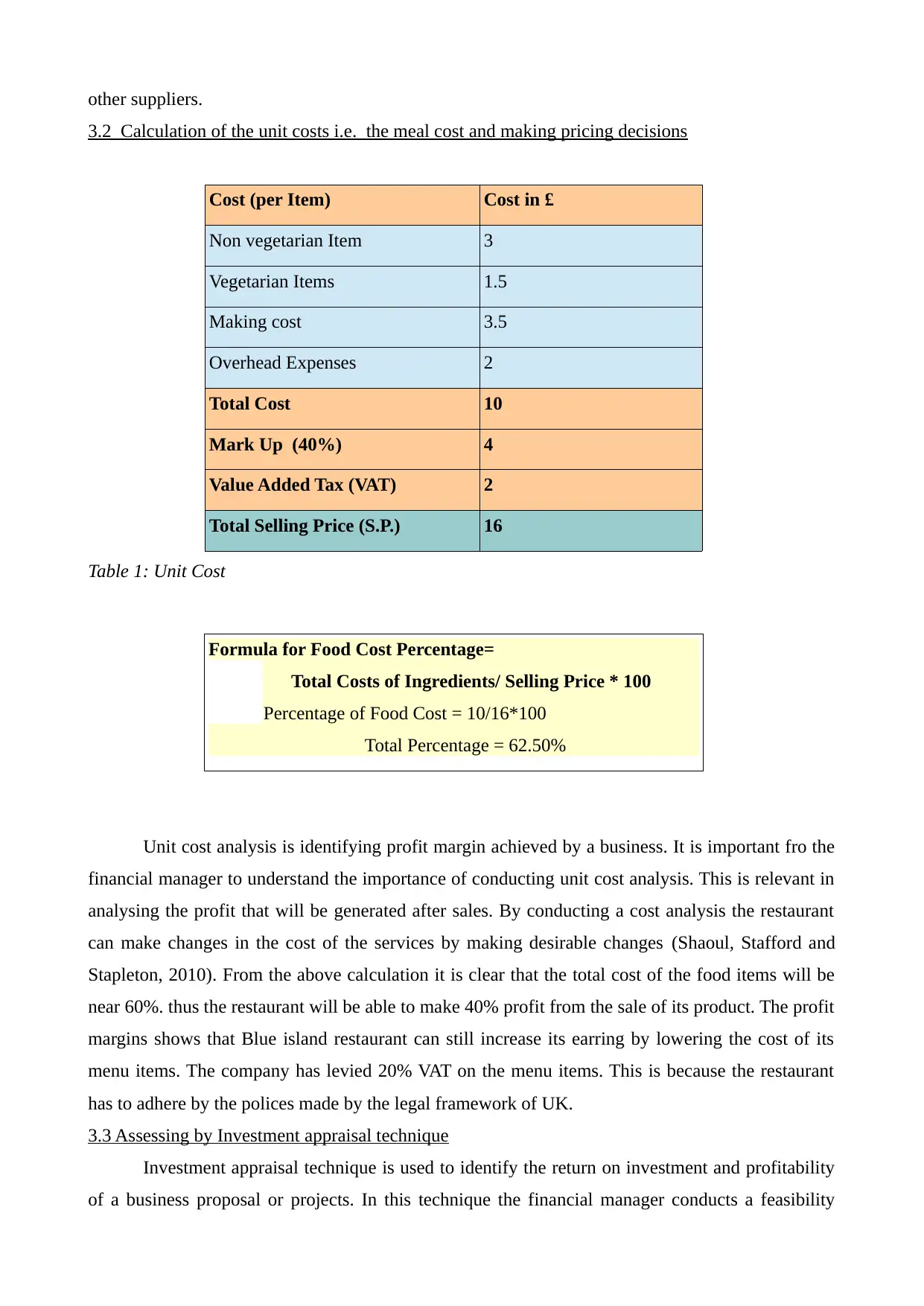
3.2 Calculation of the unit costs i.e. the meal cost and making pricing decisions
Cost (per Item) Cost in £
Non vegetarian Item 3
Vegetarian Items 1.5
Making cost 3.5
Overhead Expenses 2
Total Cost 10
Mark Up (40%) 4
Value Added Tax (VAT) 2
Total Selling Price (S.P.) 16
Table 1: Unit Cost
Formula for Food Cost Percentage=
Total Costs of Ingredients/ Selling Price * 100
Percentage of Food Cost = 10/16*100
Total Percentage = 62.50%
Unit cost analysis is identifying profit margin achieved by a business. It is important fro the
financial manager to understand the importance of conducting unit cost analysis. This is relevant in
analysing the profit that will be generated after sales. By conducting a cost analysis the restaurant
can make changes in the cost of the services by making desirable changes (Shaoul, Stafford and
Stapleton, 2010). From the above calculation it is clear that the total cost of the food items will be
near 60%. thus the restaurant will be able to make 40% profit from the sale of its product. The profit
margins shows that Blue island restaurant can still increase its earring by lowering the cost of its
menu items. The company has levied 20% VAT on the menu items. This is because the restaurant
has to adhere by the polices made by the legal framework of UK.
3.3 Assessing by Investment appraisal technique
Investment appraisal technique is used to identify the return on investment and profitability
of a business proposal or projects. In this technique the financial manager conducts a feasibility
3.2 Calculation of the unit costs i.e. the meal cost and making pricing decisions
Cost (per Item) Cost in £
Non vegetarian Item 3
Vegetarian Items 1.5
Making cost 3.5
Overhead Expenses 2
Total Cost 10
Mark Up (40%) 4
Value Added Tax (VAT) 2
Total Selling Price (S.P.) 16
Table 1: Unit Cost
Formula for Food Cost Percentage=
Total Costs of Ingredients/ Selling Price * 100
Percentage of Food Cost = 10/16*100
Total Percentage = 62.50%
Unit cost analysis is identifying profit margin achieved by a business. It is important fro the
financial manager to understand the importance of conducting unit cost analysis. This is relevant in
analysing the profit that will be generated after sales. By conducting a cost analysis the restaurant
can make changes in the cost of the services by making desirable changes (Shaoul, Stafford and
Stapleton, 2010). From the above calculation it is clear that the total cost of the food items will be
near 60%. thus the restaurant will be able to make 40% profit from the sale of its product. The profit
margins shows that Blue island restaurant can still increase its earring by lowering the cost of its
menu items. The company has levied 20% VAT on the menu items. This is because the restaurant
has to adhere by the polices made by the legal framework of UK.
3.3 Assessing by Investment appraisal technique
Investment appraisal technique is used to identify the return on investment and profitability
of a business proposal or projects. In this technique the financial manager conducts a feasibility
Paraphrase This Document
Need a fresh take? Get an instant paraphrase of this document with our AI Paraphraser
through Net Present value and Pay Back Period (Tsai, Pan and Lee, 2011). It is important for a
business to conduct this technique to identify the feasibility and viability of the business options
available for the business.
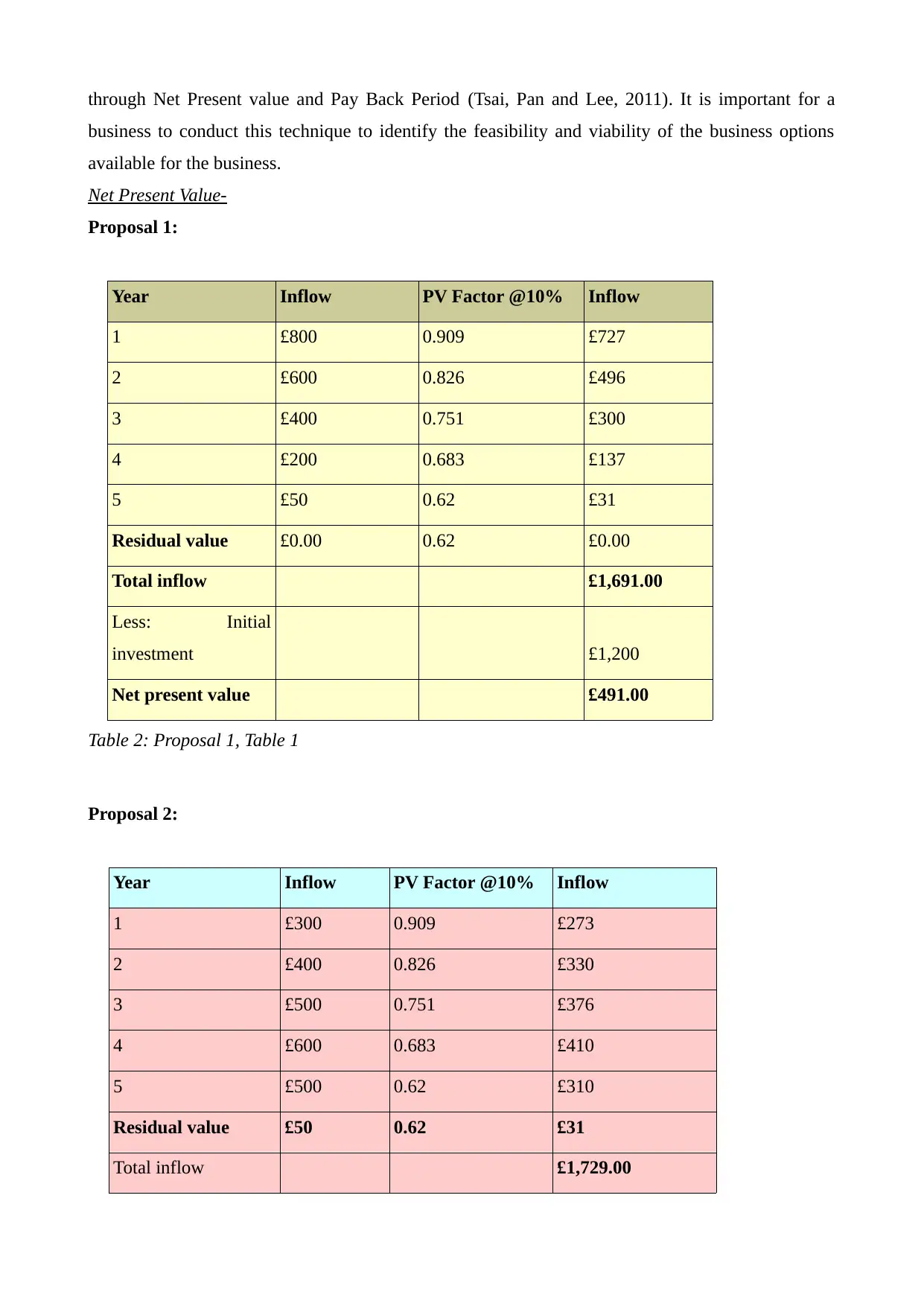
Net Present Value-
Proposal 1:
Year Inflow PV Factor @10% Inflow
1 £800 0.909 £727
2 £600 0.826 £496
3 £400 0.751 £300
4 £200 0.683 £137
5 £50 0.62 £31
Residual value £0.00 0.62 £0.00
Total inflow £1,691.00
Less: Initial
investment £1,200
Net present value £491.00
Table 2: Proposal 1, Table 1
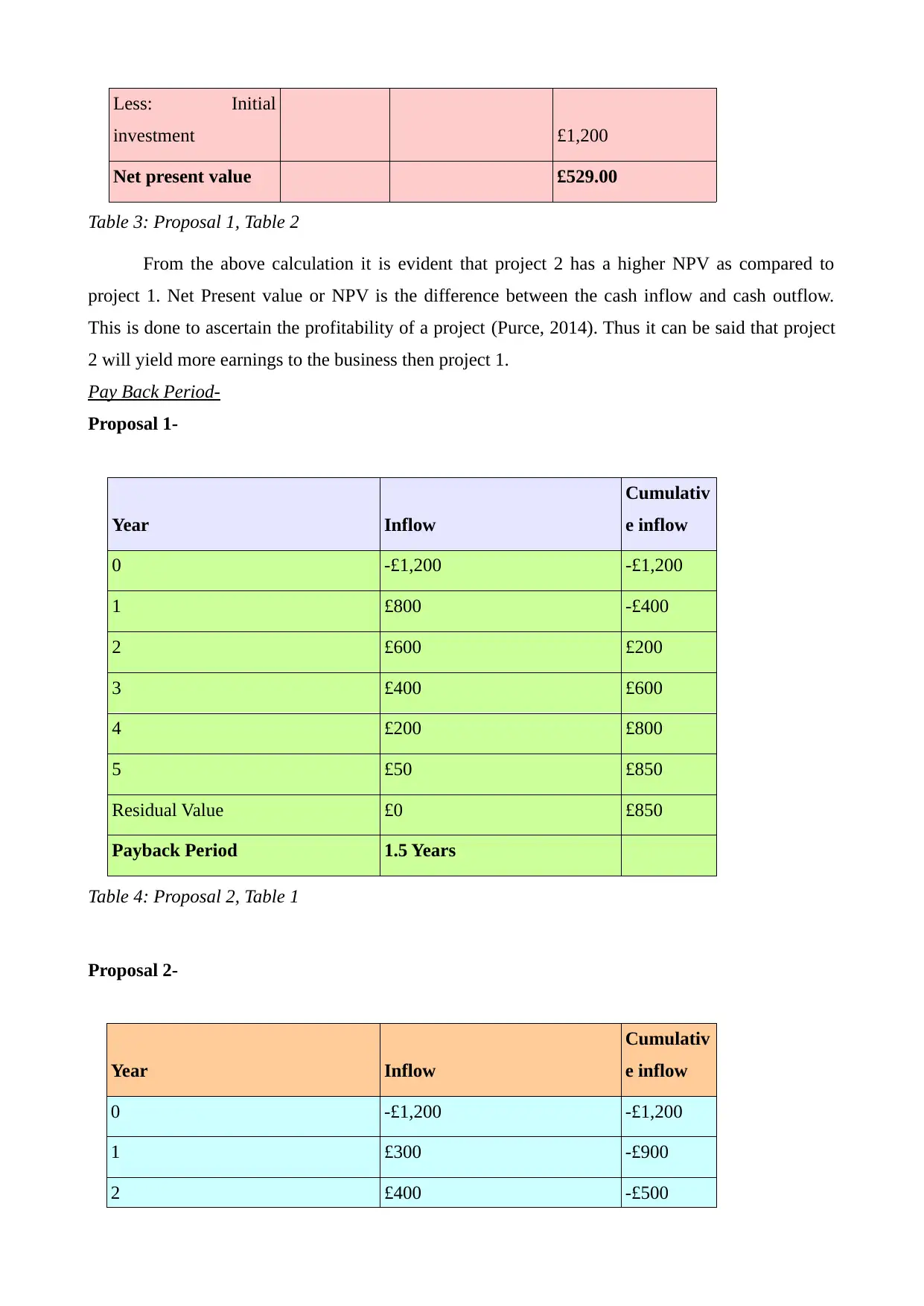
Proposal 2:
Year Inflow PV Factor @10% Inflow
1 £300 0.909 £273
2 £400 0.826 £330
3 £500 0.751 £376
4 £600 0.683 £410
5 £500 0.62 £310
Residual value £50 0.62 £31
Total inflow £1,729.00
business to conduct this technique to identify the feasibility and viability of the business options
available for the business.
Net Present Value-
Proposal 1:
Year Inflow PV Factor @10% Inflow
1 £800 0.909 £727
2 £600 0.826 £496
3 £400 0.751 £300
4 £200 0.683 £137
5 £50 0.62 £31
Residual value £0.00 0.62 £0.00
Total inflow £1,691.00
Less: Initial
investment £1,200
Net present value £491.00
Table 2: Proposal 1, Table 1
Proposal 2:
Year Inflow PV Factor @10% Inflow
1 £300 0.909 £273
2 £400 0.826 £330
3 £500 0.751 £376
4 £600 0.683 £410
5 £500 0.62 £310
Residual value £50 0.62 £31
Total inflow £1,729.00
Less: Initial
investment £1,200
Net present value £529.00
Table 3: Proposal 1, Table 2
From the above calculation it is evident that project 2 has a higher NPV as compared to
project 1. Net Present value or NPV is the difference between the cash inflow and cash outflow.
This is done to ascertain the profitability of a project (Purce, 2014). Thus it can be said that project
2 will yield more earnings to the business then project 1.
Pay Back Period-
Proposal 1-
Year Inflow
Cumulativ
e inflow
0 -£1,200 -£1,200
1 £800 -£400
2 £600 £200
3 £400 £600
4 £200 £800
5 £50 £850
Residual Value £0 £850
Payback Period 1.5 Years
Table 4: Proposal 2, Table 1
Proposal 2-
Year Inflow
Cumulativ
e inflow
0 -£1,200 -£1,200
1 £300 -£900
2 £400 -£500
investment £1,200
Net present value £529.00
Table 3: Proposal 1, Table 2
From the above calculation it is evident that project 2 has a higher NPV as compared to
project 1. Net Present value or NPV is the difference between the cash inflow and cash outflow.
This is done to ascertain the profitability of a project (Purce, 2014). Thus it can be said that project
2 will yield more earnings to the business then project 1.
Pay Back Period-
Proposal 1-
Year Inflow
Cumulativ
e inflow
0 -£1,200 -£1,200
1 £800 -£400
2 £600 £200
3 £400 £600
4 £200 £800
5 £50 £850
Residual Value £0 £850
Payback Period 1.5 Years
Table 4: Proposal 2, Table 1
Proposal 2-
Year Inflow
Cumulativ
e inflow
0 -£1,200 -£1,200
1 £300 -£900
2 £400 -£500
⊘ This is a preview!⊘
Do you want full access?
Subscribe today to unlock all pages.
Trusted by 1+ million students worldwide

1 out of 16


Related Documents


Your All-in-One AI-Powered Toolkit for Academic Success.
+13062052269
info@desklib.com
Available 24*7 on WhatsApp / Email
![[object Object]](/_next/static/media/star-bottom.7253800d.svg)
Unlock your academic potential
Copyright © 2020–2026 A2Z Services. All Rights Reserved. Developed and managed by ZUCOL.