2017 Assignment: System Analysis and Design for Hospital Management

Verified

Added on  2019/11/19

|10
|1702
|174
Report
AI Summary
This report provides a detailed analysis and design of a hospital management system, specifically focusing on emergency situations. It begins with an introduction highlighting the importance of efficient emergency departments and the need for improved hospital management. The research aims to address health and well-being concerns, focusing on care provided to young patients. The report includes stakeholder analysis, identifying roles and capabilities, followed by a questionnaire designed to gather insights from healthcare professionals. A work breakdown structure outlines the system's components, and the research evaluates existing studies to improve the patient experience. A use case diagram illustrates system functionalities, leading to a conclusion that emphasizes the importance of an effective information system for better patient care and hospital prosperity. The report references various studies related to emergency response, patient care, and hospital management practices. The report also includes a detailed analysis of the factors which are responsible for developing an advanced information system for the hospital management program to enhance the working condition.
Document Page
Assignment
System analysis and design 2017
tabler-icon-diamond-filled.svg

Paraphrase This Document

Need a fresh take? Get an instant paraphrase of this document with our AI Paraphraser
Document Page
Contents
Introduction:..........................................................................................................................................2
Research Aim:........................................................................................................................................2
Research purpose:.................................................................................................................................2
Stakeholder Analysis:.............................................................................................................................2
Questionnaire:.......................................................................................................................................4
Work Breakdown structure:..................................................................................................................5
Evaluation of the Research studies:.......................................................................................................6
Use case diagram:..................................................................................................................................8
Conclusion:............................................................................................................................................8
References:............................................................................................................................................9
Document Page
Introduction:
The emergency department is the most crucial zone of the hospital. The patient should be
given instant treatment. The high skilled workers, and house-keeping staff should be
appointed to provide first aid. There are some flaws in the current working scenario of the
hospital management.
Research Aim:
The aim of the research is to address health and well-being concern associated with the young
people who are provided with the holistic platform of care. “The concern is to raise the
facilities provided to the young and adolescent at the time of illness” (Raut, 2014).
Research purpose:
The purpose of the research is to improve the management of facilities provided to the patient
and gets proper attention of the hospital management staff at the time of emergency. The
focus should be given on improving the satisfaction level of the patients by providing them
instant and effective treatment.
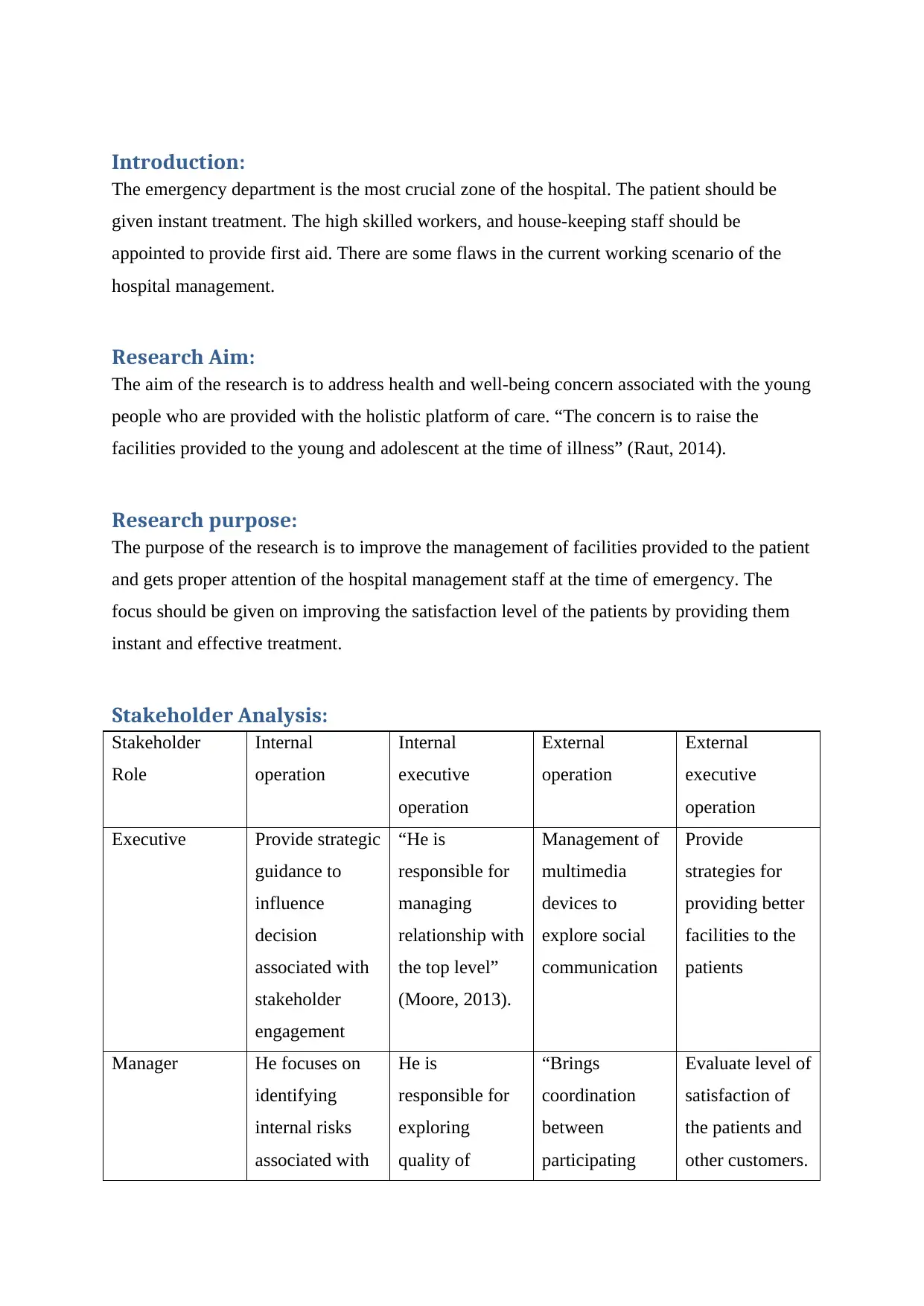
Stakeholder Analysis:
Stakeholder
Role
Internal
operation
Internal
executive
operation
External
operation
External
executive
operation
Executive Provide strategic
guidance to
influence
decision
associated with
stakeholder
engagement
“He is
responsible for
managing
relationship with
the top level”
(Moore, 2013).
Management of
multimedia
devices to
explore social
communication
Provide
strategies for
providing better
facilities to the
patients
Manager He focuses on
identifying
internal risks
associated with
He is
responsible for
exploring
quality of
“Brings
coordination
between
participating
Evaluate level of
satisfaction of
the patients and
other customers.
Document Page
the changing
working tactics
of the hospital
service provided
to the patients
units” (Delia,
2013).
Government
agencies
Establishing
network for
bringing
collaboration
with the
associated
responses.
Ensures strategic
interest in the
activities
performed for
improving the
working tactics
Establish
proactive
relationship by
implementing
multimedia
strategies
Multimedia
opportunities
gives the
positive impact
on the aligning
stakeholder
engagement
Service
Providers
Works in
managing
contracts and
service level
agreement with
the social media
paradigm
Monitoring
performance of
the new system
employed in the
working
curriculum of
the organization
Monitoring
quality and
effectiveness of
the activities
performed to
facilitates
patients in the
emergency
situation.
The reputation
of the hospital
can be
improved.
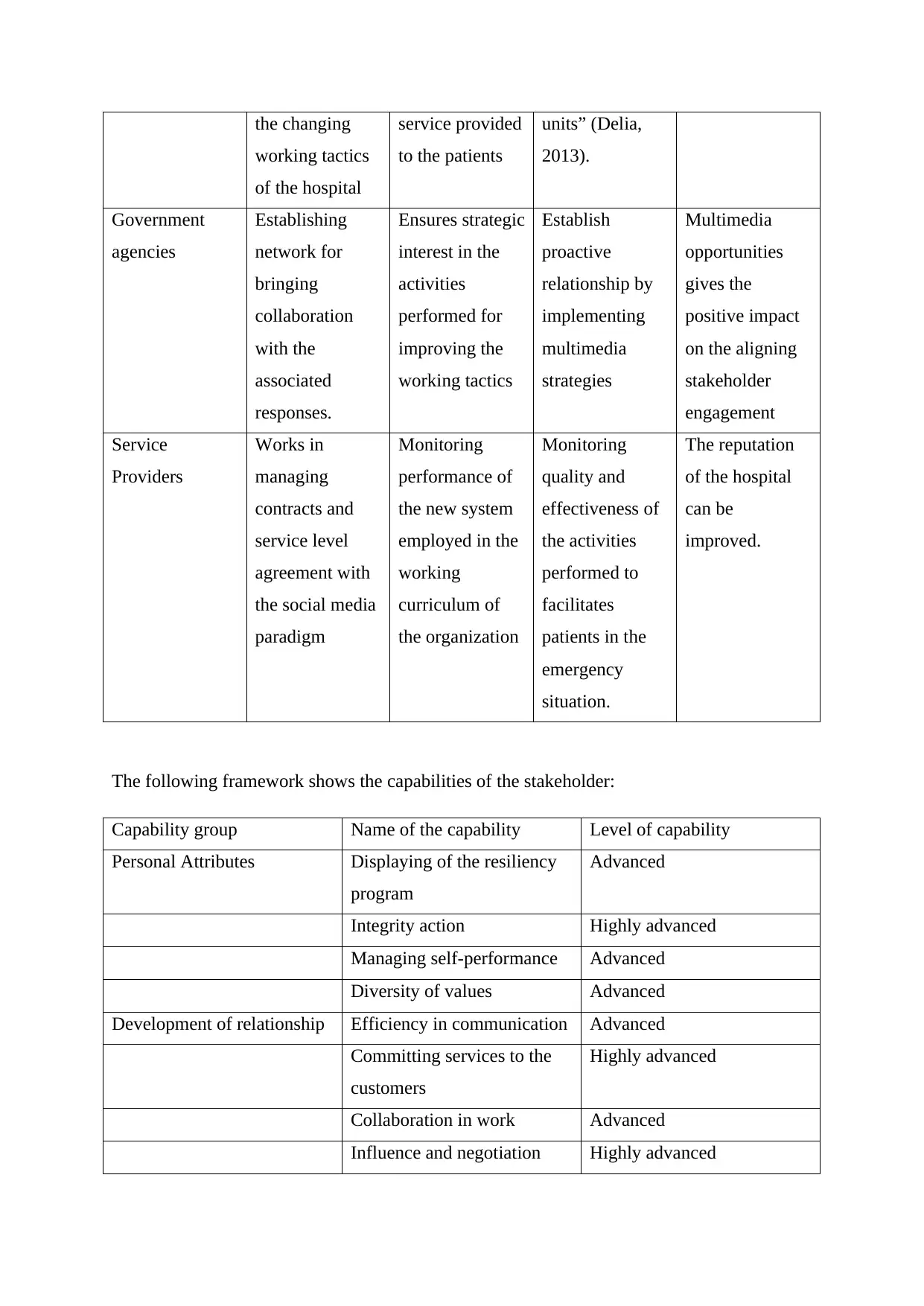
The following framework shows the capabilities of the stakeholder:
Capability group Name of the capability Level of capability
Personal Attributes Displaying of the resiliency
program
Advanced
Integrity action Highly advanced
Managing self-performance Advanced
Diversity of values Advanced
Development of relationship Efficiency in communication Advanced
Committing services to the
customers
Highly advanced
Collaboration in work Advanced
Influence and negotiation Highly advanced
tabler-icon-diamond-filled.svg

Paraphrase This Document

Need a fresh take? Get an instant paraphrase of this document with our AI Paraphraser
Document Page
Facilities provided to the
patients
“Delivering facilities”
(Wilson, 2012)
Highly advanced
Planning and prioritizing Advanced
Thinking and solving
problems
Highly advanced
Demonstrating accountability Advanced
Hospital project management Finance Highly advanced
Use of tools and technologies Highly advanced
Procurement management According to the requirement
Contract management Advanced
People management Developing and managing
patients
Advanced
Optimising facilities
provided to the customers
Advanced
Managing reforms and
changes required
Highly advanced
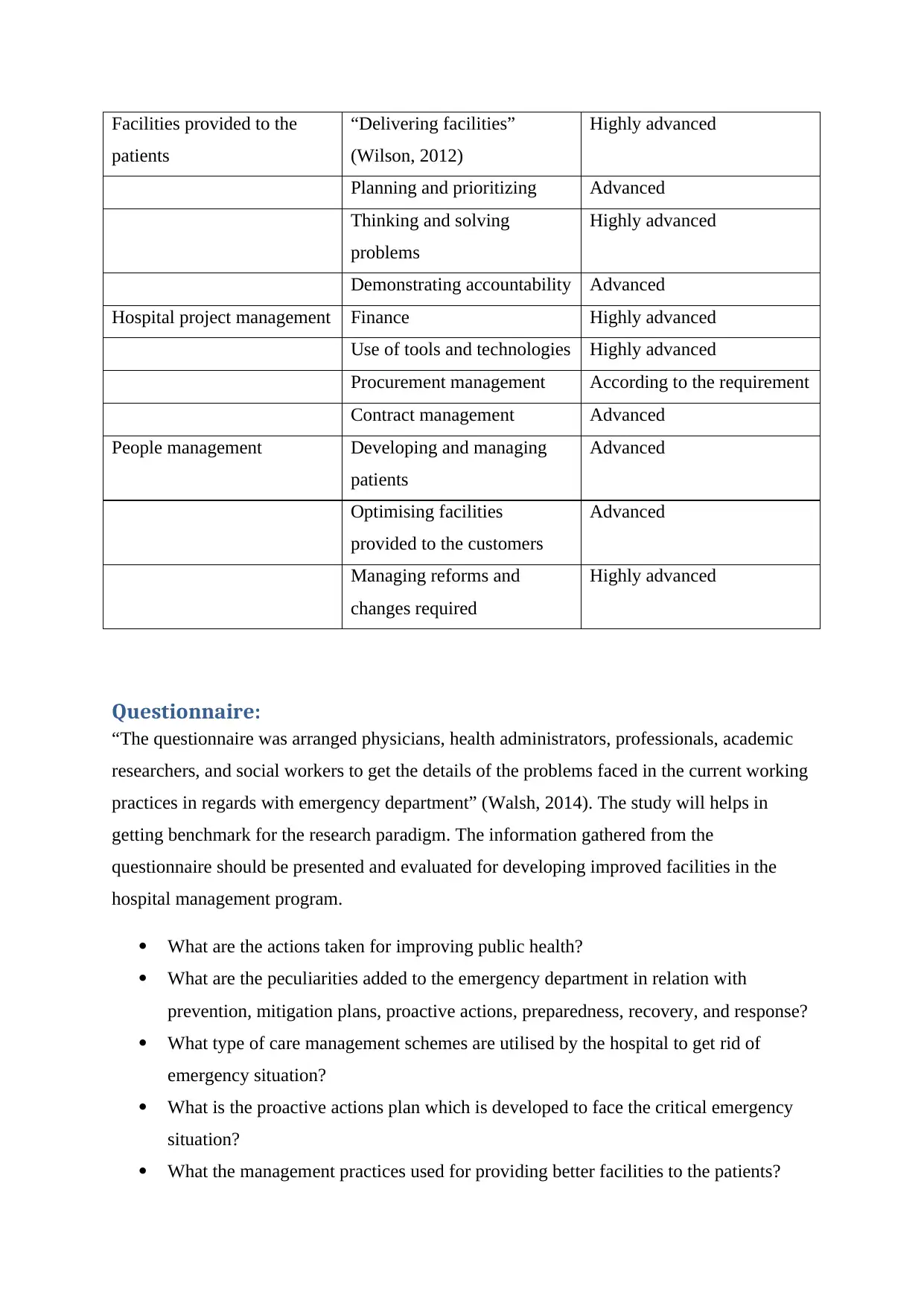
Questionnaire:
“The questionnaire was arranged physicians, health administrators, professionals, academic
researchers, and social workers to get the details of the problems faced in the current working
practices in regards with emergency department” (Walsh, 2014). The study will helps in
getting benchmark for the research paradigm. The information gathered from the
questionnaire should be presented and evaluated for developing improved facilities in the
hospital management program.
What are the actions taken for improving public health?
What are the peculiarities added to the emergency department in relation with
prevention, mitigation plans, proactive actions, preparedness, recovery, and response?
What type of care management schemes are utilised by the hospital to get rid of
emergency situation?
What is the proactive actions plan which is developed to face the critical emergency
situation?
What the management practices used for providing better facilities to the patients?
Document Page
What are the factors responsible for not providing adequate facilities to the patients in
emergency?
What steps should be taken to resolve the management issues associated with the
hospitals?
What is the measure of effectiveness of using tools and technologies to establish
improved management practices in the hospital development program?
What are the management practices should be used for integrating with the health care
system to provide improved facilities to the patient in emergency situation?
How many number of patient should be treated by the single physician at a time?
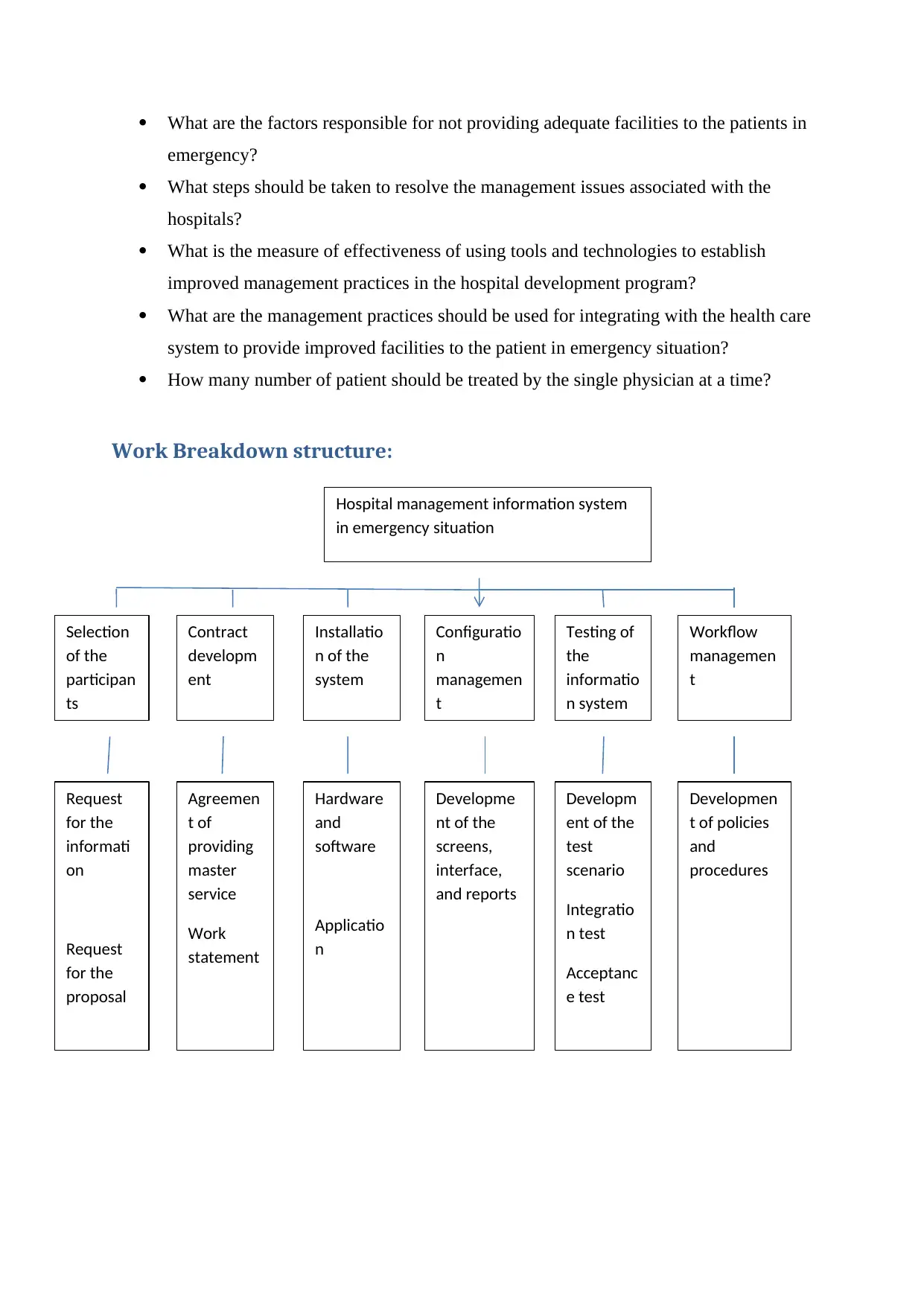
Work Breakdown structure:
Hospital management information system
in emergency situation
Selection
of the
participan
ts
Contract
developm
ent
Installatio
n of the
system
Configuratio
n
managemen
t
Testing of
the
informatio
n system
Workflow
managemen
t
Request
for the
informati
on
Request
for the
proposal
Agreemen
t of
providing
master
service
Work
statement
Hardware
and
software
Applicatio
n
Developme
nt of the
screens,
interface,
and reports
Developm
ent of the
test
scenario
Integratio
n test
Acceptanc
e test
Developmen
t of policies
and
procedures
Document Page
Evaluation of the Research studies:
From the research and survey, we analysed the patients and professionals perspective view to
improve the traditional working of the hospital system. “The focus should be given on
improving the satisfaction level of the patients by providing them instant and effective
treatment” (Hutches, 2014). The proper care should be given to the patient when they are in
critical situation such as arrangement of stretchered, wheel chairs, doctors, and house-keeping
staff. The accommodation of patient and their family members should be given privilege. The
hospital should make use of highly advanced and innovative technology for giving treatment
to the patients. The implementation of the patient perception helps in developing the
advanced information system which is capable of resolving all the issues of the patient and
increasing their confidence and satisfaction level in the hospital treatment schemes. “The
management program should be organised for managing appointments of the physician”
(Sreekala, 2015). The skilled and professional staff should be hired at the time of emergency
to provide best treatment to the patient and cure them with ease. “The positive and negative
aspect of the research should be given preference to develop the information system for
improving the present working condition of the hospitals” (Khan, 2015). There are number of
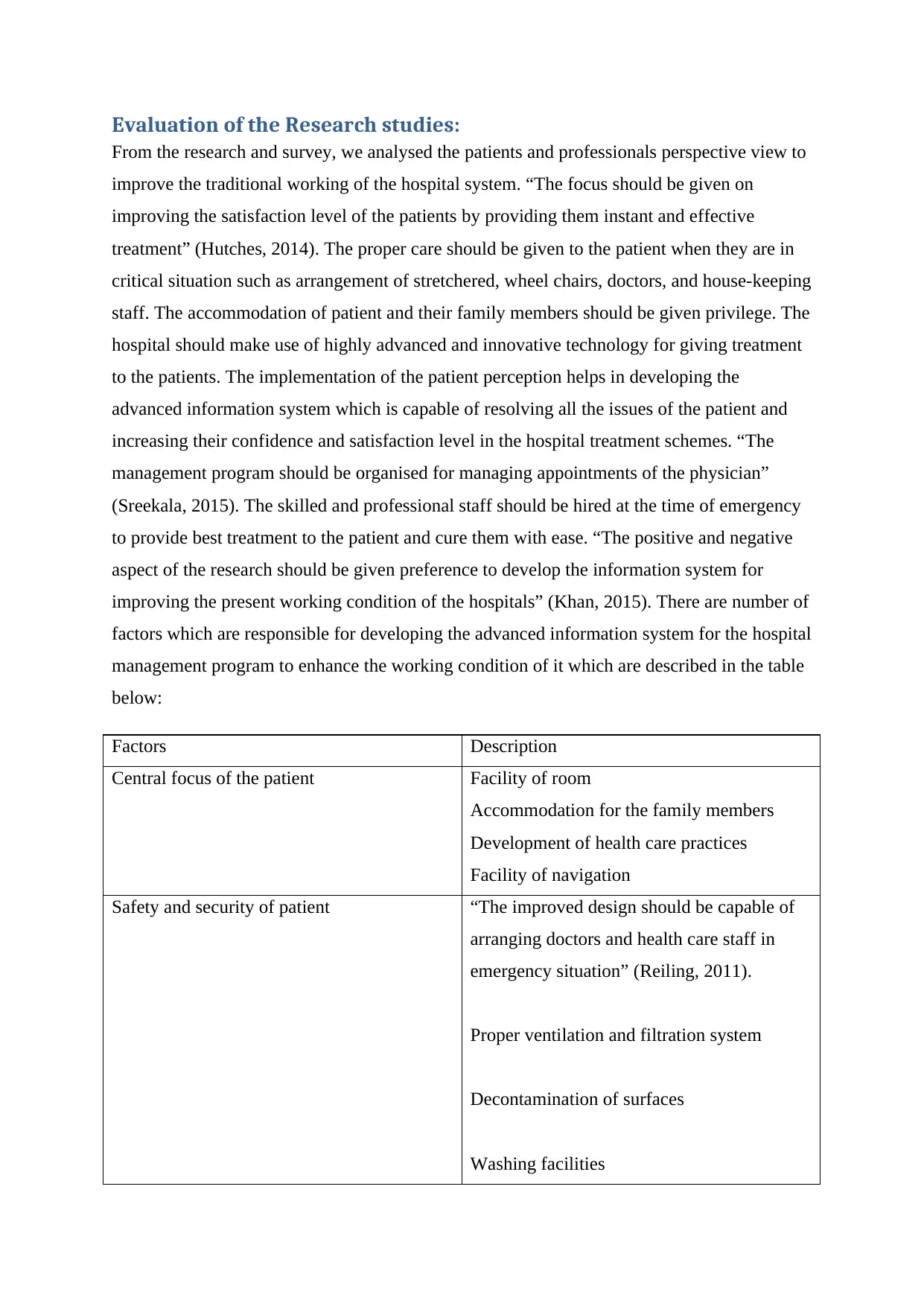
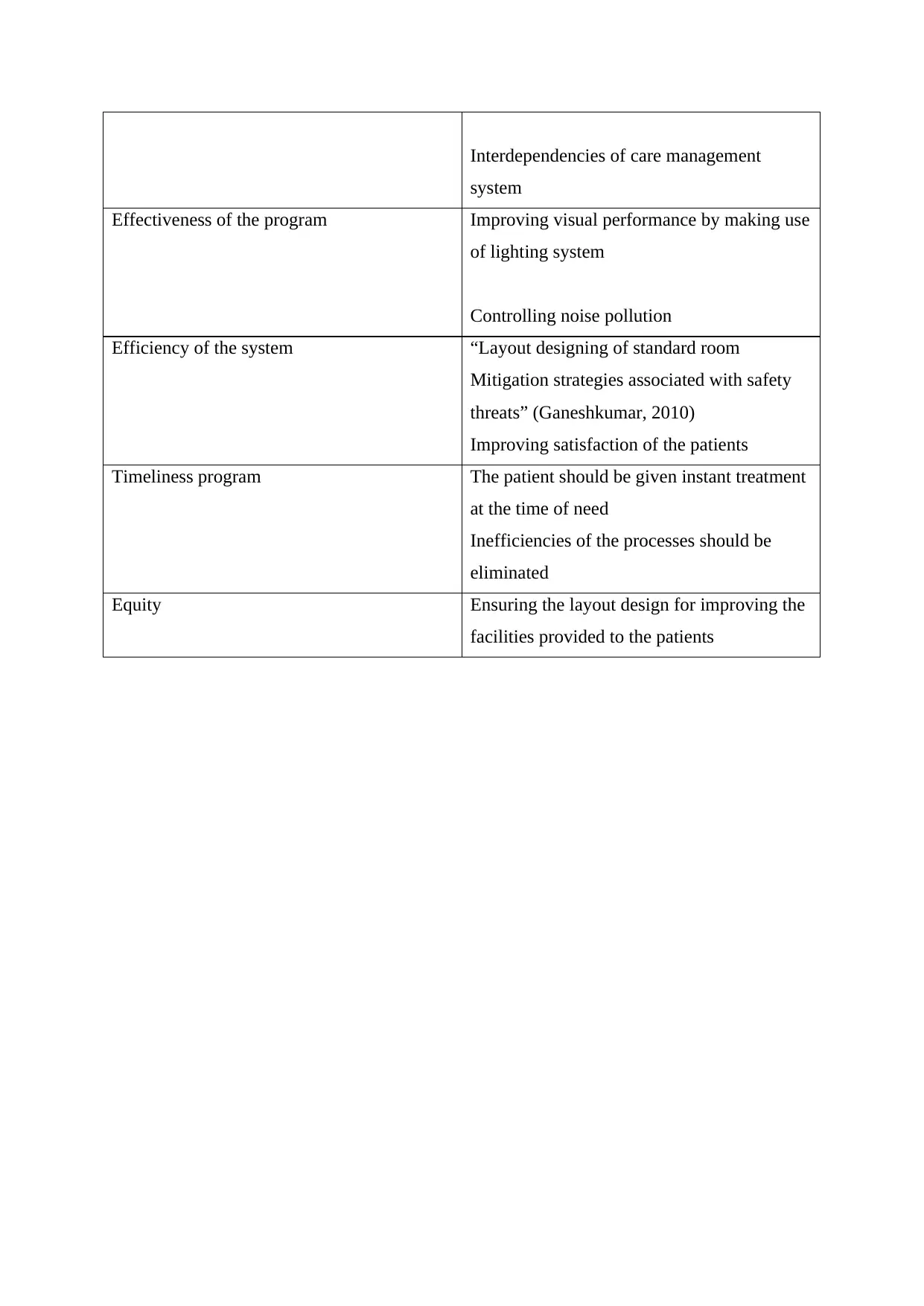
factors which are responsible for developing the advanced information system for the hospital
management program to enhance the working condition of it which are described in the table
below:
Factors Description
Central focus of the patient Facility of room
Accommodation for the family members
Development of health care practices
Facility of navigation
Safety and security of patient “The improved design should be capable of
arranging doctors and health care staff in
emergency situation” (Reiling, 2011).
Proper ventilation and filtration system
Decontamination of surfaces
Washing facilities
tabler-icon-diamond-filled.svg

Paraphrase This Document

Need a fresh take? Get an instant paraphrase of this document with our AI Paraphraser
Document Page
Interdependencies of care management
system
Effectiveness of the program Improving visual performance by making use
of lighting system
Controlling noise pollution
Efficiency of the system “Layout designing of standard room
Mitigation strategies associated with safety
threats” (Ganeshkumar, 2010)
Improving satisfaction of the patients
Timeliness program The patient should be given instant treatment
at the time of need
Inefficiencies of the processes should be
eliminated
Equity Ensuring the layout design for improving the
facilities provided to the patients
Document Page
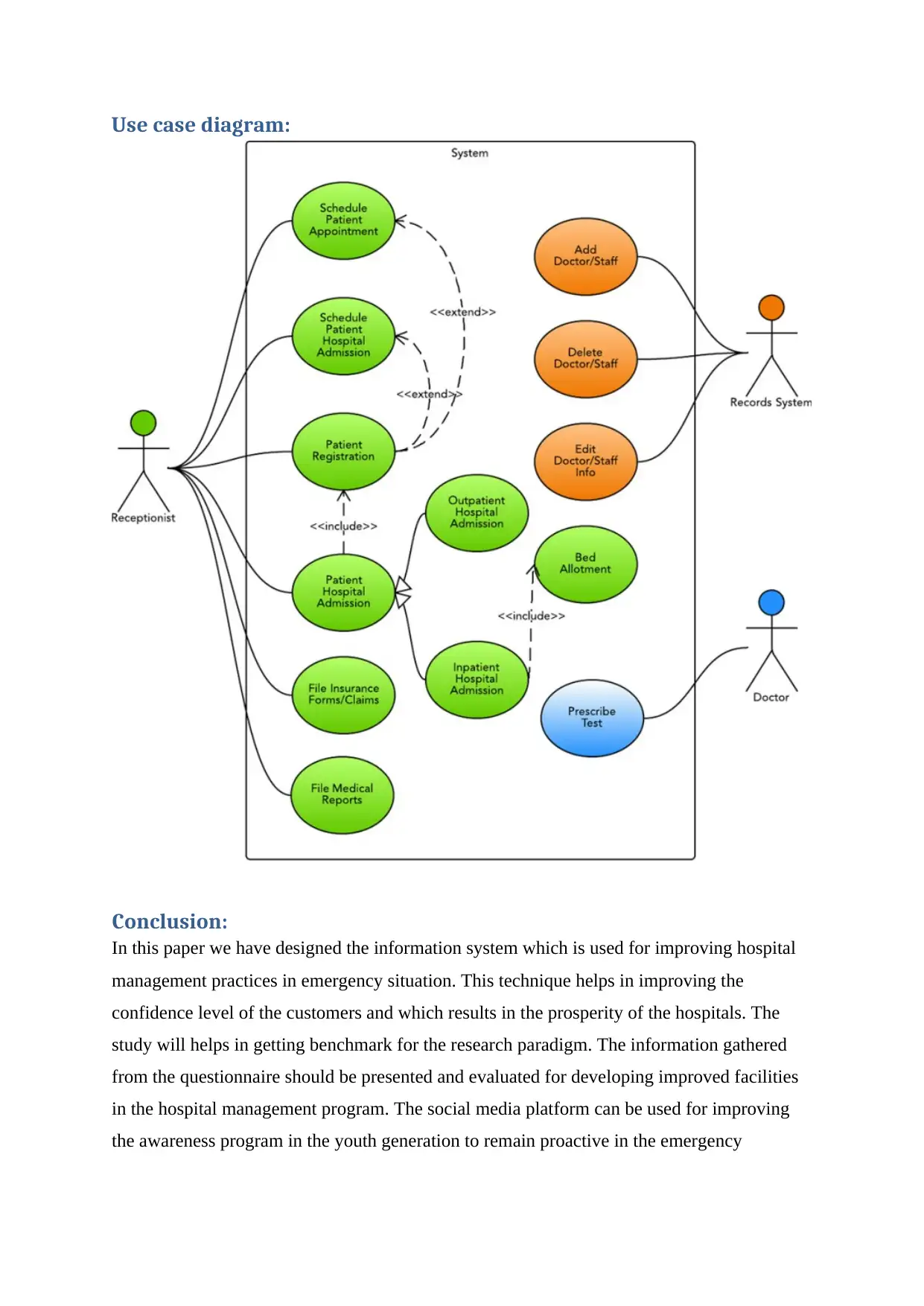
Use case diagram:
Conclusion:
In this paper we have designed the information system which is used for improving hospital
management practices in emergency situation. This technique helps in improving the
confidence level of the customers and which results in the prosperity of the hospitals. The
study will helps in getting benchmark for the research paradigm. The information gathered
from the questionnaire should be presented and evaluated for developing improved facilities
in the hospital management program. The social media platform can be used for improving
the awareness program in the youth generation to remain proactive in the emergency
Document Page
situation. The scheduling of the physician, house-keeping, and management practices helps in
improving the condition of the patient in emergency condition.
References:
Delia, D. (2013). Hospital capacity, patient flow, and emergency department. Retrieved from
http://www.nj.gov/health/rhc/documents/ed_report.pdf
Ganeshkumar, B. (2010). Emergency response management. Retrieved from
http://www.ipublishing.co.in/jggsvol1no12010/EIJGGS1001.pdf
Hughes, R. (2014). Health service research: Scope and significance. Retrieved from
https://www.ncbi.nlm.nih.gov/books/NBK2660/
Khan, Y. (2015). The evidence based on primary research in public health
emergencypreparedness. Retrieved from
https://www.ncbi.nlm.nih.gov/pmc/articles/PMC4415223/
Moore, P. (2013). Enhanced patient management in a hospital setting. Retrieved from
http://isyou.info/inpra/papers/inpra-v1n3-01.pdf
Raut, D. (2014). Research on emergency call and location tracking system with enhanced
funtionality. Retrieved from http://www.ijarcsms.com/docs/paper/volume3/issue5/V3I5-
0080.pdf
Reiling, J. (2011). The impact of facility design on patient safety. Retrieved from
https://www.ncbi.nlm.nih.gov/books/NBK2633/
Sreekala, P. (2015). Patient waiting time in emergency department. Retrieved from
http://www.ijsrp.org/research-paper-0515/ijsrp-p41112.pdf
Walsh, K. (2014). Emergency department case management. Retrieved from
https://hcmarketplace.com/aitdownloadablefiles/download/aitfile/aitfile_id/1616.pdf
Wilson, C. (2012). Hospital emergency response checklist. Retrieved from
http://www.euro.who.int/__data/assets/pdf_file/0008/268766/Hospital-emergency-response-
checklist-Eng.pdf
chevron_up_icon
1 out of 10
circle_padding
hide_on_mobile
zoom_out_icon
[object Object]