An Analysis of the Aims and Objectives in Molecular Genetics
VerifiedAdded on 2019/09/23
|10
|2771
|373
Essay
AI Summary
This essay provides a comprehensive overview of the aims of molecular genetics, a crucial field in biology. It explores the structure and function of genes at the molecular level, emphasizing their role in gene expression, genetic variation, heredity, and mutations. The essay delves into the historical context, referencing key discoveries like the identification of DNA as the carrier of genetic information. It highlights the importance of molecular genetics in understanding and treating genetic diseases, as well as its significance in medical and veterinary sciences. Furthermore, the essay discusses the differences between fundamental and basic theories within molecular genetics, exploring how genes are defined and how they influence biological processes. The ultimate goal is to provide an understanding of how molecular genetics contributes to the study of human biology in relation to disease and health. The essay also includes a discussion of the ethical aspects and applications of molecular genetics in clinical practice.

Running Head: Blog Writing
Blog Writing- Topic What are the aims of molecular genetics?
Blog Writing- Topic What are the aims of molecular genetics?

Paraphrase This Document
Need a fresh take? Get an instant paraphrase of this document with our AI Paraphraser
2
Blog Writing
Molecular Genetics-What are the aims of Molecular Genetics?
25th June 2019
Molecular Genetics
Molecular genetics is an important field of Biology which focuses on the study of function
and structure of genes at the molecular level. It employs techniques of both Genetics and
Molecular Biology. It is mainly linked with gene expression and chromosomes of an
organism with the aim of providing insights into genetic variation, heredity, and mutations.
Molecular Genetics is an important field of developmental biology study which is highly
significant in understanding several genetic diseases and in providing suitable techniques of
treating such diseases. Molecular Genetics mainly deals with the activity and structure of
genetic material at a molecular level. The data which have been accumulated by several
scientists of the initial stage of the 20th century has brought us several compelling pieces of
evidence debiting the fact that chromosomes are the fundamental carriers of genes. But we
can see that the nature of genes is not at all investigated upon intricately as we do not have
any particular or specific evidence-based understanding of the nature of genes. It is also an
important aspect to understand that the mechanism by which genes exert their impact and
influence have also not been prominent to the expected level. Basically, we can see that
Molecular Genetics is a particular field of biology which focuses only on the function and
structure of genes at a molecular level. The structure and function of genes have been the two
most important aspect of concern to the scientists and biologists. The analysis of genes could
have provided with several other aspects which could help in understanding the mysterious
nature of the genes. As we have all heard about the word DNA, which is an agent of heredity.
In the year 1869, Johann Friedrich Miescher who has been a Swiss chemist extracted a
particular substance which had phosphorus and nitrogen from nuclei cell. The substance has
been originally known as nuclein but now it is termed as deoxyribonucleic acid or DNA.
DNA can be defined as the chemical composition of chromosomes which is mainly
responsible for the staining properties present in microscopic preparations. The chromosomes
of eukaryotes have a wide range of proteins along with DNA. Now, it is very important to
understand whether the proteins or the nucleic acids or both have been the carriers of genes or
genetic information or not. During the 1950s, the majority of the biologics have been
convinced that proteins are the major carriers of heredity. There are only four unitary
Blog Writing
Molecular Genetics-What are the aims of Molecular Genetics?
25th June 2019
Molecular Genetics
Molecular genetics is an important field of Biology which focuses on the study of function
and structure of genes at the molecular level. It employs techniques of both Genetics and
Molecular Biology. It is mainly linked with gene expression and chromosomes of an
organism with the aim of providing insights into genetic variation, heredity, and mutations.
Molecular Genetics is an important field of developmental biology study which is highly
significant in understanding several genetic diseases and in providing suitable techniques of
treating such diseases. Molecular Genetics mainly deals with the activity and structure of
genetic material at a molecular level. The data which have been accumulated by several
scientists of the initial stage of the 20th century has brought us several compelling pieces of
evidence debiting the fact that chromosomes are the fundamental carriers of genes. But we
can see that the nature of genes is not at all investigated upon intricately as we do not have
any particular or specific evidence-based understanding of the nature of genes. It is also an
important aspect to understand that the mechanism by which genes exert their impact and
influence have also not been prominent to the expected level. Basically, we can see that
Molecular Genetics is a particular field of biology which focuses only on the function and
structure of genes at a molecular level. The structure and function of genes have been the two
most important aspect of concern to the scientists and biologists. The analysis of genes could
have provided with several other aspects which could help in understanding the mysterious
nature of the genes. As we have all heard about the word DNA, which is an agent of heredity.
In the year 1869, Johann Friedrich Miescher who has been a Swiss chemist extracted a
particular substance which had phosphorus and nitrogen from nuclei cell. The substance has
been originally known as nuclein but now it is termed as deoxyribonucleic acid or DNA.
DNA can be defined as the chemical composition of chromosomes which is mainly
responsible for the staining properties present in microscopic preparations. The chromosomes
of eukaryotes have a wide range of proteins along with DNA. Now, it is very important to
understand whether the proteins or the nucleic acids or both have been the carriers of genes or
genetic information or not. During the 1950s, the majority of the biologics have been
convinced that proteins are the major carriers of heredity. There are only four unitary
3
Blog Writing
building blocks in nucleic acids. On the other hand, proteins are composed of 20 amino acids
of different types. Therefore, we can see that proteins have appeared in a diverse structure
which in turn has increased the diversity of the genes. DNA basically plays the role of
carrying genetic information. This fact has been portrayed by some simple microbiological
studies in an exquisite manner. In the year, 1928, Frederick Griffith who was an English
bacteriologist have been studying two strains of bacterium Streptococcus pneumonia. One of
the strains was virulent or lethal to mice and the other one was anti-virulent and or harmless.
He found that the mice had been inoculated because of living avirulent bacteria or heat-killed
virulent bacteria. But in reality, the mice had been inoculated because of a mixture of both of
the bacteria and the mice got infected and finally died. This incident has clearly indicated that
some chemical transforming principle had been transformed into avirulent cells from dead
virulent cells. This transforming principle had changed them.
In the year 1944, Oswald T. Avery who was an American bacteriologist along with his co-
workers observed that the major transforming factor was nothing but DNA. Avery along with
his entire research team gathered mixtures from the heat-killed virulent bacteria. They have
inactivated polysaccharides or sugar subunits or, proteins, lipids, DNA, or RNA (ribonucleic
acid). They have also added an individual type of preparation to the avirulent cells. They
observed that the inactivation of DNA has prevented the transformation to virulence. This
analysis has depicted that the molecular class of DNA has the power of transforming but it
could only transform hereditary material. Molecular genetics is used in many cases to refer to
a fundamental theory which aligns genes to every life process through polypeptides
production. It is also considered as one of the modest fundamental theory which deals with
regulation and expression of genes at the molecular level. Molecular Genetics is also used in
investigative approach which can be applied to biomedical science. It is basically an
investigative strategy which has its roots in the fundamental theory of genes. Molecular
Genetics has been one of the major fields of interests in the field of philosophy. Molecular
Genetics is more responsive to being a theory or inclined to theoretical aspect more than
laboratory methods or investigative approaches. From an early philosophical analysis, it
could be said that molecular genetics is one of the basic theories which is mainly responsive
to expression, makeup, and regulation of genes. Theoretical reductionism has been the major
area of its focus. The rising of developmental biology or developmental genetics has made
philosophical attention to be drawn towards molecular genetics. The attention has
subsequently shifted to fundamental theory with relation to contemporary genetics.
Blog Writing
building blocks in nucleic acids. On the other hand, proteins are composed of 20 amino acids
of different types. Therefore, we can see that proteins have appeared in a diverse structure
which in turn has increased the diversity of the genes. DNA basically plays the role of
carrying genetic information. This fact has been portrayed by some simple microbiological
studies in an exquisite manner. In the year, 1928, Frederick Griffith who was an English
bacteriologist have been studying two strains of bacterium Streptococcus pneumonia. One of
the strains was virulent or lethal to mice and the other one was anti-virulent and or harmless.
He found that the mice had been inoculated because of living avirulent bacteria or heat-killed
virulent bacteria. But in reality, the mice had been inoculated because of a mixture of both of
the bacteria and the mice got infected and finally died. This incident has clearly indicated that
some chemical transforming principle had been transformed into avirulent cells from dead
virulent cells. This transforming principle had changed them.
In the year 1944, Oswald T. Avery who was an American bacteriologist along with his co-
workers observed that the major transforming factor was nothing but DNA. Avery along with
his entire research team gathered mixtures from the heat-killed virulent bacteria. They have
inactivated polysaccharides or sugar subunits or, proteins, lipids, DNA, or RNA (ribonucleic
acid). They have also added an individual type of preparation to the avirulent cells. They
observed that the inactivation of DNA has prevented the transformation to virulence. This
analysis has depicted that the molecular class of DNA has the power of transforming but it
could only transform hereditary material. Molecular genetics is used in many cases to refer to
a fundamental theory which aligns genes to every life process through polypeptides
production. It is also considered as one of the modest fundamental theory which deals with
regulation and expression of genes at the molecular level. Molecular Genetics is also used in
investigative approach which can be applied to biomedical science. It is basically an
investigative strategy which has its roots in the fundamental theory of genes. Molecular
Genetics has been one of the major fields of interests in the field of philosophy. Molecular
Genetics is more responsive to being a theory or inclined to theoretical aspect more than
laboratory methods or investigative approaches. From an early philosophical analysis, it
could be said that molecular genetics is one of the basic theories which is mainly responsive
to expression, makeup, and regulation of genes. Theoretical reductionism has been the major
area of its focus. The rising of developmental biology or developmental genetics has made
philosophical attention to be drawn towards molecular genetics. The attention has
subsequently shifted to fundamental theory with relation to contemporary genetics.
⊘ This is a preview!⊘
Do you want full access?
Subscribe today to unlock all pages.

Trusted by 1+ million students worldwide
4
Blog Writing
It has been observed that the fundamental theory is not much concerned about regulation,
expression, and makeup of genes because it is mainly responsive to the analyses of the
general role of genes present in the organisms. The fundamental theory has stated the fact that
DNA and genes have the power to direct every life process by initiating information which
could specify the functioning and development of organisms. Now, we can say that it is an
important question to be answered whether molecular genetics has been a simplified version
of classical genetics or not. It is also very important for us to know whether the concept of
genes has been analyzed effectively. The usefulness of genes needs to be outlived. The
fundamental theory can be questioned upon its tenability. It has been observed that the
philosophical attention has not yet been given on the reasons behind enhanced biological
research or the concepts of DNA and genes. These questions are highly important because
they ultimately can lead us to a better understanding of the aspect of molecular genetics and
its aims.
Difference between fundamental and basic theories of Molecular Genetics
There is a basic difference between fundamental theories and basic theories of molecular
genetics. According to the modest definition, genes are the linear sequences observed in
polypeptides and RNA molecules which are synthesized in the cell. But according to biology,
genes have been defined as the fundamental entities which help in the functioning and
development of organisms by developing proteins which in turn help in regulating all the
cellular processes. The proteins which are produced by the genes are quite significant because
they help in controlling and re4gulating important cellular processes. It is observed that genes
are the basic aspect of concern to Molecular Genetics and genes are defined as “the
providers” or “the program” or “the blueprint” of the information of an organism. Molecular
Genetics believes that genes are the basic carriers or the blueprint or the information or the
program with respect to an organism. It is highly important to understand the basic difference
between the fundamental theories and basic theories of molecular genetics. The basic role of
genes has been differently interpreted and presented by the fundamental and basic theories of
molecular genetics. The synthesis of polypeptide and RNA has been considered by the basic
theories of Molecular Genetics. On the other hand, the role of genetics has been the main
focus of the fundamental theory of Molecular Genetics.
Importance of Molecular Genetics
Blog Writing
It has been observed that the fundamental theory is not much concerned about regulation,
expression, and makeup of genes because it is mainly responsive to the analyses of the
general role of genes present in the organisms. The fundamental theory has stated the fact that
DNA and genes have the power to direct every life process by initiating information which
could specify the functioning and development of organisms. Now, we can say that it is an
important question to be answered whether molecular genetics has been a simplified version
of classical genetics or not. It is also very important for us to know whether the concept of
genes has been analyzed effectively. The usefulness of genes needs to be outlived. The
fundamental theory can be questioned upon its tenability. It has been observed that the
philosophical attention has not yet been given on the reasons behind enhanced biological
research or the concepts of DNA and genes. These questions are highly important because
they ultimately can lead us to a better understanding of the aspect of molecular genetics and
its aims.
Difference between fundamental and basic theories of Molecular Genetics
There is a basic difference between fundamental theories and basic theories of molecular
genetics. According to the modest definition, genes are the linear sequences observed in
polypeptides and RNA molecules which are synthesized in the cell. But according to biology,
genes have been defined as the fundamental entities which help in the functioning and
development of organisms by developing proteins which in turn help in regulating all the
cellular processes. The proteins which are produced by the genes are quite significant because
they help in controlling and re4gulating important cellular processes. It is observed that genes
are the basic aspect of concern to Molecular Genetics and genes are defined as “the
providers” or “the program” or “the blueprint” of the information of an organism. Molecular
Genetics believes that genes are the basic carriers or the blueprint or the information or the
program with respect to an organism. It is highly important to understand the basic difference
between the fundamental theories and basic theories of molecular genetics. The basic role of
genes has been differently interpreted and presented by the fundamental and basic theories of
molecular genetics. The synthesis of polypeptide and RNA has been considered by the basic
theories of Molecular Genetics. On the other hand, the role of genetics has been the main
focus of the fundamental theory of Molecular Genetics.
Importance of Molecular Genetics
Paraphrase This Document
Need a fresh take? Get an instant paraphrase of this document with our AI Paraphraser
5
Blog Writing
Molecular genetics is the field of study which focuses on the processes through which
biological information gets stored or copied or repaired or decoded so as to create protein and
molecules within tissues and cells. It is one of the influential areas of bioscience which
contributes to expanding our knowledge and understanding of the domain of Biology in a
quite significant manner. It allows us to develop a diagnosis process, treatment, and
prevention of various diseases on the basis of their genetic makeup. Furthermore, it can be
said that in the domain of Medical Science, the contribution of Molecular Genetics is quite
significant because it helps in analyzing and investigating the changes taking place in gene
expression or DNA of a patient. The treatment of a patient could be suggested on the basis of
the information about the changes in gene expression or DNA of the patient. With the help of
this knowledge, medical professionals can customize treatments to individual patients.
Molecular Genetics is one of the thrilling subjects to study. It is all about providing valuable
information on the ways our DNA, genome, and genes control all the vital living processes.
This field of study unlocks the mystery of DNA and supports us with better knowledge and
understanding of human biology in relation to disease and health.
Aims of Molecular Genetics
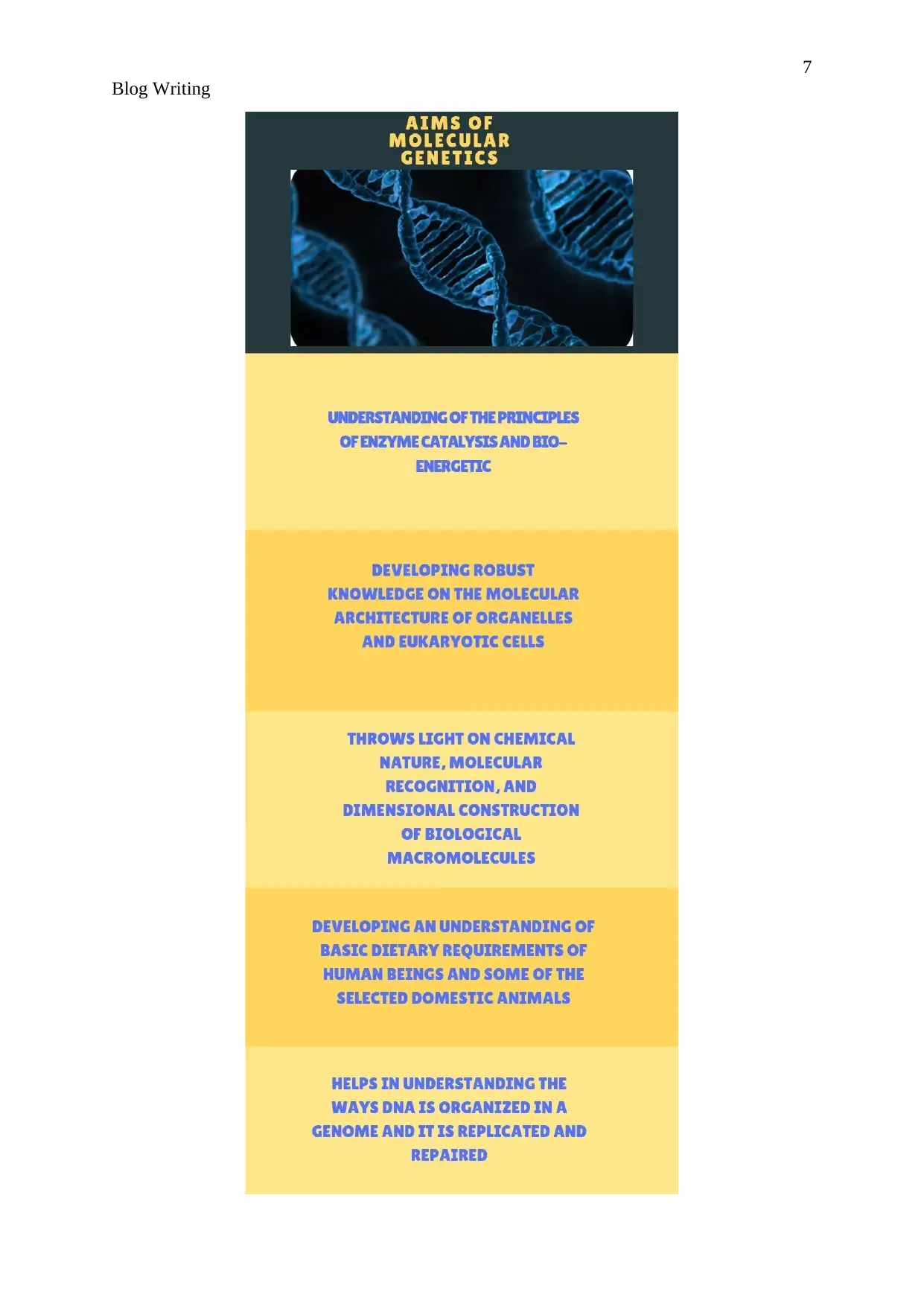
The field of molecular genetics provides a basic understanding of the principles of enzyme
catalysis and bio-energetic. It aims at developing robust knowledge on the molecular
architecture of organelles and eukaryotic cells including the study of membrane dynamics
and structure. It also throws light on chemical nature, molecular recognition, and dimensional
construction of biological macromolecules. The information which we get from the study of
molecular genetics helps in developing an understanding of basic dietary requirements of
human beings and some of the selected domestic animals. It also helps in understanding the
ways DNA is organized in a genome and it is replicated and repaired. The genetic
information which is very important for the scientists and biologics get accurately extended
by the domain of molecular genetics. It helps in highlighting the ways genetic information is
selectively expressed. It also provides us with information about the functional proteins. The
ways genes get transmitted from one generation to another is a domain which is full of
mystery. Molecular Genetics aims at simplifying the analysis of genes. Molecular Genetics
provides information about the ways genes are transmitted and probable errors which can
take place while the process of transmission takes place. Genetic variation can result in
mutant genes. It also takes place through the help of natural polymorphism. These all are
inherited genetic errors in the field of Molecular Genetics. It has provided information on the
Blog Writing
Molecular genetics is the field of study which focuses on the processes through which
biological information gets stored or copied or repaired or decoded so as to create protein and
molecules within tissues and cells. It is one of the influential areas of bioscience which
contributes to expanding our knowledge and understanding of the domain of Biology in a
quite significant manner. It allows us to develop a diagnosis process, treatment, and
prevention of various diseases on the basis of their genetic makeup. Furthermore, it can be
said that in the domain of Medical Science, the contribution of Molecular Genetics is quite
significant because it helps in analyzing and investigating the changes taking place in gene
expression or DNA of a patient. The treatment of a patient could be suggested on the basis of
the information about the changes in gene expression or DNA of the patient. With the help of
this knowledge, medical professionals can customize treatments to individual patients.
Molecular Genetics is one of the thrilling subjects to study. It is all about providing valuable
information on the ways our DNA, genome, and genes control all the vital living processes.
This field of study unlocks the mystery of DNA and supports us with better knowledge and
understanding of human biology in relation to disease and health.
Aims of Molecular Genetics
The field of molecular genetics provides a basic understanding of the principles of enzyme
catalysis and bio-energetic. It aims at developing robust knowledge on the molecular
architecture of organelles and eukaryotic cells including the study of membrane dynamics
and structure. It also throws light on chemical nature, molecular recognition, and dimensional
construction of biological macromolecules. The information which we get from the study of
molecular genetics helps in developing an understanding of basic dietary requirements of
human beings and some of the selected domestic animals. It also helps in understanding the
ways DNA is organized in a genome and it is replicated and repaired. The genetic
information which is very important for the scientists and biologics get accurately extended
by the domain of molecular genetics. It helps in highlighting the ways genetic information is
selectively expressed. It also provides us with information about the functional proteins. The
ways genes get transmitted from one generation to another is a domain which is full of
mystery. Molecular Genetics aims at simplifying the analysis of genes. Molecular Genetics
provides information about the ways genes are transmitted and probable errors which can
take place while the process of transmission takes place. Genetic variation can result in
mutant genes. It also takes place through the help of natural polymorphism. These all are
inherited genetic errors in the field of Molecular Genetics. It has provided information on the

6
Blog Writing
ways these genetic errors take place. Moreover, it is very important for medical professionals
and doctors to understand the fact that inherited genetic errors can lead to multi-factorial
diseases or single gene disease. The resultant of this inheritance has different impacts on the
population and individuals. Molecular genetics helps in providing ample information on these
domains.
Blog Writing
ways these genetic errors take place. Moreover, it is very important for medical professionals
and doctors to understand the fact that inherited genetic errors can lead to multi-factorial
diseases or single gene disease. The resultant of this inheritance has different impacts on the
population and individuals. Molecular genetics helps in providing ample information on these
domains.
⊘ This is a preview!⊘
Do you want full access?
Subscribe today to unlock all pages.
Trusted by 1+ million students worldwide
7
Blog Writing
Blog Writing
Paraphrase This Document
Need a fresh take? Get an instant paraphrase of this document with our AI Paraphraser
8
Blog Writing
It can be said that the tools which are used in molecular genetics have certain potential
applications to veterinary and Medical Science. The study of molecular genetics aims at
providing ample information on those tools which are best-suited for these two domains of
science. With the progress in medical science, we can find the significance of the study of
Molecular Genetics is also getting highly prominent. From the laboratory practice, molecular
approach, and its experimental dimension can be understood in relation to Biology. It is also
very important for modern medical professionals and scientists to understand the implications
of Molecular Genetics in the field of clinical practice where a molecular approach to biology
and Medical Science is highly significant. Furthermore, the ethical aspects of Medical and
Molecular science are very important to be understood by medical professionals. The
scientist and the biologics become aware of the various ethical aspects and approaches of
molecular science with the support of the study of molecular genetics. The overall study
helps the students and practitioners to become capable of demonstrating and understanding
the knowledge of the molecular aspects of living cells. It also helps in developing an
understanding of the principles governing the structures and participation of macromolecules
in molecular recognition. It also helps in demonstrating and understanding the knowledge of
the fundamental mechanism and principles of molecular signaling and metabolic control.
We can find various aims of molecular genetics with the use of fundamental laboratory
apparatus and skills. It becomes possible to obtain reproducible information and data from
various biochemical experiments. The field of molecular genetics has made it possible to
implement various experimental protocols and to carry out simplified investigations with the
help of a concrete plan. Furthermore, molecular genetics aims at analyzing, interpreting, and
participating, and sharing information to others on the consequences and outcomes of the
laboratory experiments. People dealing with molecular genetics can report on their teamwork
investigations orally. They can also engage in participating in problem-based assignments
and investigations. The main aim of molecular genetics is to make people dealing with it to
become capable of developing their own understanding and knowledge which they could use\
in handling specialized and advanced procedures and to become independent in the field of
molecular and medical science. They could also help the entire world to understand the
structures and mystery of genes. Therefore, it can be said that molecular genetics is one of the
vital and crucial fields of biology. The field of study of Molecular Genetics aims at providing
ample information and knowledge on the function and structure of genes at the molecular
level. Since it is highly linked with both Genetics and Molecular Biology it aims at providing
Blog Writing
It can be said that the tools which are used in molecular genetics have certain potential
applications to veterinary and Medical Science. The study of molecular genetics aims at
providing ample information on those tools which are best-suited for these two domains of
science. With the progress in medical science, we can find the significance of the study of
Molecular Genetics is also getting highly prominent. From the laboratory practice, molecular
approach, and its experimental dimension can be understood in relation to Biology. It is also
very important for modern medical professionals and scientists to understand the implications
of Molecular Genetics in the field of clinical practice where a molecular approach to biology
and Medical Science is highly significant. Furthermore, the ethical aspects of Medical and
Molecular science are very important to be understood by medical professionals. The
scientist and the biologics become aware of the various ethical aspects and approaches of
molecular science with the support of the study of molecular genetics. The overall study
helps the students and practitioners to become capable of demonstrating and understanding
the knowledge of the molecular aspects of living cells. It also helps in developing an
understanding of the principles governing the structures and participation of macromolecules
in molecular recognition. It also helps in demonstrating and understanding the knowledge of
the fundamental mechanism and principles of molecular signaling and metabolic control.
We can find various aims of molecular genetics with the use of fundamental laboratory
apparatus and skills. It becomes possible to obtain reproducible information and data from
various biochemical experiments. The field of molecular genetics has made it possible to
implement various experimental protocols and to carry out simplified investigations with the
help of a concrete plan. Furthermore, molecular genetics aims at analyzing, interpreting, and
participating, and sharing information to others on the consequences and outcomes of the
laboratory experiments. People dealing with molecular genetics can report on their teamwork
investigations orally. They can also engage in participating in problem-based assignments
and investigations. The main aim of molecular genetics is to make people dealing with it to
become capable of developing their own understanding and knowledge which they could use\
in handling specialized and advanced procedures and to become independent in the field of
molecular and medical science. They could also help the entire world to understand the
structures and mystery of genes. Therefore, it can be said that molecular genetics is one of the
vital and crucial fields of biology. The field of study of Molecular Genetics aims at providing
ample information and knowledge on the function and structure of genes at the molecular
level. Since it is highly linked with both Genetics and Molecular Biology it aims at providing
9
Blog Writing
knowledge and understanding in some other domains such as analysis and interpretation of
Genetic and molecular inherited disorders and immunological disorders. It also aims at
providing a better understanding of the field of research such as vaccine development, food
allergies, eczema, asthma, and allergic dermatitis.
The field of Molecular genetics is highly important because it helps in some vital areas of
investigation such as Parasitology, Microbiology, and Virology. In the domain of
developmental biology, Molecular Genetics also provides knowledge and information on the
cloning research and stem cells. It mainly aims at providing ample information and
knowledge to the medical/ health practitioners, Clinical Practitioners, researchers
professional bodies, students, and educational institutions. One of the major aims of this field
of study is to provide ample knowledge and understanding of the various remedies to the
issues related to health which are widely found in the developing countries. The study has
become quite crucial as it aims in making the medical practitioners and the scientists come up
with better treatments for some of the specified diseases like viral hepatitis, HIV/AIDS, and
microbial diseases at the genetic and molecular level. Hence, it can be observed that
Molecular Genetics is one of the important branches of genetics which investigates the
physical and chemical nature and mechanism of genes and it also aims at providing
information about the ways physiology, growth, and development are controlled by genes. It
also supports genetic traits and biochemical studies along with one-enzyme or one-gene
hypothesis. It also helps in understanding chemical mutagenesis and identifies the fact that
genes could permanently get modified by several reactive compounds. It also aims at
highlighting bacteriophages which behave as large molecules chemically with all the gene
properties. Therefore, molecular genetics investigates the chemical nature of the genes and
demonstrates the properties of DNA in relation to genetic material.
Blog Writing
knowledge and understanding in some other domains such as analysis and interpretation of
Genetic and molecular inherited disorders and immunological disorders. It also aims at
providing a better understanding of the field of research such as vaccine development, food
allergies, eczema, asthma, and allergic dermatitis.
The field of Molecular genetics is highly important because it helps in some vital areas of
investigation such as Parasitology, Microbiology, and Virology. In the domain of
developmental biology, Molecular Genetics also provides knowledge and information on the
cloning research and stem cells. It mainly aims at providing ample information and
knowledge to the medical/ health practitioners, Clinical Practitioners, researchers
professional bodies, students, and educational institutions. One of the major aims of this field
of study is to provide ample knowledge and understanding of the various remedies to the
issues related to health which are widely found in the developing countries. The study has
become quite crucial as it aims in making the medical practitioners and the scientists come up
with better treatments for some of the specified diseases like viral hepatitis, HIV/AIDS, and
microbial diseases at the genetic and molecular level. Hence, it can be observed that
Molecular Genetics is one of the important branches of genetics which investigates the
physical and chemical nature and mechanism of genes and it also aims at providing
information about the ways physiology, growth, and development are controlled by genes. It
also supports genetic traits and biochemical studies along with one-enzyme or one-gene
hypothesis. It also helps in understanding chemical mutagenesis and identifies the fact that
genes could permanently get modified by several reactive compounds. It also aims at
highlighting bacteriophages which behave as large molecules chemically with all the gene
properties. Therefore, molecular genetics investigates the chemical nature of the genes and
demonstrates the properties of DNA in relation to genetic material.
⊘ This is a preview!⊘
Do you want full access?
Subscribe today to unlock all pages.
Trusted by 1+ million students worldwide

10
Blog Writing
Blog Writing

1 out of 10


Related Documents


Your All-in-One AI-Powered Toolkit for Academic Success.
+13062052269
info@desklib.com
Available 24*7 on WhatsApp / Email
![[object Object]](/_next/static/media/star-bottom.7253800d.svg)
Unlock your academic potential
Copyright © 2020–2025 A2Z Services. All Rights Reserved. Developed and managed by ZUCOL.