Analysis of Coca Cola's Business Operations in the Australian Market
VerifiedAdded on 2020/02/24
|14
|4529
|75
Report
AI Summary
This report provides a comprehensive analysis of Coca-Cola's business operations in the Australian market. It begins with an overview of Coca-Cola's nature, business operations, investment, and financing activities. The report then delves into industry-specific details, including market size, growth, supply chain, major players, market share, critical success factors, and major threats. A subsequent section examines government regulations, accounting standards, and the impact of non-compliance. The analysis further includes a PESTLE analysis to assess political, economic, social, technological, legal, and environmental factors influencing Coca-Cola. A SWOT analysis identifies strengths, weaknesses, opportunities, and threats, while Porter's Five Forces analysis evaluates the competitive landscape. The report also discusses industry development risks and concludes with an analysis of Coca-Cola's value chain, supply chain management, and financial performance, including profitability and key financial ratios, offering insights into the company's strategic positioning and operational effectiveness in the Australian beverage market.
COCA COLA
ANALYSIS
1
ANALYSIS
1

Paraphrase This Document
Need a fresh take? Get an instant paraphrase of this document with our AI Paraphraser
Table of Contents
PART 1............................................................................................................................................3
Nature..........................................................................................................................................3
Business operations.....................................................................................................................3
Investment activities....................................................................................................................3
Financing activities......................................................................................................................3
Part 2................................................................................................................................................3
PART 3............................................................................................................................................5
Part 4................................................................................................................................................6
PART 5............................................................................................................................................8
PART 6..........................................................................................................................................10
Part 7..............................................................................................................................................11
a) Communication and enforcement of integrity and ethical values.........................................11
b) Commitment to competence..................................................................................................11
c) Participation by those charged with governance...................................................................11
d) Management’s philosophy and operating style.....................................................................12
e) Organizational structure........................................................................................................12
f) Assignment of authority and responsibility...........................................................................12
g) Human resource policies and practices.................................................................................13
REFERENCES..............................................................................................................................14
2
PART 1............................................................................................................................................3
Nature..........................................................................................................................................3
Business operations.....................................................................................................................3
Investment activities....................................................................................................................3
Financing activities......................................................................................................................3
Part 2................................................................................................................................................3
PART 3............................................................................................................................................5
Part 4................................................................................................................................................6
PART 5............................................................................................................................................8
PART 6..........................................................................................................................................10
Part 7..............................................................................................................................................11
a) Communication and enforcement of integrity and ethical values.........................................11
b) Commitment to competence..................................................................................................11
c) Participation by those charged with governance...................................................................11
d) Management’s philosophy and operating style.....................................................................12
e) Organizational structure........................................................................................................12
f) Assignment of authority and responsibility...........................................................................12
g) Human resource policies and practices.................................................................................13
REFERENCES..............................................................................................................................14
2
PART 1
Nature
Coca cola is an American multinational beverage corporation that produces and markets
non-alcoholic beverage concentrates and syrups. The firm carries out its operations in the
beverage industry where different types of soft drinks are offered in the market (Metzger, 2014).
Coca Cola offers wide range of products in the market but they all are associated with the
beverage industry. On determining the nature of the business it is necessary to identify the
industry in which company operates along with the type of products that are offered.
Business operations
The main operation that is being carried out by Coca Cola in the Australian market is
production of soft drinks and they are stored in the bottles so as to offer them in the market.
Further, for the manufacturing purpose advanced technology is employed that leads to efficient
production and in turn allows company to enhance its overall performance in the market (Hoy,
et. al, 2014). So, production is the main business operation and apart from this some other crucial
operations are present such as finance, marketing, human resource etc.
Investment activities
The key investment activities of Coca Cola in the Australian market involve capital
expenditure where organization purchase and sale fixed assets as per its business need and
requirement. Generally advanced machines are required in the production of soft drink and this
in turn acts as development tool for the firm (Hiscock and Warry, 2016). The Company sale
fixed assets that are of no use and this somehow generates income for the organization in every
possible manner.
Financing activities
The main financing activities of Coca Cola Company involves cash dividend paid where
organization pays dividend to its investors. Change in capital stock is also one of the major
activities along with the sale of common and preferred stock. The Company considers change in
long term debt, issuance of long term debt and reduction.
PART 2
a) Industry size – It can be expressed that Coca cola operates in the beverage industry of
Australia. The overall size of Australia food, grocery and beverage manufacturing industry is
$125.9 billion (Australian food and grocery council, 2016) Furthermore, in the year 2014, 9025
3
Nature
Coca cola is an American multinational beverage corporation that produces and markets
non-alcoholic beverage concentrates and syrups. The firm carries out its operations in the
beverage industry where different types of soft drinks are offered in the market (Metzger, 2014).
Coca Cola offers wide range of products in the market but they all are associated with the
beverage industry. On determining the nature of the business it is necessary to identify the
industry in which company operates along with the type of products that are offered.
Business operations
The main operation that is being carried out by Coca Cola in the Australian market is
production of soft drinks and they are stored in the bottles so as to offer them in the market.
Further, for the manufacturing purpose advanced technology is employed that leads to efficient
production and in turn allows company to enhance its overall performance in the market (Hoy,
et. al, 2014). So, production is the main business operation and apart from this some other crucial
operations are present such as finance, marketing, human resource etc.
Investment activities
The key investment activities of Coca Cola in the Australian market involve capital
expenditure where organization purchase and sale fixed assets as per its business need and
requirement. Generally advanced machines are required in the production of soft drink and this
in turn acts as development tool for the firm (Hiscock and Warry, 2016). The Company sale
fixed assets that are of no use and this somehow generates income for the organization in every
possible manner.
Financing activities
The main financing activities of Coca Cola Company involves cash dividend paid where
organization pays dividend to its investors. Change in capital stock is also one of the major
activities along with the sale of common and preferred stock. The Company considers change in
long term debt, issuance of long term debt and reduction.
PART 2
a) Industry size – It can be expressed that Coca cola operates in the beverage industry of
Australia. The overall size of Australia food, grocery and beverage manufacturing industry is
$125.9 billion (Australian food and grocery council, 2016) Furthermore, in the year 2014, 9025
3
⊘ This is a preview!⊘
Do you want full access?
Subscribe today to unlock all pages.

Trusted by 1+ million students worldwide
million AUD was the size of soft drinks industry in the country (Market size of soft drinks in
Australia from 2010 to 2014 (in million AUD), 2017).
b) Industry growth – The annual growth rate of beverage or soft drink industry of Australia is
0.7% which is quite low. At present, the industry is growing through decline stage as people in
the nation have become more conscious towards their health and well being. It has resulted in
decreasing the demand of soft drinks in the country.
c) Industry supply chain- It can be asserted that the industry supply chain consists of five
majors elements which are syrup producer, bottler, distributors, merchants and end customers.
Furthermore, almost every player in the market goes through the same supply chain process
(Boyjoo, et. al, 2017). The key products line of industry includes fruit beverages, carbonated soft
drinks and bottled water.
d) Major players – The major players in industry includes Coca cola, Bundaberg, PepsiCo
Nudie Foods Australia, Schweppes, Kirks. However, it can be critically argued that Coca Cola
and PepsiCo are facing intense competition from each others. The price and marketing strategies
of market players directly affect companies in the beverage industry to a great extent.
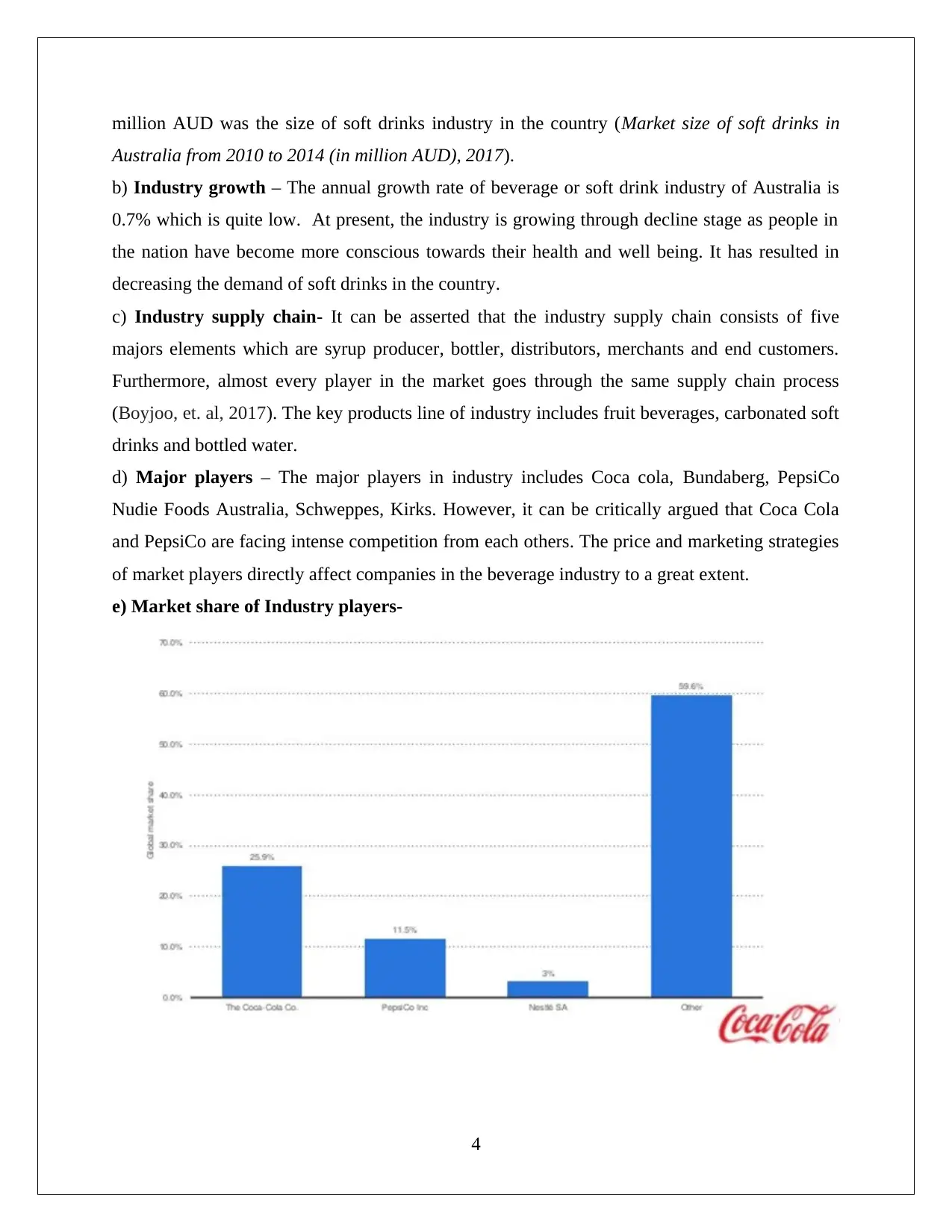
e) Market share of Industry players-
4
Australia from 2010 to 2014 (in million AUD), 2017).
b) Industry growth – The annual growth rate of beverage or soft drink industry of Australia is
0.7% which is quite low. At present, the industry is growing through decline stage as people in
the nation have become more conscious towards their health and well being. It has resulted in
decreasing the demand of soft drinks in the country.
c) Industry supply chain- It can be asserted that the industry supply chain consists of five
majors elements which are syrup producer, bottler, distributors, merchants and end customers.
Furthermore, almost every player in the market goes through the same supply chain process
(Boyjoo, et. al, 2017). The key products line of industry includes fruit beverages, carbonated soft
drinks and bottled water.
d) Major players – The major players in industry includes Coca cola, Bundaberg, PepsiCo
Nudie Foods Australia, Schweppes, Kirks. However, it can be critically argued that Coca Cola
and PepsiCo are facing intense competition from each others. The price and marketing strategies
of market players directly affect companies in the beverage industry to a great extent.
e) Market share of Industry players-
4
Paraphrase This Document
Need a fresh take? Get an instant paraphrase of this document with our AI Paraphraser
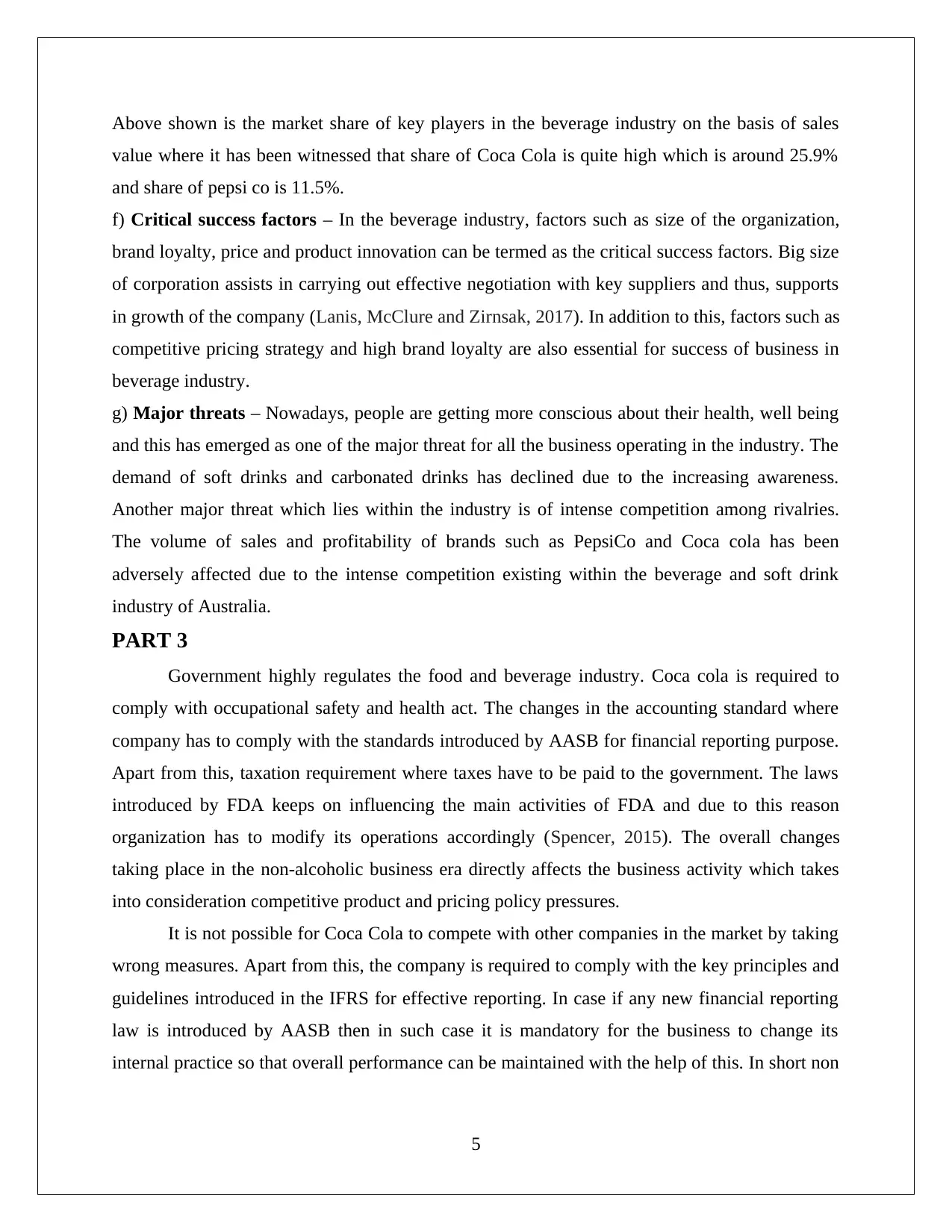
Above shown is the market share of key players in the beverage industry on the basis of sales
value where it has been witnessed that share of Coca Cola is quite high which is around 25.9%
and share of pepsi co is 11.5%.
f) Critical success factors – In the beverage industry, factors such as size of the organization,
brand loyalty, price and product innovation can be termed as the critical success factors. Big size
of corporation assists in carrying out effective negotiation with key suppliers and thus, supports
in growth of the company (Lanis, McClure and Zirnsak, 2017). In addition to this, factors such as
competitive pricing strategy and high brand loyalty are also essential for success of business in
beverage industry.
g) Major threats – Nowadays, people are getting more conscious about their health, well being
and this has emerged as one of the major threat for all the business operating in the industry. The
demand of soft drinks and carbonated drinks has declined due to the increasing awareness.
Another major threat which lies within the industry is of intense competition among rivalries.
The volume of sales and profitability of brands such as PepsiCo and Coca cola has been
adversely affected due to the intense competition existing within the beverage and soft drink
industry of Australia.
PART 3
Government highly regulates the food and beverage industry. Coca cola is required to
comply with occupational safety and health act. The changes in the accounting standard where
company has to comply with the standards introduced by AASB for financial reporting purpose.
Apart from this, taxation requirement where taxes have to be paid to the government. The laws
introduced by FDA keeps on influencing the main activities of FDA and due to this reason
organization has to modify its operations accordingly (Spencer, 2015). The overall changes
taking place in the non-alcoholic business era directly affects the business activity which takes
into consideration competitive product and pricing policy pressures.
It is not possible for Coca Cola to compete with other companies in the market by taking
wrong measures. Apart from this, the company is required to comply with the key principles and
guidelines introduced in the IFRS for effective reporting. In case if any new financial reporting
law is introduced by AASB then in such case it is mandatory for the business to change its
internal practice so that overall performance can be maintained with the help of this. In short non
5
value where it has been witnessed that share of Coca Cola is quite high which is around 25.9%
and share of pepsi co is 11.5%.
f) Critical success factors – In the beverage industry, factors such as size of the organization,
brand loyalty, price and product innovation can be termed as the critical success factors. Big size
of corporation assists in carrying out effective negotiation with key suppliers and thus, supports
in growth of the company (Lanis, McClure and Zirnsak, 2017). In addition to this, factors such as
competitive pricing strategy and high brand loyalty are also essential for success of business in
beverage industry.
g) Major threats – Nowadays, people are getting more conscious about their health, well being
and this has emerged as one of the major threat for all the business operating in the industry. The
demand of soft drinks and carbonated drinks has declined due to the increasing awareness.
Another major threat which lies within the industry is of intense competition among rivalries.
The volume of sales and profitability of brands such as PepsiCo and Coca cola has been
adversely affected due to the intense competition existing within the beverage and soft drink
industry of Australia.
PART 3
Government highly regulates the food and beverage industry. Coca cola is required to
comply with occupational safety and health act. The changes in the accounting standard where
company has to comply with the standards introduced by AASB for financial reporting purpose.
Apart from this, taxation requirement where taxes have to be paid to the government. The laws
introduced by FDA keeps on influencing the main activities of FDA and due to this reason
organization has to modify its operations accordingly (Spencer, 2015). The overall changes
taking place in the non-alcoholic business era directly affects the business activity which takes
into consideration competitive product and pricing policy pressures.
It is not possible for Coca Cola to compete with other companies in the market by taking
wrong measures. Apart from this, the company is required to comply with the key principles and
guidelines introduced in the IFRS for effective reporting. In case if any new financial reporting
law is introduced by AASB then in such case it is mandatory for the business to change its
internal practice so that overall performance can be maintained with the help of this. In short non
5
compliance with the government regulations that can lead to business failure in every possible
manner.
PART 4
a) Pest analysis
It can be stated that factors such as political, economical, social and technology has direct
impact on the overall operations Coca Cola Australia. The nation has developed strict laws and
regulations which need to be followed by all the companies operating in the beverage industry of
Australia. Changes in healthy policy and labour laws can adversely affected the business
operations of Coca Cola. On the other side of this, the economic condition of Australia is stable
and this has helped the company to carry out smooth flow of all its operations (Naramore,
Virojanapa, Bell and Jhaveri, 2015). However, economic issues such as energy crises of
Australia have adversely affected process such as manufacturing, sales and distribution of Coca
Cola’s products in the country. Apart from this, the changing need and demand of people living
in Australia have also changed drastically and the company has been affected by the same. For
example, now people in country have started to focus more on consuming healthy food and
drinks. The company is now respond quickly to these changing customer demands and should
emphasize more on developing drinks which are healthy and full of nutrients. Factors such as
technology have affected Coca Cola in positive terms and have contributed a lot in development
of the brand. For example, high rate of technological innovations in the country have supported
manufacturing units of Coca Cola to develop better and quality products. Technological
innovations have also contributed a lot in carrying out aggressive marketing of Coca Cola’s
products and services.
b) Swot analysis
Strength
High brand equity
Global presence
Customer loyalty
Weakness
Failure to offer healthy beverages
Low product diversification
Ineffective water management practices
Opportunities
Product diversification
Enhancement in supply chain
management practices
Threats
Intense competition from brands such
as PepsiCo
Sourcing of raw material
6
manner.
PART 4
a) Pest analysis
It can be stated that factors such as political, economical, social and technology has direct
impact on the overall operations Coca Cola Australia. The nation has developed strict laws and
regulations which need to be followed by all the companies operating in the beverage industry of
Australia. Changes in healthy policy and labour laws can adversely affected the business
operations of Coca Cola. On the other side of this, the economic condition of Australia is stable
and this has helped the company to carry out smooth flow of all its operations (Naramore,
Virojanapa, Bell and Jhaveri, 2015). However, economic issues such as energy crises of
Australia have adversely affected process such as manufacturing, sales and distribution of Coca
Cola’s products in the country. Apart from this, the changing need and demand of people living
in Australia have also changed drastically and the company has been affected by the same. For
example, now people in country have started to focus more on consuming healthy food and
drinks. The company is now respond quickly to these changing customer demands and should
emphasize more on developing drinks which are healthy and full of nutrients. Factors such as
technology have affected Coca Cola in positive terms and have contributed a lot in development
of the brand. For example, high rate of technological innovations in the country have supported
manufacturing units of Coca Cola to develop better and quality products. Technological
innovations have also contributed a lot in carrying out aggressive marketing of Coca Cola’s
products and services.
b) Swot analysis
Strength
High brand equity
Global presence
Customer loyalty
Weakness
Failure to offer healthy beverages
Low product diversification
Ineffective water management practices
Opportunities
Product diversification
Enhancement in supply chain
management practices
Threats
Intense competition from brands such
as PepsiCo
Sourcing of raw material
6
⊘ This is a preview!⊘
Do you want full access?
Subscribe today to unlock all pages.
Trusted by 1+ million students worldwide
From the above mentioned table, it has been analyzed that high brand equity, global
presence and customer loyalty are the three major strengths of Coca Cola. These strengths have
provided the selected company with an opportunity to increase its sales, profits and gain
competitive advantage over other market players. On the other hand, the company does not offer
beverages which are healthy and can improve the well being of people and this can be termed as
the major weakness of Coca Cola.
The company’s product line is limited and it does not operate with a diversified range of
products and services. Product diversification in food and beverage industry can be termed as the
key opportunity for Coca Cola. It will help the organization to find new customers and enhance
its existing market share (Hill, Jones and Schilling, 2014). Apart from this, Coca Cola also has
the opportunity to improve its supply chain management practices and this will support in
lowering down the overall operational cost. It can be evaluated that intense competition from
brands such as PepsiCo is the key threat which affects the sales and profitability of Coca Cola.
c) Porter five forces Analysis
Bargaining power of supplier – It can be expressed that factors such as large availability
of supplier and low cost of switching has resulted in making the bargaining power of
suppliers very low. As compared to switching of suppliers from Coca Cola to other
brand, it is easier for Coca Cola to switch from one supplier to another.
Bargaining power of customers – Coca Cola in Australia carry out its business practices
and operations with low bargaining power of customers (Stead and Stead, 2013). It can
be stated that the customers of Coca Cola are very loyal towards the brand and the
customers are less sensitive about the prices.
Threat of new entry – For a company like Coca Cola, the threat of new entry in the
industry is also low. The rationale behind this is that huge amount of human, financial
and technological resources are required to entry the food and beverage industry. Even
for companies which wish to operate at small scale, huge investment in terms of
marketing and staff members are required. This restricts businesses to enter the market
and compete with giants such as Coca Cola and PepsiCo.
7
presence and customer loyalty are the three major strengths of Coca Cola. These strengths have
provided the selected company with an opportunity to increase its sales, profits and gain
competitive advantage over other market players. On the other hand, the company does not offer
beverages which are healthy and can improve the well being of people and this can be termed as
the major weakness of Coca Cola.
The company’s product line is limited and it does not operate with a diversified range of
products and services. Product diversification in food and beverage industry can be termed as the
key opportunity for Coca Cola. It will help the organization to find new customers and enhance
its existing market share (Hill, Jones and Schilling, 2014). Apart from this, Coca Cola also has
the opportunity to improve its supply chain management practices and this will support in
lowering down the overall operational cost. It can be evaluated that intense competition from
brands such as PepsiCo is the key threat which affects the sales and profitability of Coca Cola.
c) Porter five forces Analysis
Bargaining power of supplier – It can be expressed that factors such as large availability
of supplier and low cost of switching has resulted in making the bargaining power of
suppliers very low. As compared to switching of suppliers from Coca Cola to other
brand, it is easier for Coca Cola to switch from one supplier to another.
Bargaining power of customers – Coca Cola in Australia carry out its business practices
and operations with low bargaining power of customers (Stead and Stead, 2013). It can
be stated that the customers of Coca Cola are very loyal towards the brand and the
customers are less sensitive about the prices.
Threat of new entry – For a company like Coca Cola, the threat of new entry in the
industry is also low. The rationale behind this is that huge amount of human, financial
and technological resources are required to entry the food and beverage industry. Even
for companies which wish to operate at small scale, huge investment in terms of
marketing and staff members are required. This restricts businesses to enter the market
and compete with giants such as Coca Cola and PepsiCo.
7
Paraphrase This Document
Need a fresh take? Get an instant paraphrase of this document with our AI Paraphraser
Competition among existing business- The rivalry among existing companies in
beverage industry of Australia is highly intense (Morden, 2016). Furthermore, Coca Cola
is facing direct and intense competition from brands such as PepsiCo. High degree of
competition has adversely affected the figure of sales, profits and market share of Coca
Cola.
Threat of substitute – The number of alternatives or substitutes of Coca Cola is very high
and this has restricted the company to acquire large market share. Customers in the
beverage industry of Australia are focusing more on Coca Cola’s substitute which are
fruit juices and other healthy beverages.
d) Other external factors
It can be expressed that external factors such as general economic conditions and interest
rates can also affect the overall operations of the selected business enterprise. For example,
situations such as economic downturn will restrict people in the market to spend more money on
the consumption of food and beverages (Grant, 2016). At the same time, increasing rate of
interest will create obstacles for the business in terms of carrying out aggressive marketing and
expansion in the Australia market.
PART 5
a) Industry development
The risk associated with industry development is very high for brand like Coca Cola. The
company will be required to make become competent in terms responding back to the changing
demand and trends within the industry (Zhou and Wan, 2017). For example if the demand of
fresh juice and beverages increases within the industry, then Coca Cola will need to make
changes in its products offering according to the same. Lack of expertise will results in adversely
affecting the brand image and operations of Coca Cola.
b) New products and services
Increasing product liability and failure of new product in the market are another major risk which
needs to be taken care by Coca Cola. The brand will need to ensure that it does not get indulge in
manufacturing products which are faulty or which adversely affect the health and well being of
customers.
c) Expansion of business
8
beverage industry of Australia is highly intense (Morden, 2016). Furthermore, Coca Cola
is facing direct and intense competition from brands such as PepsiCo. High degree of
competition has adversely affected the figure of sales, profits and market share of Coca
Cola.
Threat of substitute – The number of alternatives or substitutes of Coca Cola is very high
and this has restricted the company to acquire large market share. Customers in the
beverage industry of Australia are focusing more on Coca Cola’s substitute which are
fruit juices and other healthy beverages.
d) Other external factors
It can be expressed that external factors such as general economic conditions and interest
rates can also affect the overall operations of the selected business enterprise. For example,
situations such as economic downturn will restrict people in the market to spend more money on
the consumption of food and beverages (Grant, 2016). At the same time, increasing rate of
interest will create obstacles for the business in terms of carrying out aggressive marketing and
expansion in the Australia market.
PART 5
a) Industry development
The risk associated with industry development is very high for brand like Coca Cola. The
company will be required to make become competent in terms responding back to the changing
demand and trends within the industry (Zhou and Wan, 2017). For example if the demand of
fresh juice and beverages increases within the industry, then Coca Cola will need to make
changes in its products offering according to the same. Lack of expertise will results in adversely
affecting the brand image and operations of Coca Cola.
b) New products and services
Increasing product liability and failure of new product in the market are another major risk which
needs to be taken care by Coca Cola. The brand will need to ensure that it does not get indulge in
manufacturing products which are faulty or which adversely affect the health and well being of
customers.
c) Expansion of business
8
At the time of carrying out business expansion, Coca Cola will be required to ensure that
effective market research has been carried out and the demand of people has been estimated in
the best possible manner. The rationale behind this is that the risks associated with failure of
estimating customer demand accurately can negatively affect the overall cost of operations. It
can also results in financial failure of Coca Cola which is a big threat in long run.
d) New accounting equipment
The accounting requirement introduced by AASB keeps on changing rapidly and it is mandatory
for every business to comply with the requirement. In near future it is possible that Coca Cola
may face risk due to introduction of new accounting requirement as it can enhance business cost
due to implementation (Frynas and Mellahi, 2015). Generally, when any new requirement takes
place then its implementation enhances cost of the business in terms of providing training to the
accounting manager etc.
e) Regulatory requirements
It takes into consideration the legal requirement introduced by the government of Australia. For
instance if government has introduced any new law linked with recycling of bottles and Coca
Cola is not able to comply with such law. Then in such case it will act as major risk for the
business and in turn it has to be managed in proper manner.
f) Current and prospective financial requirement
The finance related requirement can also act as hurdle for the business in every possible manner.
Further, in case if interest rates are increased then in such case to satisfy the investment activities
business will not be able to obtain loan from the bank. This will act as major risk and satisfying
the overall financing activity for the organization will not be possible.
g) Use of IT
Another business risk which Coca Cola might face is linked with the use of IT systems which are
ineffective and incompatible (Coombs, 2014). Here, the risk is that the selected company may
lose large part of its market share to its competitors by using IT systems which are incompatible.
The brand will also face challenges in terms of carrying out smooth flow of its business
operations by making use of such IT systems.
h) The effect of implementing a strategy
9
effective market research has been carried out and the demand of people has been estimated in
the best possible manner. The rationale behind this is that the risks associated with failure of
estimating customer demand accurately can negatively affect the overall cost of operations. It
can also results in financial failure of Coca Cola which is a big threat in long run.
d) New accounting equipment
The accounting requirement introduced by AASB keeps on changing rapidly and it is mandatory
for every business to comply with the requirement. In near future it is possible that Coca Cola
may face risk due to introduction of new accounting requirement as it can enhance business cost
due to implementation (Frynas and Mellahi, 2015). Generally, when any new requirement takes
place then its implementation enhances cost of the business in terms of providing training to the
accounting manager etc.
e) Regulatory requirements
It takes into consideration the legal requirement introduced by the government of Australia. For
instance if government has introduced any new law linked with recycling of bottles and Coca
Cola is not able to comply with such law. Then in such case it will act as major risk for the
business and in turn it has to be managed in proper manner.
f) Current and prospective financial requirement
The finance related requirement can also act as hurdle for the business in every possible manner.
Further, in case if interest rates are increased then in such case to satisfy the investment activities
business will not be able to obtain loan from the bank. This will act as major risk and satisfying
the overall financing activity for the organization will not be possible.
g) Use of IT
Another business risk which Coca Cola might face is linked with the use of IT systems which are
ineffective and incompatible (Coombs, 2014). Here, the risk is that the selected company may
lose large part of its market share to its competitors by using IT systems which are incompatible.
The brand will also face challenges in terms of carrying out smooth flow of its business
operations by making use of such IT systems.
h) The effect of implementing a strategy
9
⊘ This is a preview!⊘
Do you want full access?
Subscribe today to unlock all pages.
Trusted by 1+ million students worldwide
Improper implementation of strategy is a risk because it will results in wastage of resources such
as technology, time, efforts and finances. The brand will need to ensure the fact that developed
strategies are implemented in the best possible and desired manner.
PART 6
Coca Cola
Ratio 2014 2015 2016
Current ratio 1.02 1.24 1.28
Quick ratio 0.81 0.89 0.98
Asset turnover 0.51 0.49 0.47
Return on invested
capital
22.36% 26.31% 26.85%
Pepsi Co
Ratio 2014 2015 2016
Current ratio 1.14 1.31 1.28
Quick ratio 0.85 1.05 1.08
Asset turnover 0.90 0.90 0.87
Return on invested
capital
14.07% 14.22% 13.39%
Above shown are the financial ratios for analyzing the performance of Coca Cola and it
has been compared with one of the main competitor of company named Pepsico operating in the
market. Further, considering the current ratio of company that supports in knowing the cash
position of the business and highlights whether business is able to meet its major expenses or
not. So, the current ratio of Coca Cola is growing every year and it is highlighting the financial
efficiency of the enterprise. On the other hand, Pepsico current ratio is also growing and it is
same as compared with Coca Cola. Therefore, it is recommended to Coca Cola to focus on its
performance enhancement so that it can perform better as compared with Pepsico.
Considering the asset turnover ratio of Coca Cola which has declined in the year 2016 as
compared with the past. This is representing the inefficiency of the business in utilizing its assets
and corrective actions are required to be taken so that company can utilize its assets in effective
manner. In case of Pepsico its asset turnover ratio is better as compared with Coca Cola.
10
as technology, time, efforts and finances. The brand will need to ensure the fact that developed
strategies are implemented in the best possible and desired manner.
PART 6
Coca Cola
Ratio 2014 2015 2016
Current ratio 1.02 1.24 1.28
Quick ratio 0.81 0.89 0.98
Asset turnover 0.51 0.49 0.47
Return on invested
capital
22.36% 26.31% 26.85%
Pepsi Co
Ratio 2014 2015 2016
Current ratio 1.14 1.31 1.28
Quick ratio 0.85 1.05 1.08
Asset turnover 0.90 0.90 0.87
Return on invested
capital
14.07% 14.22% 13.39%
Above shown are the financial ratios for analyzing the performance of Coca Cola and it
has been compared with one of the main competitor of company named Pepsico operating in the
market. Further, considering the current ratio of company that supports in knowing the cash
position of the business and highlights whether business is able to meet its major expenses or
not. So, the current ratio of Coca Cola is growing every year and it is highlighting the financial
efficiency of the enterprise. On the other hand, Pepsico current ratio is also growing and it is
same as compared with Coca Cola. Therefore, it is recommended to Coca Cola to focus on its
performance enhancement so that it can perform better as compared with Pepsico.
Considering the asset turnover ratio of Coca Cola which has declined in the year 2016 as
compared with the past. This is representing the inefficiency of the business in utilizing its assets
and corrective actions are required to be taken so that company can utilize its assets in effective
manner. In case of Pepsico its asset turnover ratio is better as compared with Coca Cola.
10
Paraphrase This Document
Need a fresh take? Get an instant paraphrase of this document with our AI Paraphraser
Therefore, it is recommended to Coca Cola to focus on this area for enhancing its overall
performance in the market. Return on invested capital of Coca cola is quite high and is
representing the efficiency of the organization.
Company is able to gain high return on the invested capital and due to this reason its
profitability level is quite high. Considering the case of Pepsico its return on capital employed
ratio is less as compared with Coca Cola which is representing inefficiency of the business.
Therefore, on the basis of overall analysis it has been found that Coca Cola is operating
efficiently as compared with its key competitor Pepsico in the market.
PART 7
a) Communication and enforcement of integrity and ethical values
The selected business enterprise has adopted for open communication channels which
assist in encouraging the views and opinions of workers (Rothaermel, 2015). Furthermore, Coca
Cola also promotes integrity and ethical values through its communication channels. The results
of this is that areas such as monitoring, administration and design of the entire organization. The
company promotes ethical practices and encourages all the staff members to follow the same.
b) Commitment to competence
Effective training and development programs are offered to all staff members with an
objective to enhance their overall competency level. At the same time, Coca Cola conducts
business seminars and conferences to increase the existing knowledge base and skill set of all its
workers. A fair and transparent process of recruitment and selection is used by the brand and
here, staff members are selected on the basis of factors such as experience, core competencies,
knowledge level and skills set (Deresky, 2017). No form of discrimination is promoted within
the business practices.
c) Participation by those charged with governance
It can be expressed that government, regulatory authorities and investors plays very
important role in the overall decision making and corporate governance of Coca Cola. These
parties work separately from the management and ensure that the company is carrying out legal
and ethical practices. The level of involvement of these parties is quite high and at the same time,
their experience level is also good. These parties interact with external and internal auditors at
regular intervals with an objective to ensure smooth functioning of all business activities of Coca
11
performance in the market. Return on invested capital of Coca cola is quite high and is
representing the efficiency of the organization.
Company is able to gain high return on the invested capital and due to this reason its
profitability level is quite high. Considering the case of Pepsico its return on capital employed
ratio is less as compared with Coca Cola which is representing inefficiency of the business.
Therefore, on the basis of overall analysis it has been found that Coca Cola is operating
efficiently as compared with its key competitor Pepsico in the market.
PART 7
a) Communication and enforcement of integrity and ethical values
The selected business enterprise has adopted for open communication channels which
assist in encouraging the views and opinions of workers (Rothaermel, 2015). Furthermore, Coca
Cola also promotes integrity and ethical values through its communication channels. The results
of this is that areas such as monitoring, administration and design of the entire organization. The
company promotes ethical practices and encourages all the staff members to follow the same.
b) Commitment to competence
Effective training and development programs are offered to all staff members with an
objective to enhance their overall competency level. At the same time, Coca Cola conducts
business seminars and conferences to increase the existing knowledge base and skill set of all its
workers. A fair and transparent process of recruitment and selection is used by the brand and
here, staff members are selected on the basis of factors such as experience, core competencies,
knowledge level and skills set (Deresky, 2017). No form of discrimination is promoted within
the business practices.
c) Participation by those charged with governance
It can be expressed that government, regulatory authorities and investors plays very
important role in the overall decision making and corporate governance of Coca Cola. These
parties work separately from the management and ensure that the company is carrying out legal
and ethical practices. The level of involvement of these parties is quite high and at the same time,
their experience level is also good. These parties interact with external and internal auditors at
regular intervals with an objective to ensure smooth functioning of all business activities of Coca
11
Cola. Suggestions and opinions are offered by these parties to enhance the overall corporate
governance practices of the selected business enterprise.
d) Management’s philosophy and operating style
The company is open towards taking business risk at regular intervals and effective
management of risk is carried out by Coca Cola. However, it can be critically argued that instead
of taking normal risk, the corporation focuses more on taking calculative risk. The risks taken are
generally linked with implementation of new marketing strategy or expansion of business in new
markets (Kaynak, Mockler and Dologite, 2014). A set procedure of financial reporting is
followed by Coca Cola where the business focuses on carrying out compliance of the reports
with the accountings standards. In addition to this, the organization also believes in honest
disclosure of financial performance and maintaining transparency in the entire procedure of
financial reporting. Both manual and automated systems are used by Coca Cola to process the
information and carry out different functions of accounting.
e) Organizational structure
Coca Cola is operating with hierarchical organization structure and it has developed
various levels of management. Employees working in the organization subordinate with other
people and this result in carrying out flow of operations and activities in the desired manner.
Apart from this, Coca Cola uses hierarchal structures because it supports the brand in making
every employee well clear about his/her roles and responsibilities. The decision making within
organization is mainly decentralized and decisions regarding planning, execution, control and
review are taken on the basis of the same.
f) Assignment of authority and responsibility
The process of assigning authority and responsibility is highly effective within Coca
Cola. The rationale behind this is that the company’s HR policies focus more on making
employee clear about their roles (Iivonen, 2017). Furthermore, the responsibilities are being
assigned to workers on the basis of factors such as their area of expertise, experience, skill set
and knowledge base. Each employee except the CEO has a reporting authority and there is
proper chain of command which needs to be followed while communicating any formal
information. Different departments have been established and the managers of those departments
are authorized to assign roles and responsibilities of workers along with the consultation of top
management of Coca Cola.
12
governance practices of the selected business enterprise.
d) Management’s philosophy and operating style
The company is open towards taking business risk at regular intervals and effective
management of risk is carried out by Coca Cola. However, it can be critically argued that instead
of taking normal risk, the corporation focuses more on taking calculative risk. The risks taken are
generally linked with implementation of new marketing strategy or expansion of business in new
markets (Kaynak, Mockler and Dologite, 2014). A set procedure of financial reporting is
followed by Coca Cola where the business focuses on carrying out compliance of the reports
with the accountings standards. In addition to this, the organization also believes in honest
disclosure of financial performance and maintaining transparency in the entire procedure of
financial reporting. Both manual and automated systems are used by Coca Cola to process the
information and carry out different functions of accounting.
e) Organizational structure
Coca Cola is operating with hierarchical organization structure and it has developed
various levels of management. Employees working in the organization subordinate with other
people and this result in carrying out flow of operations and activities in the desired manner.
Apart from this, Coca Cola uses hierarchal structures because it supports the brand in making
every employee well clear about his/her roles and responsibilities. The decision making within
organization is mainly decentralized and decisions regarding planning, execution, control and
review are taken on the basis of the same.
f) Assignment of authority and responsibility
The process of assigning authority and responsibility is highly effective within Coca
Cola. The rationale behind this is that the company’s HR policies focus more on making
employee clear about their roles (Iivonen, 2017). Furthermore, the responsibilities are being
assigned to workers on the basis of factors such as their area of expertise, experience, skill set
and knowledge base. Each employee except the CEO has a reporting authority and there is
proper chain of command which needs to be followed while communicating any formal
information. Different departments have been established and the managers of those departments
are authorized to assign roles and responsibilities of workers along with the consultation of top
management of Coca Cola.
12
⊘ This is a preview!⊘
Do you want full access?
Subscribe today to unlock all pages.
Trusted by 1+ million students worldwide

1 out of 14


Related Documents


Your All-in-One AI-Powered Toolkit for Academic Success.
+13062052269
info@desklib.com
Available 24*7 on WhatsApp / Email
![[object Object]](/_next/static/media/star-bottom.7253800d.svg)
Unlock your academic potential
Copyright © 2020–2026 A2Z Services. All Rights Reserved. Developed and managed by ZUCOL.