Human Resource Development Report: Training and Development Strategies
VerifiedAdded on 2020/07/22
|15
|4135
|51
Report
AI Summary
This report delves into the core concepts of Human Resource Development (HRD), outlining its significance in organizational success. It begins by examining diverse learning styles, such as Kolb's model, and the role of the learning curve in assessing employee performance. The report then explores various learning theories, including behavioral, cognitive, and constructivism, and their application in planning training events. It further analyzes the need for training at different organizational levels and details various training methods like on-the-job and off-the-job training, alongside a systematic approach to planning a training event. The report also covers techniques used in training evaluation, the impact of government initiatives, and the role of competency movements in HRD.

HUMAN RESOURCE
DEVELOPMENT
DEVELOPMENT

Paraphrase This Document
Need a fresh take? Get an instant paraphrase of this document with our AI Paraphraser
TABLE OF CONTENTS
INTRODUCTION...........................................................................................................................1
TASK 1 ...........................................................................................................................................1
(I) Different learning styles ........................................................................................................1
(ii) Role of learning curve...........................................................................................................2
(iii) Role of learning theories in planning an event.....................................................................3
TASK 2............................................................................................................................................4
(I) Need of training at different levels.........................................................................................4
(ii) Training method use in organisation. ...................................................................................5
(iii) Systematic approach to plan training event.........................................................................6
TASK 3............................................................................................................................................8
(i) Techniques used in the evaluation of training session (140)..................................................8
(ii)Evaluation of training event...................................................................................................9
(iii) Success of evaluation process. ............................................................................................9
TASK 4..........................................................................................................................................10
(I) Role of government in training development and lifelong learning....................................10
(ii) Impact of competency movement.......................................................................................10
(iii) Training initiative of government aided in human resource developemnt........................10
CONCLUSION..............................................................................................................................11
REFERENCES..............................................................................................................................12
INTRODUCTION...........................................................................................................................1
TASK 1 ...........................................................................................................................................1
(I) Different learning styles ........................................................................................................1
(ii) Role of learning curve...........................................................................................................2
(iii) Role of learning theories in planning an event.....................................................................3
TASK 2............................................................................................................................................4
(I) Need of training at different levels.........................................................................................4
(ii) Training method use in organisation. ...................................................................................5
(iii) Systematic approach to plan training event.........................................................................6
TASK 3............................................................................................................................................8
(i) Techniques used in the evaluation of training session (140)..................................................8
(ii)Evaluation of training event...................................................................................................9
(iii) Success of evaluation process. ............................................................................................9
TASK 4..........................................................................................................................................10
(I) Role of government in training development and lifelong learning....................................10
(ii) Impact of competency movement.......................................................................................10
(iii) Training initiative of government aided in human resource developemnt........................10
CONCLUSION..............................................................................................................................11
REFERENCES..............................................................................................................................12
INTRODUCTION
Human resource development is a framework that is designed by organisation through
which they can develop the skills, abilities and knowledge of employees so that efficiency and
effectiveness can be brought in the working of an individual as well as organisation (Knowles,
Holton and Swanson, 2014). Human resource development in firm is responsible for the
management of staff and also contribute in the overall success of firm.
Training and development programmes are essential part of organisation. In the present
report, importance of this programme along with different learning theories and their role in
planning and development of an individual is discussed. A complete plan or design using
systematic approach of training and development is also made. The role of government and its
various programs are also mentioned here.
TASK 1
(I) Different learning styles
Each individual has his own way of learning things. This learning style provides
individual a different way through which a person can enhance its knowledge, intellectual as
well as concentration power. Kolb's had produced a learning style model that discusses different
types of people and their learning styles which are given as below:
Kolb's learning model
Assimilating: This type of people focusses on logic rather than practice or
implementation in learning (Armstrong and Taylor, 2014). This type of individual are theoretical
and analytical in nature and prefer concise learning with concept and good idea is the learning
style that this group prefer.
Accommodating: This kind of people relies on their institution in tackling problems and
consider experimental and practical approach as the best way to learn new things.
Converging: This type of people relies on their existing knowledge to find solution of
things. This group favour technical task to enhance their learning. Interpersonal aspect of
learning doesn't interest these individuals.
Diverging: People in this group use their observation skill to learn new things. They
prefer to watch things from side line and then create a perception out of their observation or what
they have learnt (Brewster and Hegewisch, 2017).
1
Human resource development is a framework that is designed by organisation through
which they can develop the skills, abilities and knowledge of employees so that efficiency and
effectiveness can be brought in the working of an individual as well as organisation (Knowles,
Holton and Swanson, 2014). Human resource development in firm is responsible for the
management of staff and also contribute in the overall success of firm.
Training and development programmes are essential part of organisation. In the present
report, importance of this programme along with different learning theories and their role in
planning and development of an individual is discussed. A complete plan or design using
systematic approach of training and development is also made. The role of government and its
various programs are also mentioned here.
TASK 1
(I) Different learning styles
Each individual has his own way of learning things. This learning style provides
individual a different way through which a person can enhance its knowledge, intellectual as
well as concentration power. Kolb's had produced a learning style model that discusses different
types of people and their learning styles which are given as below:
Kolb's learning model
Assimilating: This type of people focusses on logic rather than practice or
implementation in learning (Armstrong and Taylor, 2014). This type of individual are theoretical
and analytical in nature and prefer concise learning with concept and good idea is the learning
style that this group prefer.
Accommodating: This kind of people relies on their institution in tackling problems and
consider experimental and practical approach as the best way to learn new things.
Converging: This type of people relies on their existing knowledge to find solution of
things. This group favour technical task to enhance their learning. Interpersonal aspect of
learning doesn't interest these individuals.
Diverging: People in this group use their observation skill to learn new things. They
prefer to watch things from side line and then create a perception out of their observation or what
they have learnt (Brewster and Hegewisch, 2017).
1
⊘ This is a preview!⊘
Do you want full access?
Subscribe today to unlock all pages.

Trusted by 1+ million students worldwide
By using Kolb's model, firm can arrange different training and workshop event so that
workers can have maximum benefit out of it.
There are other ways which firm can adopt so that proper learning can be provided to
staff such as
Face to face
Online or webinar
Face to face learning provides proper interaction with staff. This method is quite effective
in making workers understand the key values of firm. This style promotes individuals to make
their own perception regarding things instead of using practical reason (Storey, 2014). Along
with Kolb's and face to face method, firm can also recommend their employees some online
seminar that can help them in their self-learning which is quite effective and also, cost efficient.
(ii) Role of learning curve
Learning curve is one of the important tools that is quite useful for the evaluation of staff
performance. Learning curve is a graphical structure that shows growth of employees or the
process of learning and its experimental stage. It helps in identifying the need of individuals and
arrange proper training and development programmes for those in need (Budhwar and Debrah,
2013). It aids in enhancing the performance of individuals and organisation. It is used in many
other activities of firm such as labour forecasting, negotiation in supply chain, cost and budgets,
etc.
Transferring of knowledge:
Transferring knowledge is the process where learning gained in one context is used and
applied in other situation. It occurs when an individual finds common features or concepts in two
different things and use that knowledge in other situation. Transferring knowledge in business
assists individuals in its development (Marchington, Wilkinson and Kynighou, 2016). It
enhances one's knowledge and also, increases individual’s skill. It is also quite useful in
understanding the values of firm. Proper training, workshop and supervisor’s advice are different
ways through which learning can be transferred in the organisation. This transferring of
knowledge not only enhances the calibre of person but also gives a boost to creativity. It also
plays an important role in the development of team building, passing ideas and using united force
to come up with solution for various problem. It is important for entity to understand the basic of
2
workers can have maximum benefit out of it.
There are other ways which firm can adopt so that proper learning can be provided to
staff such as
Face to face
Online or webinar
Face to face learning provides proper interaction with staff. This method is quite effective
in making workers understand the key values of firm. This style promotes individuals to make
their own perception regarding things instead of using practical reason (Storey, 2014). Along
with Kolb's and face to face method, firm can also recommend their employees some online
seminar that can help them in their self-learning which is quite effective and also, cost efficient.
(ii) Role of learning curve
Learning curve is one of the important tools that is quite useful for the evaluation of staff
performance. Learning curve is a graphical structure that shows growth of employees or the
process of learning and its experimental stage. It helps in identifying the need of individuals and
arrange proper training and development programmes for those in need (Budhwar and Debrah,
2013). It aids in enhancing the performance of individuals and organisation. It is used in many
other activities of firm such as labour forecasting, negotiation in supply chain, cost and budgets,
etc.
Transferring of knowledge:
Transferring knowledge is the process where learning gained in one context is used and
applied in other situation. It occurs when an individual finds common features or concepts in two
different things and use that knowledge in other situation. Transferring knowledge in business
assists individuals in its development (Marchington, Wilkinson and Kynighou, 2016). It
enhances one's knowledge and also, increases individual’s skill. It is also quite useful in
understanding the values of firm. Proper training, workshop and supervisor’s advice are different
ways through which learning can be transferred in the organisation. This transferring of
knowledge not only enhances the calibre of person but also gives a boost to creativity. It also
plays an important role in the development of team building, passing ideas and using united force
to come up with solution for various problem. It is important for entity to understand the basic of
2
Paraphrase This Document
Need a fresh take? Get an instant paraphrase of this document with our AI Paraphraser
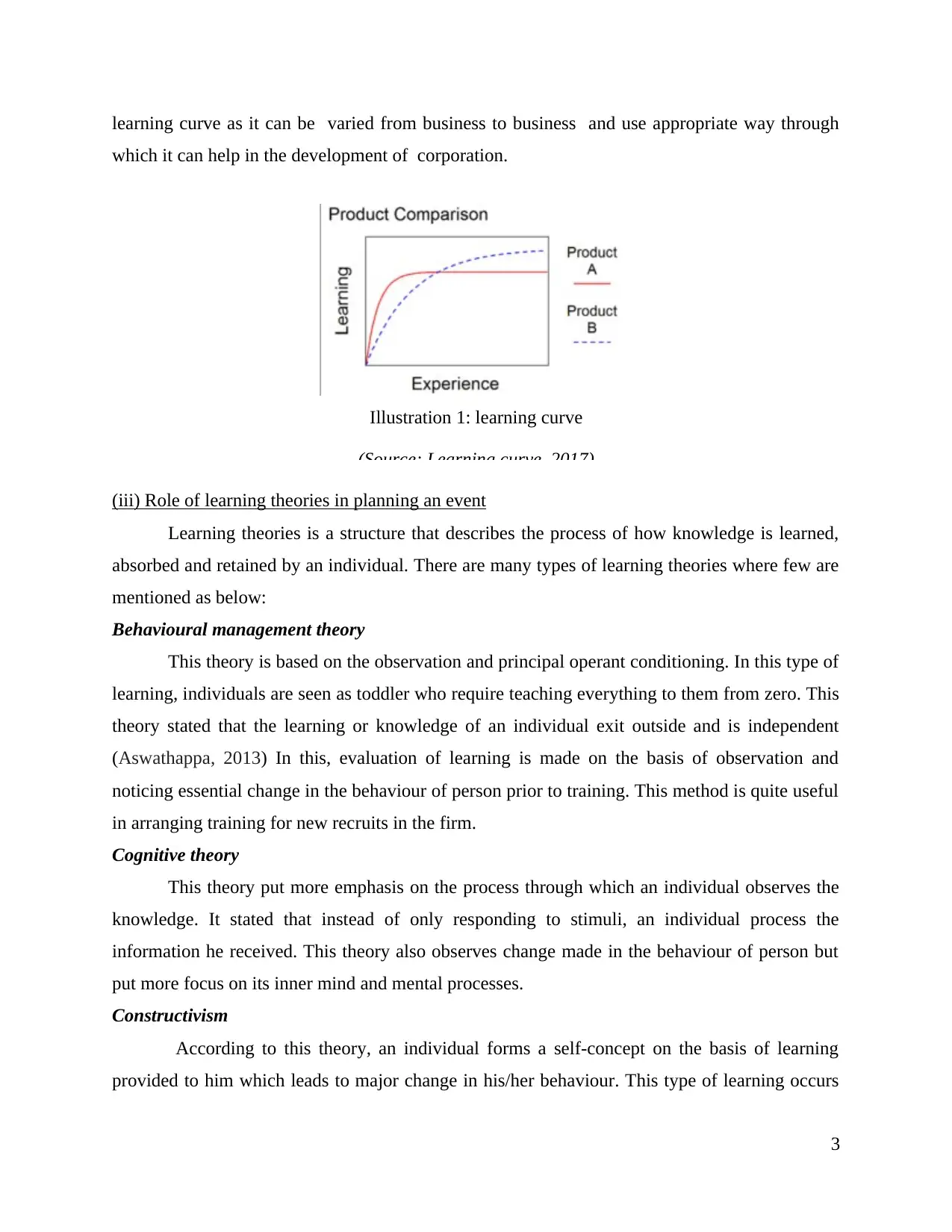
learning curve as it can be varied from business to business and use appropriate way through
which it can help in the development of corporation.
Illustration 1: learning curve
(Source: Learning curve, 2017)
(iii) Role of learning theories in planning an event
Learning theories is a structure that describes the process of how knowledge is learned,
absorbed and retained by an individual. There are many types of learning theories where few are
mentioned as below:
Behavioural management theory
This theory is based on the observation and principal operant conditioning. In this type of
learning, individuals are seen as toddler who require teaching everything to them from zero. This
theory stated that the learning or knowledge of an individual exit outside and is independent
(Aswathappa, 2013) In this, evaluation of learning is made on the basis of observation and
noticing essential change in the behaviour of person prior to training. This method is quite useful
in arranging training for new recruits in the firm.
Cognitive theory
This theory put more emphasis on the process through which an individual observes the
knowledge. It stated that instead of only responding to stimuli, an individual process the
information he received. This theory also observes change made in the behaviour of person but
put more focus on its inner mind and mental processes.
Constructivism
According to this theory, an individual forms a self-concept on the basis of learning
provided to him which leads to major change in his/her behaviour. This type of learning occurs
3
which it can help in the development of corporation.
Illustration 1: learning curve
(Source: Learning curve, 2017)
(iii) Role of learning theories in planning an event
Learning theories is a structure that describes the process of how knowledge is learned,
absorbed and retained by an individual. There are many types of learning theories where few are
mentioned as below:
Behavioural management theory
This theory is based on the observation and principal operant conditioning. In this type of
learning, individuals are seen as toddler who require teaching everything to them from zero. This
theory stated that the learning or knowledge of an individual exit outside and is independent
(Aswathappa, 2013) In this, evaluation of learning is made on the basis of observation and
noticing essential change in the behaviour of person prior to training. This method is quite useful
in arranging training for new recruits in the firm.
Cognitive theory
This theory put more emphasis on the process through which an individual observes the
knowledge. It stated that instead of only responding to stimuli, an individual process the
information he received. This theory also observes change made in the behaviour of person but
put more focus on its inner mind and mental processes.
Constructivism
According to this theory, an individual forms a self-concept on the basis of learning
provided to him which leads to major change in his/her behaviour. This type of learning occurs
3
when person learns new things and connect with the knowledge he had already gained
(Chelladurai and Kerwin, 2017). In this, knowledge is constructed by learner himself on the basis
of experience and perception. This type of learning is unique in its own way as every person has
their own learning and experience.
This learning can be quite useful in arranging training for various people in the firm for
freshers and recruit behaviour theory can be applied while for training of senior management
constructivism can be useful.
TASK 2
(I) Need of training at different levels
An entity is made up of different department who have their own roles and
responsibilities which are quite different and varied in nature. To provide better training and
development programme, it is necessary for higher authority to understand their roles and
provide proper training that can fulfil their needs. To make sure that efficiency and effectiveness
are maintained in the firm, it is necessary to provide training at various levels. Training needed at
various levels are mentioned below:
Director’s level
The training for employees at director level requires proper knowledge of policy making,
good leadership skill, knowledge of current happening in market, budget, finance, etc. This will
assist employees in keeping update with changing environment and market which will aid them
in making appropriate policy and terms that can help firm and workers in their development.
Management level
The training provided to this level should focuses more on the development of decision
making skill, leadership skills etc. Leadership skill training is must for management level as they
are responsible for the development and efficient working of its team. They are required to have
proper training so that their skills in process review, identifying work skill, proper learning of
budget can be enhanced which help them in leading a team smoothly (Kavanagh and Johnson,
2017).
Customer service training
The employee at clerical level are responsible to represent the firm in positive light in
front of customer as they are the only people who came in direct contact of clients. Its necessary
4
(Chelladurai and Kerwin, 2017). In this, knowledge is constructed by learner himself on the basis
of experience and perception. This type of learning is unique in its own way as every person has
their own learning and experience.
This learning can be quite useful in arranging training for various people in the firm for
freshers and recruit behaviour theory can be applied while for training of senior management
constructivism can be useful.
TASK 2
(I) Need of training at different levels
An entity is made up of different department who have their own roles and
responsibilities which are quite different and varied in nature. To provide better training and
development programme, it is necessary for higher authority to understand their roles and
provide proper training that can fulfil their needs. To make sure that efficiency and effectiveness
are maintained in the firm, it is necessary to provide training at various levels. Training needed at
various levels are mentioned below:
Director’s level
The training for employees at director level requires proper knowledge of policy making,
good leadership skill, knowledge of current happening in market, budget, finance, etc. This will
assist employees in keeping update with changing environment and market which will aid them
in making appropriate policy and terms that can help firm and workers in their development.
Management level
The training provided to this level should focuses more on the development of decision
making skill, leadership skills etc. Leadership skill training is must for management level as they
are responsible for the development and efficient working of its team. They are required to have
proper training so that their skills in process review, identifying work skill, proper learning of
budget can be enhanced which help them in leading a team smoothly (Kavanagh and Johnson,
2017).
Customer service training
The employee at clerical level are responsible to represent the firm in positive light in
front of customer as they are the only people who came in direct contact of clients. Its necessary
4
⊘ This is a preview!⊘
Do you want full access?
Subscribe today to unlock all pages.
Trusted by 1+ million students worldwide
of firm to provide them with proper training so that they can mange their customer and can make
good perception of firm in the eye of client. The training provided to them may include
interpersonal skills through which they can interact properly with service user which help firm in
gaining customer satisfaction and loyalty.
Having a proper training on the basis of specific level help firm in the proper transfer of
knowledge. A proper training program should be made on the basis of the need of employee
which help in increasing the efficiency of firm.
(ii) Training method use in organisation.
There are different method that firm can use in order to train their employee some are
mentioned below:
On the job training: In this training is provided at the job while doing the actual work. Some of
its type are mentioned below:
Job rotation: In this type of training, trainee are made to do various job so that knowledge and
experience can be gained. (Anderson, 2013)
Coaching: In this a supervisor is assigned to trainee that direct and help the person in gaining
knowledge.
Advantages
Flexible in nature
less expensive Learning from practical knowledge.
Disadvantage
low productivity
Create stress on both trainee and supervisor.
Off the job training: When employee get trained away from the place of work. Some of its
type include.
Case study method: in this type of method an employee is given a case or problem that firm is
going through and is asked for all possible solution a person can come up with.
Role play: In this a situation is created for a person and trainee are asked to assume a role of
particular person. This whole play get recorded and trainee get a chance to see his own
performance and evaluate it.
Advantages
5
good perception of firm in the eye of client. The training provided to them may include
interpersonal skills through which they can interact properly with service user which help firm in
gaining customer satisfaction and loyalty.
Having a proper training on the basis of specific level help firm in the proper transfer of
knowledge. A proper training program should be made on the basis of the need of employee
which help in increasing the efficiency of firm.
(ii) Training method use in organisation.
There are different method that firm can use in order to train their employee some are
mentioned below:
On the job training: In this training is provided at the job while doing the actual work. Some of
its type are mentioned below:
Job rotation: In this type of training, trainee are made to do various job so that knowledge and
experience can be gained. (Anderson, 2013)
Coaching: In this a supervisor is assigned to trainee that direct and help the person in gaining
knowledge.
Advantages
Flexible in nature
less expensive Learning from practical knowledge.
Disadvantage
low productivity
Create stress on both trainee and supervisor.
Off the job training: When employee get trained away from the place of work. Some of its
type include.
Case study method: in this type of method an employee is given a case or problem that firm is
going through and is asked for all possible solution a person can come up with.
Role play: In this a situation is created for a person and trainee are asked to assume a role of
particular person. This whole play get recorded and trainee get a chance to see his own
performance and evaluate it.
Advantages
5
Paraphrase This Document
Need a fresh take? Get an instant paraphrase of this document with our AI Paraphraser
Provide individual a chance to learn a wide range of skills. Helpful in enhancing critical and analytical skill for other.
Disadvantage
Loss in the working time.
High cost and extra expenditure.
Class room learning: In this learning is provided through workbooks, DVD e learning and
proper trainer. The advantage of this type of learning is that is help in building strong team
foundation. The only disadvantage it has that it create pressure on management as its quite
difficult to arrange such training for large no. of employees.
(iii) Systematic approach to plan training event
Training can be defined as a process through which a skills' knowledge and attitude of an
individual can be enhanced through proper learning which help him is brining the efficiency in
its working style. Systematic approach has been used in order to plan the training event for the
firm.
Training and need analysis : through a proper analysis of the performance of an employee and
its behaviour in context of organisational goal the need of training can be determined. The
supervisory staff of firm is responsible for critical analysis of employee and identifying the need
so that proper training can be initiated. From proper analysis it has come forward that firm
require training in operational management and finance department.
Plan and design training: after determining the need plan can proceed to the next step which
include planning and designing an event. It includes determining of an objective, instructional
method that firm can use, identifying of training material, location etc. (Sparrow, Brewster and
Chung, 2016)
Implementation: Its climax stage of whole process. It can be defined as culmination of all
previous process. This stage include integration of data and research and use of proper learning
style tools that can help in the whole learning process.
Evaluation: Evaluation is not made at the end of whole process but at the end of each step it
maintains the effectiveness and efficiency throughout the process. The evaluation of entire
approach is measure the value of training program on the basis of company goal and employee
performance as well as on his behaviour.
6
Disadvantage
Loss in the working time.
High cost and extra expenditure.
Class room learning: In this learning is provided through workbooks, DVD e learning and
proper trainer. The advantage of this type of learning is that is help in building strong team
foundation. The only disadvantage it has that it create pressure on management as its quite
difficult to arrange such training for large no. of employees.
(iii) Systematic approach to plan training event
Training can be defined as a process through which a skills' knowledge and attitude of an
individual can be enhanced through proper learning which help him is brining the efficiency in
its working style. Systematic approach has been used in order to plan the training event for the
firm.
Training and need analysis : through a proper analysis of the performance of an employee and
its behaviour in context of organisational goal the need of training can be determined. The
supervisory staff of firm is responsible for critical analysis of employee and identifying the need
so that proper training can be initiated. From proper analysis it has come forward that firm
require training in operational management and finance department.
Plan and design training: after determining the need plan can proceed to the next step which
include planning and designing an event. It includes determining of an objective, instructional
method that firm can use, identifying of training material, location etc. (Sparrow, Brewster and
Chung, 2016)
Implementation: Its climax stage of whole process. It can be defined as culmination of all
previous process. This stage include integration of data and research and use of proper learning
style tools that can help in the whole learning process.
Evaluation: Evaluation is not made at the end of whole process but at the end of each step it
maintains the effectiveness and efficiency throughout the process. The evaluation of entire
approach is measure the value of training program on the basis of company goal and employee
performance as well as on his behaviour.
6
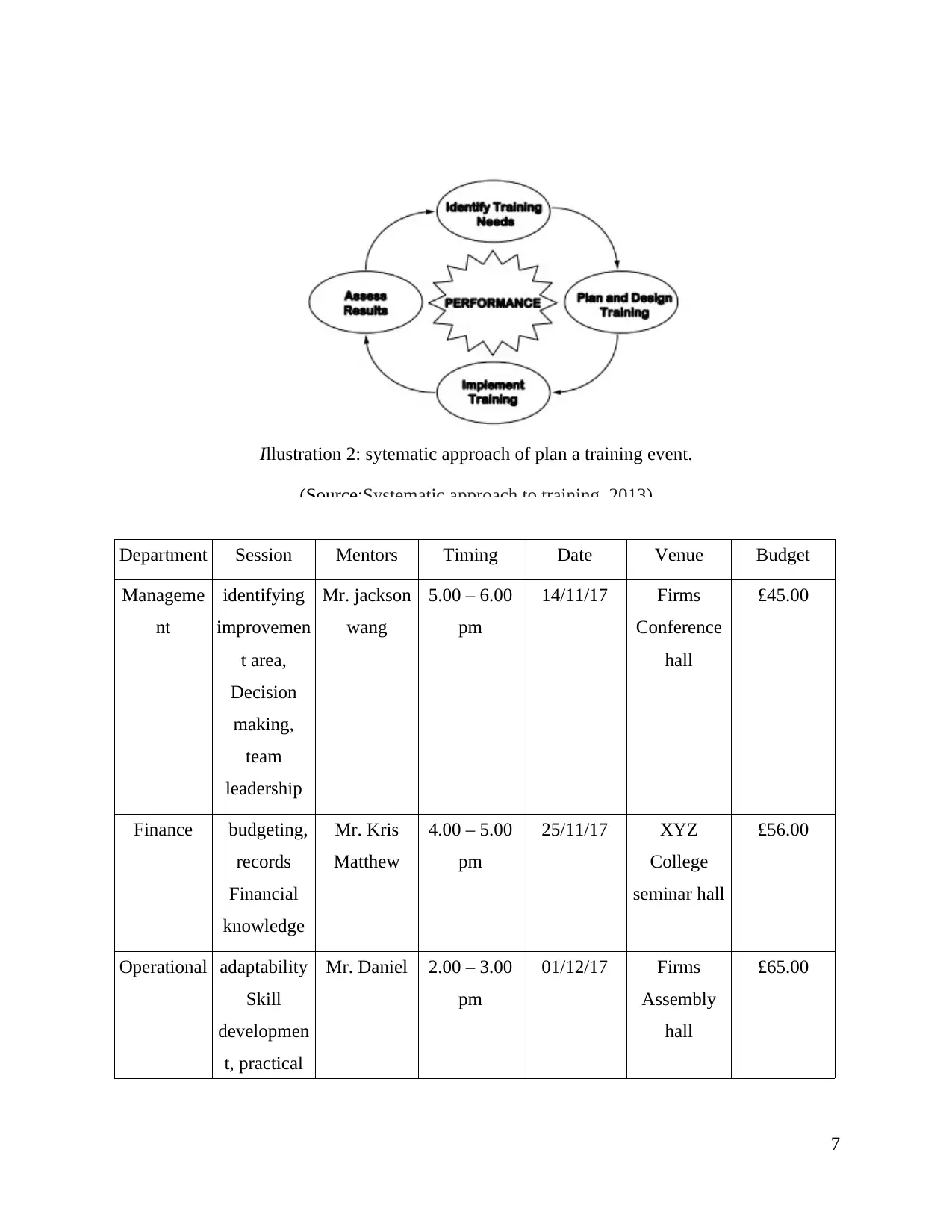
Illustration 2: sytematic approach of plan a training event.
(Source:Systematic approach to training. 2013)
Department Session Mentors Timing Date Venue Budget
Manageme
nt
identifying
improvemen
t area,
Decision
making,
team
leadership
Mr. jackson
wang
5.00 – 6.00
pm
14/11/17 Firms
Conference
hall
£45.00
Finance budgeting,
records
Financial
knowledge
Mr. Kris
Matthew
4.00 – 5.00
pm
25/11/17 XYZ
College
seminar hall
£56.00
Operational adaptability
Skill
developmen
t, practical
Mr. Daniel 2.00 – 3.00
pm
01/12/17 Firms
Assembly
hall
£65.00
7
(Source:Systematic approach to training. 2013)
Department Session Mentors Timing Date Venue Budget
Manageme
nt
identifying
improvemen
t area,
Decision
making,
team
leadership
Mr. jackson
wang
5.00 – 6.00
pm
14/11/17 Firms
Conference
hall
£45.00
Finance budgeting,
records
Financial
knowledge
Mr. Kris
Matthew
4.00 – 5.00
pm
25/11/17 XYZ
College
seminar hall
£56.00
Operational adaptability
Skill
developmen
t, practical
Mr. Daniel 2.00 – 3.00
pm
01/12/17 Firms
Assembly
hall
£65.00
7
⊘ This is a preview!⊘
Do you want full access?
Subscribe today to unlock all pages.
Trusted by 1+ million students worldwide
knowledge
Problems
There are many many problems a firm can face during whole process. The lack of knowledge or
negligence in working can cause big hindrance in this whole process. Negligence in identifying
the need of trainee will make whole process useless. Along with this budget has also been an
problem as it difficult to arrange a place where training for such a big no. can occur, in addition
to this hiring professional was also expensive.
TASK 3
(i) Techniques used in the evaluation of training session (140)
Kirkpatrick model can be quite useful for evaluating the effectiveness of the training
session.
Reaction: it observes the reaction of employee toward the training provided to them were they
satisfied and find training relevant or were they dissatisfied by organisation.
Learning: This stage focuses on the learning whether the individual learn anything or not. It
provides a scale which measure the length which a person was able to acquire knowledge or grab
the skill through training.
Behaviour: This step observe the employee and see whether employees are using the knowledge
in practical working (Purce, 2014Reynolds, 2017)
Results : This is a last stage where the evaluation of whole process is made on the basis of the
firm achievement whether the goals and objectives of firm was achieved or not are measured in
this.
Other than this other methods can also be used:
Customer feedback: Asking the view of customer can also help in evaluation. It will be quite
effective to evaluate the performance of people at clerical level.
Training audit: it observes the sales of firm before the training session and after the training
session and notice whether there is some change or not.
Strongly
Agree
Agree Neutral Disagree Strongly
Disagree
8
Problems
There are many many problems a firm can face during whole process. The lack of knowledge or
negligence in working can cause big hindrance in this whole process. Negligence in identifying
the need of trainee will make whole process useless. Along with this budget has also been an
problem as it difficult to arrange a place where training for such a big no. can occur, in addition
to this hiring professional was also expensive.
TASK 3
(i) Techniques used in the evaluation of training session (140)
Kirkpatrick model can be quite useful for evaluating the effectiveness of the training
session.
Reaction: it observes the reaction of employee toward the training provided to them were they
satisfied and find training relevant or were they dissatisfied by organisation.
Learning: This stage focuses on the learning whether the individual learn anything or not. It
provides a scale which measure the length which a person was able to acquire knowledge or grab
the skill through training.
Behaviour: This step observe the employee and see whether employees are using the knowledge
in practical working (Purce, 2014Reynolds, 2017)
Results : This is a last stage where the evaluation of whole process is made on the basis of the
firm achievement whether the goals and objectives of firm was achieved or not are measured in
this.
Other than this other methods can also be used:
Customer feedback: Asking the view of customer can also help in evaluation. It will be quite
effective to evaluate the performance of people at clerical level.
Training audit: it observes the sales of firm before the training session and after the training
session and notice whether there is some change or not.
Strongly
Agree
Agree Neutral Disagree Strongly
Disagree
8
Paraphrase This Document
Need a fresh take? Get an instant paraphrase of this document with our AI Paraphraser
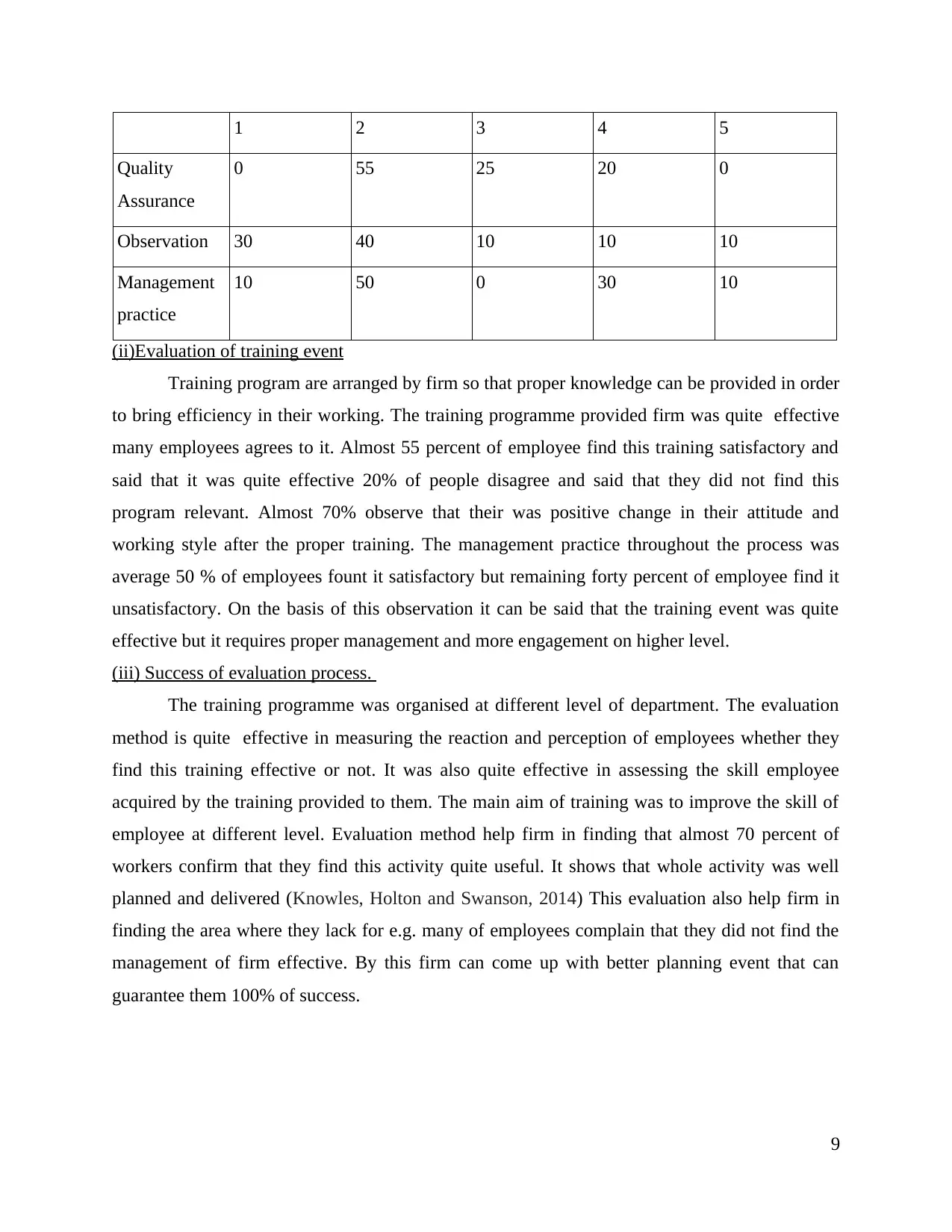
1 2 3 4 5
Quality
Assurance
0 55 25 20 0
Observation 30 40 10 10 10
Management
practice
10 50 0 30 10
(ii)Evaluation of training event
Training program are arranged by firm so that proper knowledge can be provided in order
to bring efficiency in their working. The training programme provided firm was quite effective
many employees agrees to it. Almost 55 percent of employee find this training satisfactory and
said that it was quite effective 20% of people disagree and said that they did not find this
program relevant. Almost 70% observe that their was positive change in their attitude and
working style after the proper training. The management practice throughout the process was
average 50 % of employees fount it satisfactory but remaining forty percent of employee find it
unsatisfactory. On the basis of this observation it can be said that the training event was quite
effective but it requires proper management and more engagement on higher level.
(iii) Success of evaluation process.
The training programme was organised at different level of department. The evaluation
method is quite effective in measuring the reaction and perception of employees whether they
find this training effective or not. It was also quite effective in assessing the skill employee
acquired by the training provided to them. The main aim of training was to improve the skill of
employee at different level. Evaluation method help firm in finding that almost 70 percent of
workers confirm that they find this activity quite useful. It shows that whole activity was well
planned and delivered (Knowles, Holton and Swanson, 2014) This evaluation also help firm in
finding the area where they lack for e.g. many of employees complain that they did not find the
management of firm effective. By this firm can come up with better planning event that can
guarantee them 100% of success.
9
Quality
Assurance
0 55 25 20 0
Observation 30 40 10 10 10
Management
practice
10 50 0 30 10
(ii)Evaluation of training event
Training program are arranged by firm so that proper knowledge can be provided in order
to bring efficiency in their working. The training programme provided firm was quite effective
many employees agrees to it. Almost 55 percent of employee find this training satisfactory and
said that it was quite effective 20% of people disagree and said that they did not find this
program relevant. Almost 70% observe that their was positive change in their attitude and
working style after the proper training. The management practice throughout the process was
average 50 % of employees fount it satisfactory but remaining forty percent of employee find it
unsatisfactory. On the basis of this observation it can be said that the training event was quite
effective but it requires proper management and more engagement on higher level.
(iii) Success of evaluation process.
The training programme was organised at different level of department. The evaluation
method is quite effective in measuring the reaction and perception of employees whether they
find this training effective or not. It was also quite effective in assessing the skill employee
acquired by the training provided to them. The main aim of training was to improve the skill of
employee at different level. Evaluation method help firm in finding that almost 70 percent of
workers confirm that they find this activity quite useful. It shows that whole activity was well
planned and delivered (Knowles, Holton and Swanson, 2014) This evaluation also help firm in
finding the area where they lack for e.g. many of employees complain that they did not find the
management of firm effective. By this firm can come up with better planning event that can
guarantee them 100% of success.
9
TASK 4
(I) Role of government in training development and lifelong learning
Government understands the role individual play in the development of strong economy.
In order to support the individual many programmes and changes has been made so that skills of
workers can be enhanced. By looking at changing technology and population necessary changes
are made so that proper investment in skills can be made along with lifelong learning so that
positive impact can be made on the productivity of nation (Armstrong and Taylor, 2014) There
are many programs that are organised by the government few are mentioned below:
Digital skill and lifetime learning: This scheme focus on slow adaptors who still are unaware of
digital learning this type of people are unable to take advantage of online services which affect
their working. These people generally come from lower income house or are unemployed or
disabled. This program is specially designed targeting this people so that skill and efficiency can
be enhanced.
Apprenticeship skills: Its one of the most effective way initiated by government to enhance the
skills of labour. In this person get a chance to work as an apprentice in one of the leading firm of
nation so that he can enhance its skill. This programmes play major role in the enhancement of
the skills among the working class of nation
(ii) Impact of competency movement
Competency movement change the view of public and private sector. It makes
organisation more cautious regarding the performance of employee. This movement put more
focus on the capability of people in carrying various role and responsibility. It makes
organisation realize that performance of workforce play major role in the success of firm
(Brewster and Hegewisch, 2017) With the competency movement business entity started
focusing more on the development of the knowledge and skill of an individual, various training
and workshop programme was arranges so that competency can be bought. This also help firm in
gaining competitive advantage in market.
(iii) Training initiative of government aided in human resource developemnt.
There are many training programmes that has been used by different organisation in order
to increase the efficiency of employees. Few of which are mentioned below.
IiP: This scheme was introduce by government in order to bring efficiency in the management
of people. This programmes provide accreditation to various firm that are interested in the
10
(I) Role of government in training development and lifelong learning
Government understands the role individual play in the development of strong economy.
In order to support the individual many programmes and changes has been made so that skills of
workers can be enhanced. By looking at changing technology and population necessary changes
are made so that proper investment in skills can be made along with lifelong learning so that
positive impact can be made on the productivity of nation (Armstrong and Taylor, 2014) There
are many programs that are organised by the government few are mentioned below:
Digital skill and lifetime learning: This scheme focus on slow adaptors who still are unaware of
digital learning this type of people are unable to take advantage of online services which affect
their working. These people generally come from lower income house or are unemployed or
disabled. This program is specially designed targeting this people so that skill and efficiency can
be enhanced.
Apprenticeship skills: Its one of the most effective way initiated by government to enhance the
skills of labour. In this person get a chance to work as an apprentice in one of the leading firm of
nation so that he can enhance its skill. This programmes play major role in the enhancement of
the skills among the working class of nation
(ii) Impact of competency movement
Competency movement change the view of public and private sector. It makes
organisation more cautious regarding the performance of employee. This movement put more
focus on the capability of people in carrying various role and responsibility. It makes
organisation realize that performance of workforce play major role in the success of firm
(Brewster and Hegewisch, 2017) With the competency movement business entity started
focusing more on the development of the knowledge and skill of an individual, various training
and workshop programme was arranges so that competency can be bought. This also help firm in
gaining competitive advantage in market.
(iii) Training initiative of government aided in human resource developemnt.
There are many training programmes that has been used by different organisation in order
to increase the efficiency of employees. Few of which are mentioned below.
IiP: This scheme was introduce by government in order to bring efficiency in the management
of people. This programmes provide accreditation to various firm that are interested in the
10
⊘ This is a preview!⊘
Do you want full access?
Subscribe today to unlock all pages.
Trusted by 1+ million students worldwide

1 out of 15


Related Documents


Your All-in-One AI-Powered Toolkit for Academic Success.
+13062052269
info@desklib.com
Available 24*7 on WhatsApp / Email
![[object Object]](/_next/static/media/star-bottom.7253800d.svg)
Unlock your academic potential
Copyright © 2020–2026 A2Z Services. All Rights Reserved. Developed and managed by ZUCOL.