Organisational Behaviour Report: Leadership and Team Dynamics
VerifiedAdded on 2019/12/28
|37
|7866
|340
Report
AI Summary
This report provides a comprehensive analysis of organisational behaviour, focusing on key aspects such as organisational culture, structure, leadership styles, and team dynamics. It begins by defining organisational behaviour and exploring the relationship between culture and structure, examining how they impact business performance. The report then delves into factors influencing individual behaviour at work and the role of managers in developing effective policies. Different leadership styles are compared, considering their effectiveness in various organisational contexts, particularly within the sales department. Furthermore, the report evaluates management functions and skills applicable to the sales department, using examples from different organisations. The report also examines team selection, development, and the impact of technology on team functioning within the HRM department, highlighting barriers to effective teamwork and strategies for improvement. Overall, the report aims to provide insights into creating a positive and productive work environment.
Organisation and Behaviour
Contents
INTRODUCTION...........................................................................................................................................2
TASK 1..........................................................................................................................................................3
1.1 What is the culture and use of an organizational structure in an organization? How the team
formed have compared and contrasted their organizational structure and culture to other possible
organizations...........................................................................................................................................3
1.2 Further explain the importance of the relationship of structure and culture and how both can have
an impact on the performance of a business..........................................................................................5
1.3 List and explain all the factors which could influence individual behaviour at work and the likely
problems a manager should be aware of, in relation to developing new policies...................................6
TASK 2..........................................................................................................................................................8
2.1 Compare the effectiveness of different leadership style in different organizations and situations...8
2.2 The functions and the nature of management that would be suited to the sales department.......10
2.3 Explain with the use of different organizations how you would evaluate the different approaches
to management skills & theories and which could be applied to the sales department.......................13
TASK 3........................................................................................................................................................14
TASK 4........................................................................................................................................................17
4.1 How an effective team was selected by you to carry out the task within the HRM department.....17
4.2 Describe the barriers which prevented the development of an effective team in the HRM
department and how did the team perform once it became cohesive.................................................19
4.3 Evaluate what was the impact of technology on the team functioning within the HRM department
...............................................................................................................................................................21
CONCLUSION.............................................................................................................................................22
REFERENCES..............................................................................................................................................23
1 | P a g e
Contents
INTRODUCTION...........................................................................................................................................2
TASK 1..........................................................................................................................................................3
1.1 What is the culture and use of an organizational structure in an organization? How the team
formed have compared and contrasted their organizational structure and culture to other possible
organizations...........................................................................................................................................3
1.2 Further explain the importance of the relationship of structure and culture and how both can have
an impact on the performance of a business..........................................................................................5
1.3 List and explain all the factors which could influence individual behaviour at work and the likely
problems a manager should be aware of, in relation to developing new policies...................................6
TASK 2..........................................................................................................................................................8
2.1 Compare the effectiveness of different leadership style in different organizations and situations...8
2.2 The functions and the nature of management that would be suited to the sales department.......10
2.3 Explain with the use of different organizations how you would evaluate the different approaches
to management skills & theories and which could be applied to the sales department.......................13
TASK 3........................................................................................................................................................14
TASK 4........................................................................................................................................................17
4.1 How an effective team was selected by you to carry out the task within the HRM department.....17
4.2 Describe the barriers which prevented the development of an effective team in the HRM
department and how did the team perform once it became cohesive.................................................19
4.3 Evaluate what was the impact of technology on the team functioning within the HRM department
...............................................................................................................................................................21
CONCLUSION.............................................................................................................................................22
REFERENCES..............................................................................................................................................23
1 | P a g e

Paraphrase This Document
Need a fresh take? Get an instant paraphrase of this document with our AI Paraphraser
Organisation and Behaviour
INTRODUCTION
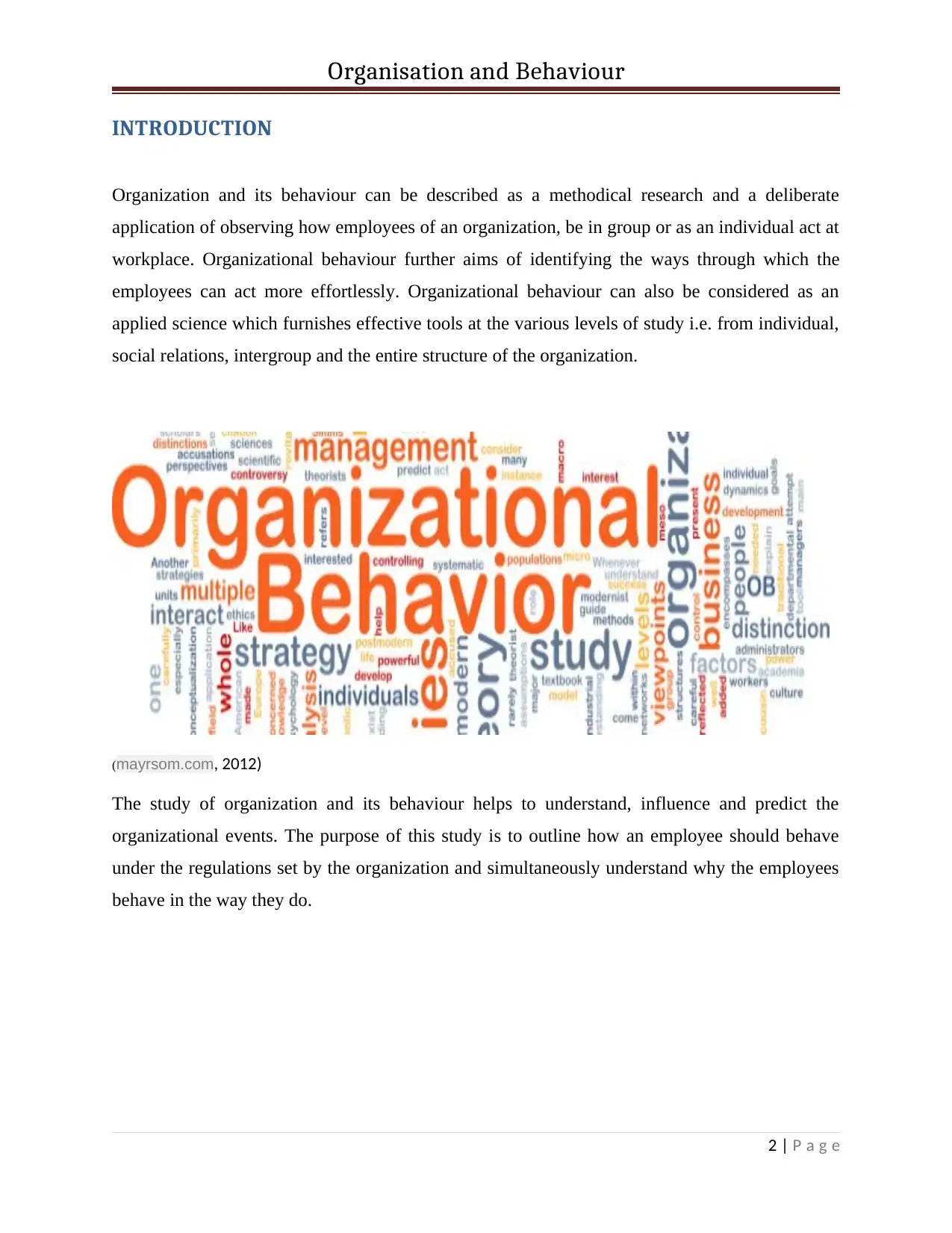
Organization and its behaviour can be described as a methodical research and a deliberate
application of observing how employees of an organization, be in group or as an individual act at
workplace. Organizational behaviour further aims of identifying the ways through which the
employees can act more effortlessly. Organizational behaviour can also be considered as an
applied science which furnishes effective tools at the various levels of study i.e. from individual,
social relations, intergroup and the entire structure of the organization.
(mayrsom.com, 2012)
The study of organization and its behaviour helps to understand, influence and predict the
organizational events. The purpose of this study is to outline how an employee should behave
under the regulations set by the organization and simultaneously understand why the employees
behave in the way they do.
2 | P a g e
INTRODUCTION
Organization and its behaviour can be described as a methodical research and a deliberate
application of observing how employees of an organization, be in group or as an individual act at
workplace. Organizational behaviour further aims of identifying the ways through which the
employees can act more effortlessly. Organizational behaviour can also be considered as an
applied science which furnishes effective tools at the various levels of study i.e. from individual,
social relations, intergroup and the entire structure of the organization.
(mayrsom.com, 2012)
The study of organization and its behaviour helps to understand, influence and predict the
organizational events. The purpose of this study is to outline how an employee should behave
under the regulations set by the organization and simultaneously understand why the employees
behave in the way they do.
2 | P a g e
Organisation and Behaviour
TASK 1
1.1 What is the culture and use of an organizational structure in an
organization? How the team formed have compared and contrasted their
organizational structure and culture to other possible organizations
The structure of an organization is process through which an organization functions and executes
its business activities whereas the culture of an organization is the philosophies, perspectives,
beliefs and the practices which further represent the organization. The culture of an organization
is a mere reflection of the characteristics which help an organization to differ itself from another.
In other words we can say that the organizational culture in general relates to the image of the
organization where each of it reinforces and appraises the other. (Flamholtz, 2012)
There are various kinds of organizational structures which varies depending upon their
functionalities and purposes. These are:
In centralised organization structure the decision making power lies in the hands of limited
influential people working in the top management of the organization. These people show their
command and control over the entire operations of the organization and does not normally
appreciate or empower others to involve in the process.
In participative organizational structure, everyone working in the organization are equally
valued and motivated to involve in decision making process giving more empowerment in their
hands. Hence, this structure allows empowerment to express individual ideas or opinions on
various matters in a participative manner.
In Tall organizational Structure, the chain of command is widely distributed and structured into
various levels and hence has clarity of roles and functions. Hence, control becomes easier and
well executed.
In Flat organizational Structure, there is no separate secondary level and the entire functions
are controlled and monitored under the supervision of top management. The top level enjoys
authoritative capacity.
Organizations structure and culture
It has been observed that every organization possesses its very own unique structure and culture.
The structure of an organization exemplifies a coherent administration in the management and
3 | P a g e
TASK 1
1.1 What is the culture and use of an organizational structure in an
organization? How the team formed have compared and contrasted their
organizational structure and culture to other possible organizations
The structure of an organization is process through which an organization functions and executes
its business activities whereas the culture of an organization is the philosophies, perspectives,
beliefs and the practices which further represent the organization. The culture of an organization
is a mere reflection of the characteristics which help an organization to differ itself from another.
In other words we can say that the organizational culture in general relates to the image of the
organization where each of it reinforces and appraises the other. (Flamholtz, 2012)
There are various kinds of organizational structures which varies depending upon their
functionalities and purposes. These are:
In centralised organization structure the decision making power lies in the hands of limited
influential people working in the top management of the organization. These people show their
command and control over the entire operations of the organization and does not normally
appreciate or empower others to involve in the process.
In participative organizational structure, everyone working in the organization are equally
valued and motivated to involve in decision making process giving more empowerment in their
hands. Hence, this structure allows empowerment to express individual ideas or opinions on
various matters in a participative manner.
In Tall organizational Structure, the chain of command is widely distributed and structured into
various levels and hence has clarity of roles and functions. Hence, control becomes easier and
well executed.
In Flat organizational Structure, there is no separate secondary level and the entire functions
are controlled and monitored under the supervision of top management. The top level enjoys
authoritative capacity.
Organizations structure and culture
It has been observed that every organization possesses its very own unique structure and culture.
The structure of an organization exemplifies a coherent administration in the management and
3 | P a g e
⊘ This is a preview!⊘
Do you want full access?
Subscribe today to unlock all pages.

Trusted by 1+ million students worldwide
Organisation and Behaviour
passing on of information which further helps in adequate allocation of the human resources and
other assets of the organization. It is necessary that organizational structure is elementary in
nature as it will further help to assimilate the individual working of an employee and the
management. An organization should raise a kind of culture which will further help in cultivating
a name for the organization as it is known fact that the culture of an organization which makes it
extraordinary and different from the other organizations. It has been observed that a culture
presents a transparent interpretation of the prospect and approach of the organization. An
organization gets to be known because of its culture and beliefs it has derived since its inception.
The management of the organization is solely responsible for making decisions and ensure that
all the operations of the business are efficiently executed in compliance to the ground rule set in
the organization. The employees are expected to work accordingly under the guidelines given by
the management. The jobs are allocated accordingly to every employee and a timeframe is set so
that all employees can give their contribution in achieving the goals of the organization by
coordinating with each other and if necessary, work together as a team. The workforce is divided
as per their expertise which further empowers them to excel in their respective fields. Also the
manager of every department who is answerable to the management supports the team when and
wherever needed which helps in scheduled accomplishment of the job given.
Organisational culture is based on workplace environment where all people have shared
assumptions, values and beliefs, which govern how people behave in organisation. On the other
side firm’s structure is laid on formal functions where whole management coordinate and control
entire system of the firm. It is a formal arrangement of roles and responsibilities with in
enterprise.
In this context HR department has been asked to form a team that can study on different aspects
of culture, structure, policies, leadership and management styles to motivate the sales team and
resolve their concerns. The newly built HR team has analysed and identified various culture and
structures across leading companies and has decided to reform to adapt to new changes. Some of
the other organization’s that were analysed are:
Take for example, Hartridges which is a soft drink manufacturing company has a centralized
organizational structure has helped it to gain empowerment, increase in productivity and lower
the level of crisis. The influence of Hartridges culture can be seen in its operations. It has been
4 | P a g e
passing on of information which further helps in adequate allocation of the human resources and
other assets of the organization. It is necessary that organizational structure is elementary in
nature as it will further help to assimilate the individual working of an employee and the
management. An organization should raise a kind of culture which will further help in cultivating
a name for the organization as it is known fact that the culture of an organization which makes it
extraordinary and different from the other organizations. It has been observed that a culture
presents a transparent interpretation of the prospect and approach of the organization. An
organization gets to be known because of its culture and beliefs it has derived since its inception.
The management of the organization is solely responsible for making decisions and ensure that
all the operations of the business are efficiently executed in compliance to the ground rule set in
the organization. The employees are expected to work accordingly under the guidelines given by
the management. The jobs are allocated accordingly to every employee and a timeframe is set so
that all employees can give their contribution in achieving the goals of the organization by
coordinating with each other and if necessary, work together as a team. The workforce is divided
as per their expertise which further empowers them to excel in their respective fields. Also the
manager of every department who is answerable to the management supports the team when and
wherever needed which helps in scheduled accomplishment of the job given.
Organisational culture is based on workplace environment where all people have shared
assumptions, values and beliefs, which govern how people behave in organisation. On the other
side firm’s structure is laid on formal functions where whole management coordinate and control
entire system of the firm. It is a formal arrangement of roles and responsibilities with in
enterprise.
In this context HR department has been asked to form a team that can study on different aspects
of culture, structure, policies, leadership and management styles to motivate the sales team and
resolve their concerns. The newly built HR team has analysed and identified various culture and
structures across leading companies and has decided to reform to adapt to new changes. Some of
the other organization’s that were analysed are:
Take for example, Hartridges which is a soft drink manufacturing company has a centralized
organizational structure has helped it to gain empowerment, increase in productivity and lower
the level of crisis. The influence of Hartridges culture can be seen in its operations. It has been
4 | P a g e
Paraphrase This Document
Need a fresh take? Get an instant paraphrase of this document with our AI Paraphraser
Organisation and Behaviour
observed that Hartridges thinks of the welfare of its employees along with the customers and
hence ensures that healthy working environments are provided to the employees and quality
products are send in the market for customer consumption. The marketing strategies of
Hartridges aim to target maximum number of customers and because of availability of variety in
the products it has also become easier for the customers to choose a drink which suites their taste
buds. Being a global exporter Hartridges emphasizes that its employees bring innovation in their
working styles. The management also organizes adequate training programs so that the
employees can enhance their skills in order to remain competitive in the market. Training also
boosts their confidence level and prepares them to deal with crisis situations. The organizational
culture of Hartridges believes in acquiring goodwill and grandeur.
Another example is CITI which is a leading global bank. They have Tall structure where each
level and function has department heads who oversee and command functional responsibilities.
Thus their approach is strategic and aggressive where new possibilities are first explored and
marketed at discounted tariffs to catch market volume as compared to their rivals and once they
set off, a more in-house model is being followed.
5 | P a g e
observed that Hartridges thinks of the welfare of its employees along with the customers and
hence ensures that healthy working environments are provided to the employees and quality
products are send in the market for customer consumption. The marketing strategies of
Hartridges aim to target maximum number of customers and because of availability of variety in
the products it has also become easier for the customers to choose a drink which suites their taste
buds. Being a global exporter Hartridges emphasizes that its employees bring innovation in their
working styles. The management also organizes adequate training programs so that the
employees can enhance their skills in order to remain competitive in the market. Training also
boosts their confidence level and prepares them to deal with crisis situations. The organizational
culture of Hartridges believes in acquiring goodwill and grandeur.
Another example is CITI which is a leading global bank. They have Tall structure where each
level and function has department heads who oversee and command functional responsibilities.
Thus their approach is strategic and aggressive where new possibilities are first explored and
marketed at discounted tariffs to catch market volume as compared to their rivals and once they
set off, a more in-house model is being followed.
5 | P a g e
Organisation and Behaviour
1.2 Further explain the importance of the relationship of structure and culture
and how both can have an impact on the performance of a business
It has been observed that the operations of an organization get influenced by the relationship
between its structure and culture. The success and failure of an organization is entirely dependent
on the kind of structure and culture it promotes. By cultivating a competitive organizational
structure and culture an organization easily seek the attention of the customers and effectively
deal with constant competition it faces from the rival companies. The overall productivity of an
organization depends on its structure even if the employee strength of the organization is
minimal. The productivity of a change in the structure of an organization is dependent on the
organizational culture. By maintaining an efficient culture, an organization can further derive a
well planned organizational structure which will help the business to expand its network around
the world. The culture of an organization engages its structure in spite of being interconnected.
Organizational culture represents a larger prospect which contains countless problems and
organization’s aspects whereas the organizational structure refers the facilities required for the
smooth functioning of the business along with infrastructural development. The structure and
culture of an organization help the management to set goals and objectives for the business. A
competent culture and structure will further help the workforce to evolve professionally.
Organizational structure improves the overall performance of the business whereas
organizational culture establishes coordination at workplace. (Becker, 2013)
6 | P a g e
1.2 Further explain the importance of the relationship of structure and culture
and how both can have an impact on the performance of a business
It has been observed that the operations of an organization get influenced by the relationship
between its structure and culture. The success and failure of an organization is entirely dependent
on the kind of structure and culture it promotes. By cultivating a competitive organizational
structure and culture an organization easily seek the attention of the customers and effectively
deal with constant competition it faces from the rival companies. The overall productivity of an
organization depends on its structure even if the employee strength of the organization is
minimal. The productivity of a change in the structure of an organization is dependent on the
organizational culture. By maintaining an efficient culture, an organization can further derive a
well planned organizational structure which will help the business to expand its network around
the world. The culture of an organization engages its structure in spite of being interconnected.
Organizational culture represents a larger prospect which contains countless problems and
organization’s aspects whereas the organizational structure refers the facilities required for the
smooth functioning of the business along with infrastructural development. The structure and
culture of an organization help the management to set goals and objectives for the business. A
competent culture and structure will further help the workforce to evolve professionally.
Organizational structure improves the overall performance of the business whereas
organizational culture establishes coordination at workplace. (Becker, 2013)
6 | P a g e
⊘ This is a preview!⊘
Do you want full access?
Subscribe today to unlock all pages.
Trusted by 1+ million students worldwide
Organisation and Behaviour
1.3 List and explain all the factors which could influence individual behaviour
at work and the likely problems a manager should be aware of, in relation to
developing new policies
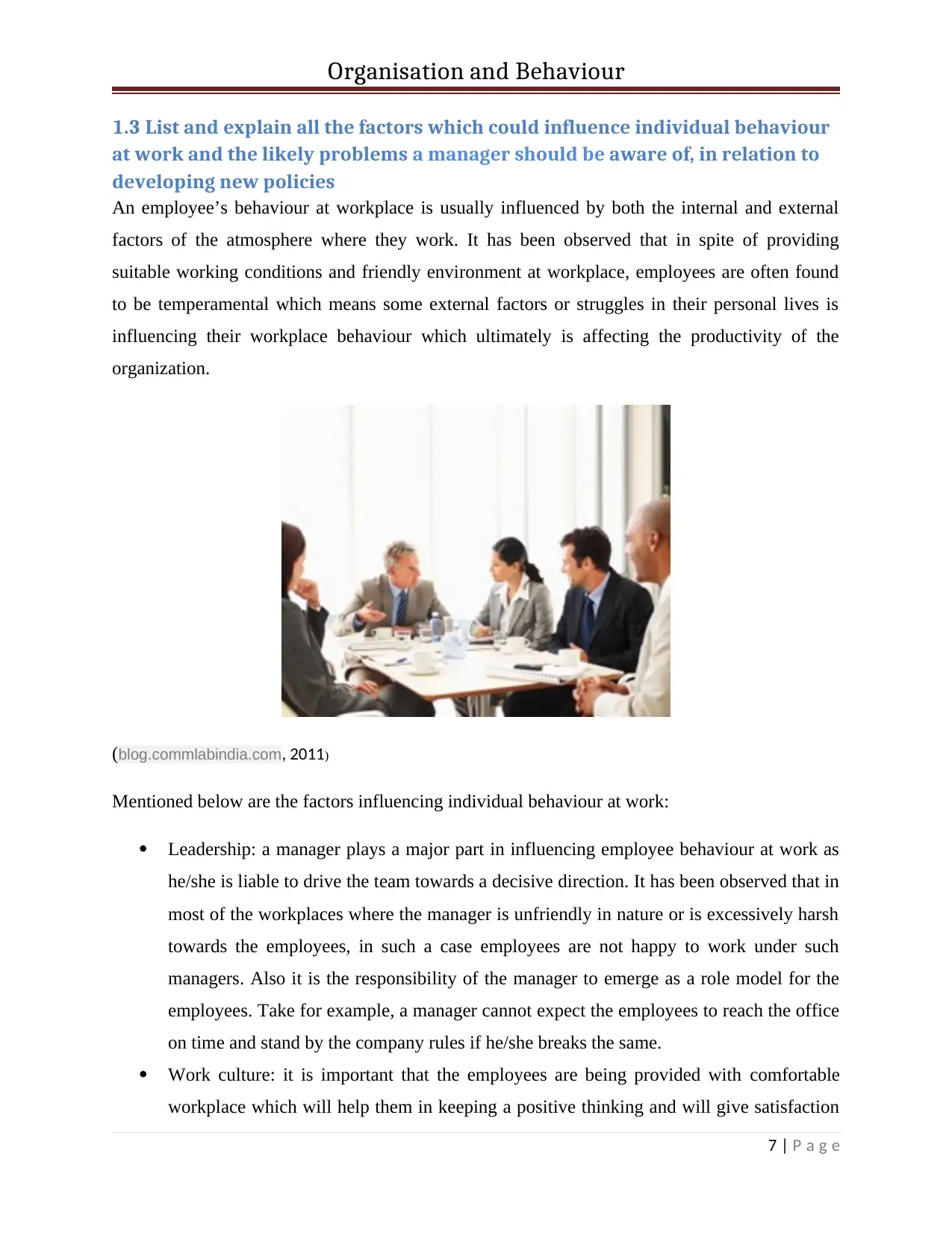
An employee’s behaviour at workplace is usually influenced by both the internal and external
factors of the atmosphere where they work. It has been observed that in spite of providing
suitable working conditions and friendly environment at workplace, employees are often found
to be temperamental which means some external factors or struggles in their personal lives is
influencing their workplace behaviour which ultimately is affecting the productivity of the
organization.
(blog.commlabindia.com, 2011)
Mentioned below are the factors influencing individual behaviour at work:
Leadership: a manager plays a major part in influencing employee behaviour at work as
he/she is liable to drive the team towards a decisive direction. It has been observed that in
most of the workplaces where the manager is unfriendly in nature or is excessively harsh
towards the employees, in such a case employees are not happy to work under such
managers. Also it is the responsibility of the manager to emerge as a role model for the
employees. Take for example, a manager cannot expect the employees to reach the office
on time and stand by the company rules if he/she breaks the same.
Work culture: it is important that the employees are being provided with comfortable
workplace which will help them in keeping a positive thinking and will give satisfaction
7 | P a g e
1.3 List and explain all the factors which could influence individual behaviour
at work and the likely problems a manager should be aware of, in relation to
developing new policies
An employee’s behaviour at workplace is usually influenced by both the internal and external
factors of the atmosphere where they work. It has been observed that in spite of providing
suitable working conditions and friendly environment at workplace, employees are often found
to be temperamental which means some external factors or struggles in their personal lives is
influencing their workplace behaviour which ultimately is affecting the productivity of the
organization.
(blog.commlabindia.com, 2011)
Mentioned below are the factors influencing individual behaviour at work:
Leadership: a manager plays a major part in influencing employee behaviour at work as
he/she is liable to drive the team towards a decisive direction. It has been observed that in
most of the workplaces where the manager is unfriendly in nature or is excessively harsh
towards the employees, in such a case employees are not happy to work under such
managers. Also it is the responsibility of the manager to emerge as a role model for the
employees. Take for example, a manager cannot expect the employees to reach the office
on time and stand by the company rules if he/she breaks the same.
Work culture: it is important that the employees are being provided with comfortable
workplace which will help them in keeping a positive thinking and will give satisfaction
7 | P a g e
Paraphrase This Document
Need a fresh take? Get an instant paraphrase of this document with our AI Paraphraser
Organisation and Behaviour
at work. Also the management should ensure that the rules imposed are equal for every
employee and maintain transparency at all levels. Reporting to the managers should be
encouraged and the system for the same should be uncomplicated. Apart from this,
security in job is also an essential factor which influences employee behaviour at work.
When an employee sees that the management stands by the employee through thick and
thin then automatically the employees will also move back from their commitment
towards the organization.
Job duties: a manager should distribute work as per the capabilities of the employees.
Forcing an employee to do something they are not good at will only affect the
organization as in such a situation the employees will work half heartedly. Also the
manager should ensure that the employees are not overburdened as they tend to get
irritated if they get burdened under responsibilities and the affect of this can be seen in
their performances.
Communication: a manger should establish effective communication amid the employees
as an employee feels that he/she is not being accepted as a part of the group then they
tend to lose interest and focus in their work. Employees should be encouraged to share
their views and keep their grievances without any hesitation.
Personal life: the behaviour of an employee gets affected if he/she is going through some
personal turmoil. Struggles in personal lives make them irritated and they lose their focus
on the job. It has often been found that an employee who is facing a tensed relation with
his/her family tend to sit late at work.
Workplace relations: a manager should encourage the employees to develop friendship
with each other so that they can share their prior experiences both at personal and
professional levels. Working in isolation can bring changes in the behaviour of an
employee. Restricting interaction with co-workers can lead to frustration and stress in the
employees which can bring a negative environment at workplace.
(Furnham, 2002)
8 | P a g e
at work. Also the management should ensure that the rules imposed are equal for every
employee and maintain transparency at all levels. Reporting to the managers should be
encouraged and the system for the same should be uncomplicated. Apart from this,
security in job is also an essential factor which influences employee behaviour at work.
When an employee sees that the management stands by the employee through thick and
thin then automatically the employees will also move back from their commitment
towards the organization.
Job duties: a manager should distribute work as per the capabilities of the employees.
Forcing an employee to do something they are not good at will only affect the
organization as in such a situation the employees will work half heartedly. Also the
manager should ensure that the employees are not overburdened as they tend to get
irritated if they get burdened under responsibilities and the affect of this can be seen in
their performances.
Communication: a manger should establish effective communication amid the employees
as an employee feels that he/she is not being accepted as a part of the group then they
tend to lose interest and focus in their work. Employees should be encouraged to share
their views and keep their grievances without any hesitation.
Personal life: the behaviour of an employee gets affected if he/she is going through some
personal turmoil. Struggles in personal lives make them irritated and they lose their focus
on the job. It has often been found that an employee who is facing a tensed relation with
his/her family tend to sit late at work.
Workplace relations: a manager should encourage the employees to develop friendship
with each other so that they can share their prior experiences both at personal and
professional levels. Working in isolation can bring changes in the behaviour of an
employee. Restricting interaction with co-workers can lead to frustration and stress in the
employees which can bring a negative environment at workplace.
(Furnham, 2002)
8 | P a g e
Organisation and Behaviour
TASK 2
2.1 Compare the effectiveness of different leadership style in different
organizations and situations
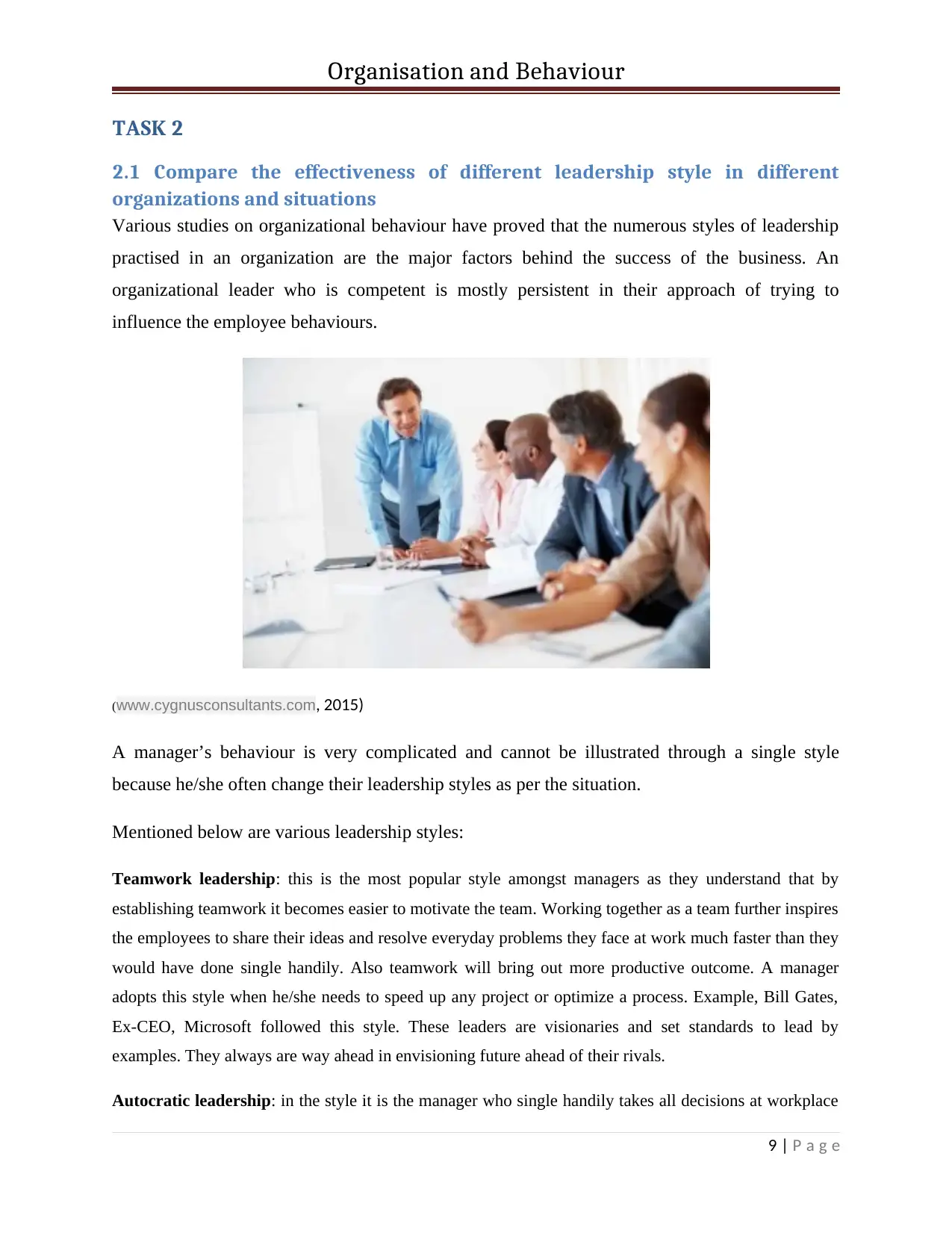
Various studies on organizational behaviour have proved that the numerous styles of leadership
practised in an organization are the major factors behind the success of the business. An
organizational leader who is competent is mostly persistent in their approach of trying to
influence the employee behaviours.
(www.cygnusconsultants.com, 2015)
A manager’s behaviour is very complicated and cannot be illustrated through a single style
because he/she often change their leadership styles as per the situation.
Mentioned below are various leadership styles:
Teamwork leadership: this is the most popular style amongst managers as they understand that by
establishing teamwork it becomes easier to motivate the team. Working together as a team further inspires
the employees to share their ideas and resolve everyday problems they face at work much faster than they
would have done single handily. Also teamwork will bring out more productive outcome. A manager
adopts this style when he/she needs to speed up any project or optimize a process. Example, Bill Gates,
Ex-CEO, Microsoft followed this style. These leaders are visionaries and set standards to lead by
examples. They always are way ahead in envisioning future ahead of their rivals.
Autocratic leadership: in the style it is the manager who single handily takes all decisions at workplace
9 | P a g e
TASK 2
2.1 Compare the effectiveness of different leadership style in different
organizations and situations
Various studies on organizational behaviour have proved that the numerous styles of leadership
practised in an organization are the major factors behind the success of the business. An
organizational leader who is competent is mostly persistent in their approach of trying to
influence the employee behaviours.
(www.cygnusconsultants.com, 2015)
A manager’s behaviour is very complicated and cannot be illustrated through a single style
because he/she often change their leadership styles as per the situation.
Mentioned below are various leadership styles:
Teamwork leadership: this is the most popular style amongst managers as they understand that by
establishing teamwork it becomes easier to motivate the team. Working together as a team further inspires
the employees to share their ideas and resolve everyday problems they face at work much faster than they
would have done single handily. Also teamwork will bring out more productive outcome. A manager
adopts this style when he/she needs to speed up any project or optimize a process. Example, Bill Gates,
Ex-CEO, Microsoft followed this style. These leaders are visionaries and set standards to lead by
examples. They always are way ahead in envisioning future ahead of their rivals.
Autocratic leadership: in the style it is the manager who single handily takes all decisions at workplace
9 | P a g e
⊘ This is a preview!⊘
Do you want full access?
Subscribe today to unlock all pages.
Trusted by 1+ million students worldwide
Organisation and Behaviour
without discussing the issues with the team. Such a kind of manager assumes that an employee does not
have the capability to complete a given job on their own and they needed to be pushed to do so. An
autocratic manager tells the team what to do, how to do and when to do. This kind of a leadership style is
usually implemented to meet tight deadlines. Example, when Thomas Cook faced tourism revival
concerns, then Harriet Green demonstrated autocratic style in her leadership and management being a
change leader. Her controlled decisions and experience helped Thomas Cook reform a turnaround.
Laissez-faire leadership: a manager usually practices this style he/she has confidence
that the employees have the competency to complete a given job on their own. Organizations
where this leadership style is being practiced, the employees make decisions and set policies
without the manager. This style is successful amongst employees who are experienced and are
self-motivated. Example, Hartridges manager is a follower of laissez faire leadership style as it is
an industrial system that is further based on an individual and self-interest and is apt for a small
organization like Hartridges. Practice of this style helps in improving the understanding and
thinking abilities of the employees and they are further motivated in performing a task without
seeking help from the manager. It has been observed that Hartridges approach of working with
experienced employees has worked best for the company.
Participatory leadership: managers following this style believe in integrating the contributions
made by different groups to complete a job. He/she motivates the team by showing them a
direction to work for a bigger goal in future. The employees are encouraged to give suggestions
on how to complete a job. This leadership style works best in a situation when employees need
the support of their manager. Example, participative or democratic style of leadership when was
introduced at Ford Motors, helped them redefine their remarkable success in automobile
industries. This style empowered the staff with more decision making powers thereby making
them more enthusiastic with the process. This greater involvement helped Ford Motors achieve
better outcomes due to committed talented manpower.
Coaching leadership: this style is effective in situations where a manager expects the team to
accomplish a given job on their own and will help whenever a crisis situation arises. A manager
who practices this style further acts as a coach who empower the employees to finish a job.
(Bertocci, 2009) Example, Nick Bollettieri, the Great American Tennis Coach to star players such as
Andre Agassi, Maria Sharapova etc practised coaching leadership. These leaders know the strengths of
their team and believe that knowledge transfer is a continuous process of evolution., which helps their
10 | P a g e
without discussing the issues with the team. Such a kind of manager assumes that an employee does not
have the capability to complete a given job on their own and they needed to be pushed to do so. An
autocratic manager tells the team what to do, how to do and when to do. This kind of a leadership style is
usually implemented to meet tight deadlines. Example, when Thomas Cook faced tourism revival
concerns, then Harriet Green demonstrated autocratic style in her leadership and management being a
change leader. Her controlled decisions and experience helped Thomas Cook reform a turnaround.
Laissez-faire leadership: a manager usually practices this style he/she has confidence
that the employees have the competency to complete a given job on their own. Organizations
where this leadership style is being practiced, the employees make decisions and set policies
without the manager. This style is successful amongst employees who are experienced and are
self-motivated. Example, Hartridges manager is a follower of laissez faire leadership style as it is
an industrial system that is further based on an individual and self-interest and is apt for a small
organization like Hartridges. Practice of this style helps in improving the understanding and
thinking abilities of the employees and they are further motivated in performing a task without
seeking help from the manager. It has been observed that Hartridges approach of working with
experienced employees has worked best for the company.
Participatory leadership: managers following this style believe in integrating the contributions
made by different groups to complete a job. He/she motivates the team by showing them a
direction to work for a bigger goal in future. The employees are encouraged to give suggestions
on how to complete a job. This leadership style works best in a situation when employees need
the support of their manager. Example, participative or democratic style of leadership when was
introduced at Ford Motors, helped them redefine their remarkable success in automobile
industries. This style empowered the staff with more decision making powers thereby making
them more enthusiastic with the process. This greater involvement helped Ford Motors achieve
better outcomes due to committed talented manpower.
Coaching leadership: this style is effective in situations where a manager expects the team to
accomplish a given job on their own and will help whenever a crisis situation arises. A manager
who practices this style further acts as a coach who empower the employees to finish a job.
(Bertocci, 2009) Example, Nick Bollettieri, the Great American Tennis Coach to star players such as
Andre Agassi, Maria Sharapova etc practised coaching leadership. These leaders know the strengths of
their team and believe that knowledge transfer is a continuous process of evolution., which helps their
10 | P a g e
Paraphrase This Document
Need a fresh take? Get an instant paraphrase of this document with our AI Paraphraser
Organisation and Behaviour
team emerge as winners. But this style may create increased dependencies on leaders, leading further to
micro-managing, hence is not suitable for large teams or companies.
There are various effectiveness of leadership styles:
Proper leadership provides goal determination and guidance to achieve success.
Leadership styles provide co-ordination in an organisation and create healthy workplace
environment.
In leadership, attributes of leaders helps to provide innovative facilities for working methods and
give them inspirations.
Leadership styles helps to provide a proper team work environment and maintain work efficiency.
11 | P a g e
team emerge as winners. But this style may create increased dependencies on leaders, leading further to
micro-managing, hence is not suitable for large teams or companies.
There are various effectiveness of leadership styles:
Proper leadership provides goal determination and guidance to achieve success.
Leadership styles provide co-ordination in an organisation and create healthy workplace
environment.
In leadership, attributes of leaders helps to provide innovative facilities for working methods and
give them inspirations.
Leadership styles helps to provide a proper team work environment and maintain work efficiency.
11 | P a g e
Organisation and Behaviour
2.2 The functions and the nature of management that would be suited to the
sales department
Organizational theory in general tries to infiltrate into the behaviour of an employee who may
either be an individual or an entire team and studies the impact of their behaviour on that of an
organization. Studies based on leadership qualities have proven that a manager who is not happy
with his/her job roles and is always irritated because of the responsibilities does not have the
potentiality of becoming a good leader. The definition of a good leader is someone who is clear
of the purpose and goals of the organization and has the competency to drive the team towards a
right direction in achieving the goals by inculcating motivation and participation. There is a
strong relationship between the structure and culture of an organization and both leave an impact
on its overall performance. The management of Hartridges not only aims to secure a sustainable
growth for the organization but simultaneously ensures that the employees are satisfied with their
job roles and are wilfully happy to work not because of any pressure being mounted on them.
The management and organizational theories are quite hard to practice together at the same time.
In case these theories are forced on the employees they become highly dissatisfied and tend to
lose their focus. Take for example, a sales department manager consistently aims of reaching the
goals of the organization by following its structure. In case if the HR department suddenly
decides to bring a change in the organizational structure then it can create problems for the
manager of the sales department as confusion will spread in his/her team and will further take
time to get themselves adjusted with the same. This confusion can leave an impact on the
performances of the team. If the strengths and interest of the employees gets underpinned by the
structure of the organization then it should be transformed into practice management which will
cultivate satisfaction and growth amid the employees. In order to run a business successfully
various theories of management and organizational theories are implemented. In order to adjust
with the organizational structure and culture of an organization it is necessary that employees
have the desire to learn new things to achieve the goals and objectives of the company. In an
organization the HR department plans the operations and employees are expected to modify their
style of working as per the structure provided to them. These frequent changes affect the
12 | P a g e
2.2 The functions and the nature of management that would be suited to the
sales department
Organizational theory in general tries to infiltrate into the behaviour of an employee who may
either be an individual or an entire team and studies the impact of their behaviour on that of an
organization. Studies based on leadership qualities have proven that a manager who is not happy
with his/her job roles and is always irritated because of the responsibilities does not have the
potentiality of becoming a good leader. The definition of a good leader is someone who is clear
of the purpose and goals of the organization and has the competency to drive the team towards a
right direction in achieving the goals by inculcating motivation and participation. There is a
strong relationship between the structure and culture of an organization and both leave an impact
on its overall performance. The management of Hartridges not only aims to secure a sustainable
growth for the organization but simultaneously ensures that the employees are satisfied with their
job roles and are wilfully happy to work not because of any pressure being mounted on them.
The management and organizational theories are quite hard to practice together at the same time.
In case these theories are forced on the employees they become highly dissatisfied and tend to
lose their focus. Take for example, a sales department manager consistently aims of reaching the
goals of the organization by following its structure. In case if the HR department suddenly
decides to bring a change in the organizational structure then it can create problems for the
manager of the sales department as confusion will spread in his/her team and will further take
time to get themselves adjusted with the same. This confusion can leave an impact on the
performances of the team. If the strengths and interest of the employees gets underpinned by the
structure of the organization then it should be transformed into practice management which will
cultivate satisfaction and growth amid the employees. In order to run a business successfully
various theories of management and organizational theories are implemented. In order to adjust
with the organizational structure and culture of an organization it is necessary that employees
have the desire to learn new things to achieve the goals and objectives of the company. In an
organization the HR department plans the operations and employees are expected to modify their
style of working as per the structure provided to them. These frequent changes affect the
12 | P a g e
⊘ This is a preview!⊘
Do you want full access?
Subscribe today to unlock all pages.
Trusted by 1+ million students worldwide

1 out of 37


Related Documents


Your All-in-One AI-Powered Toolkit for Academic Success.
+13062052269
info@desklib.com
Available 24*7 on WhatsApp / Email
![[object Object]](/_next/static/media/star-bottom.7253800d.svg)
Unlock your academic potential
Copyright © 2020–2026 A2Z Services. All Rights Reserved. Developed and managed by ZUCOL.