Retail Analysis: Zara's Strategies in the UK Fashion Market
VerifiedAdded on 2020/10/05
|11
|3506
|73
Report
AI Summary
This report offers a detailed analysis of Zara's retail operations within the UK fashion industry. It begins with an introduction to retail and the company Zara, outlining the core concepts and context of the analysis. The report then delves into the key relevant changes within the UK fashion retail environment, employing a PESTLE analysis to evaluate the political, economic, social, technological, legal, and environmental factors influencing Zara's business. Furthermore, it examines the micro-environment using a SWOT analysis to assess Zara's strengths, weaknesses, opportunities, and threats. The report also discusses business strategies and tactics that Zara can employ, culminating in recommendations for the company. The report's structure ensures a comprehensive understanding of Zara's market position, challenges, and strategic options.
RETAIL THEORY
AND PRACTICE
AND PRACTICE

Paraphrase This Document
Need a fresh take? Get an instant paraphrase of this document with our AI Paraphraser
Table of Contents
INTRODUCTION...........................................................................................................................1
Introduction to retail. .............................................................................................................1
Introduction to the company...................................................................................................1
Key relevant changes within the UK fashion retail................................................................2
Relevant changes within micro environment.........................................................................5
Business strategies and tactics................................................................................................6
Recommendations..................................................................................................................7
CONCLUSION................................................................................................................................7
REFERENCES................................................................................................................................8
INTRODUCTION...........................................................................................................................1
Introduction to retail. .............................................................................................................1
Introduction to the company...................................................................................................1
Key relevant changes within the UK fashion retail................................................................2
Relevant changes within micro environment.........................................................................5
Business strategies and tactics................................................................................................6
Recommendations..................................................................................................................7
CONCLUSION................................................................................................................................7
REFERENCES................................................................................................................................8
INTRODUCTION
Retail is the process of selling goods and services to the customer. This occurs when an
organisation sells products and services by using various number of distribution channel such as
online, direct mail, etc. This is important in the business organisation as it enables the business
enterprise to emphasis on producing goods without being distracted by the enormous amount of
efforts through which it interacts with the customer who wants to purchase the products (Baker
and Saren 2016). Organisation undertaken in this report Zara which was founded in 1975 which
is a retail industry and deals in clothing products. This report will explain the relevant changes in
the fashion industry of UK internally and externally to the business environment. Furthermore,
the report will depict the suggestions and discuss the strategies and tactics which can be used
within the business environment.
Introduction to retail.
Retailing is a method of selling goods and services. A retail sale occur when a business
sell its products or services to an individual consumer for there own use. These transaction can
be done with the use of different channels such as online, direct sale, or through direct mail. The
aspects that qualifies a transaction into a retail transaction is that the end user for the product and
services should be the buyer (Black, 2018). There are different players in the retail industry such
as fashion retailers. Once the clothes have been designed and manufactured in the factory it
needs to reach customers for further sale. Companies do not sell their product at retail they place
their product at wholesale prices in the hands of different kinds of retailers such as online stores,
boutique and department stores.
Introduction to the company.
Zara is a clothing retailer brand it was founded by Amancio ortega in 1963. It offers wide
variety of products such as collection for women, men and children. It has also launched a line of
cosmetic, perfume and household products. Its first store was featured with products which were
priced low and then the new stored opened in 1980s brought in the alternations and
modifications in design, manufacturing and distribution process to minimise lead time and
enactment to new fashion trends in rapid way. Its expansion has improved its product line and
ways of selling products, customer services and offerings.
1
Retail is the process of selling goods and services to the customer. This occurs when an
organisation sells products and services by using various number of distribution channel such as
online, direct mail, etc. This is important in the business organisation as it enables the business
enterprise to emphasis on producing goods without being distracted by the enormous amount of
efforts through which it interacts with the customer who wants to purchase the products (Baker
and Saren 2016). Organisation undertaken in this report Zara which was founded in 1975 which
is a retail industry and deals in clothing products. This report will explain the relevant changes in
the fashion industry of UK internally and externally to the business environment. Furthermore,
the report will depict the suggestions and discuss the strategies and tactics which can be used
within the business environment.
Introduction to retail.
Retailing is a method of selling goods and services. A retail sale occur when a business
sell its products or services to an individual consumer for there own use. These transaction can
be done with the use of different channels such as online, direct sale, or through direct mail. The
aspects that qualifies a transaction into a retail transaction is that the end user for the product and
services should be the buyer (Black, 2018). There are different players in the retail industry such
as fashion retailers. Once the clothes have been designed and manufactured in the factory it
needs to reach customers for further sale. Companies do not sell their product at retail they place
their product at wholesale prices in the hands of different kinds of retailers such as online stores,
boutique and department stores.
Introduction to the company.
Zara is a clothing retailer brand it was founded by Amancio ortega in 1963. It offers wide
variety of products such as collection for women, men and children. It has also launched a line of
cosmetic, perfume and household products. Its first store was featured with products which were
priced low and then the new stored opened in 1980s brought in the alternations and
modifications in design, manufacturing and distribution process to minimise lead time and
enactment to new fashion trends in rapid way. Its expansion has improved its product line and
ways of selling products, customer services and offerings.
1
⊘ This is a preview!⊘
Do you want full access?
Subscribe today to unlock all pages.

Trusted by 1+ million students worldwide
Key relevant changes within the UK fashion retail.
Fashion industry is always dynamic in nature. It is growing at an tremendous rate and
modern industry is expanding and competing with one another because of multiple new brands.
Being the highly dynamic nature designers are launching new designs, clothes and materials.
However, Zara being the good and reputed brand in the market still faces changes within the
fashion industry of the UK and this can be understood deeply with the help of PESTLE.
Pestle analyses is a analytical instrument for strategic business planning. This model is
helpful for apprehending external determinant on business. This concept of marketing is used by
the companies to trace the environment in which the company is operating and planning to
launch a new product (Bodie, 2015). In marketing environment of the organisation, before
implementing any plan of business, it is considered to be highly valuable to conduct the
situational analyses which can be done by using PESTLE which is discussed below :
Political factors : These factors are concerned with the burden and opportunities which
are brought in by the political institutions and the degree which impacts the government policies
for the businesses. It also includes factors like taxation polices, trade agreements, government
rules and regulations, import export duties, etc. which has a strong influence on Zara. The free
trade agreement in Europe has helped Zara to hike the UK sales because with the help of this
agreement the goods and services can be independently delivered between several European
countries with no border tariff, no restrictions on quantity and quality of imported or exported
products (Bowen, 2016). Zara has also faced political turmoil and has overcome with this
problem by limiting its supply chain operations in domestic country and neighbouring nations.
Economic factors : It is related to the economic policies, structures and the degree at
which it impacts the business. This includes factors like local economy, inflation, deflation,
interest rates, economy trends and seasonality issues, etc. The situation of economy has a direct
impact on retail industry because if the economic condition within the country is smooth than the
flow will also be smooth and vice versa (PESTEL Analysis, 2019). Zara has always increased its
sales due to the staggering broad level of unemployment and high population in the UK, the cost
of labour was low which has also led to the lower cost of production and superior quality
products at affordable and lower prices which has ultimately attracted the majority of the
customers. Apart from this, the British exit from the European union has resulted in depreciation
of pound which has led to high inflation rate and maximised the cost of living with minimum
2
Fashion industry is always dynamic in nature. It is growing at an tremendous rate and
modern industry is expanding and competing with one another because of multiple new brands.
Being the highly dynamic nature designers are launching new designs, clothes and materials.
However, Zara being the good and reputed brand in the market still faces changes within the
fashion industry of the UK and this can be understood deeply with the help of PESTLE.
Pestle analyses is a analytical instrument for strategic business planning. This model is
helpful for apprehending external determinant on business. This concept of marketing is used by
the companies to trace the environment in which the company is operating and planning to
launch a new product (Bodie, 2015). In marketing environment of the organisation, before
implementing any plan of business, it is considered to be highly valuable to conduct the
situational analyses which can be done by using PESTLE which is discussed below :
Political factors : These factors are concerned with the burden and opportunities which
are brought in by the political institutions and the degree which impacts the government policies
for the businesses. It also includes factors like taxation polices, trade agreements, government
rules and regulations, import export duties, etc. which has a strong influence on Zara. The free
trade agreement in Europe has helped Zara to hike the UK sales because with the help of this
agreement the goods and services can be independently delivered between several European
countries with no border tariff, no restrictions on quantity and quality of imported or exported
products (Bowen, 2016). Zara has also faced political turmoil and has overcome with this
problem by limiting its supply chain operations in domestic country and neighbouring nations.
Economic factors : It is related to the economic policies, structures and the degree at
which it impacts the business. This includes factors like local economy, inflation, deflation,
interest rates, economy trends and seasonality issues, etc. The situation of economy has a direct
impact on retail industry because if the economic condition within the country is smooth than the
flow will also be smooth and vice versa (PESTEL Analysis, 2019). Zara has always increased its
sales due to the staggering broad level of unemployment and high population in the UK, the cost
of labour was low which has also led to the lower cost of production and superior quality
products at affordable and lower prices which has ultimately attracted the majority of the
customers. Apart from this, the British exit from the European union has resulted in depreciation
of pound which has led to high inflation rate and maximised the cost of living with minimum
2
Paraphrase This Document
Need a fresh take? Get an instant paraphrase of this document with our AI Paraphraser
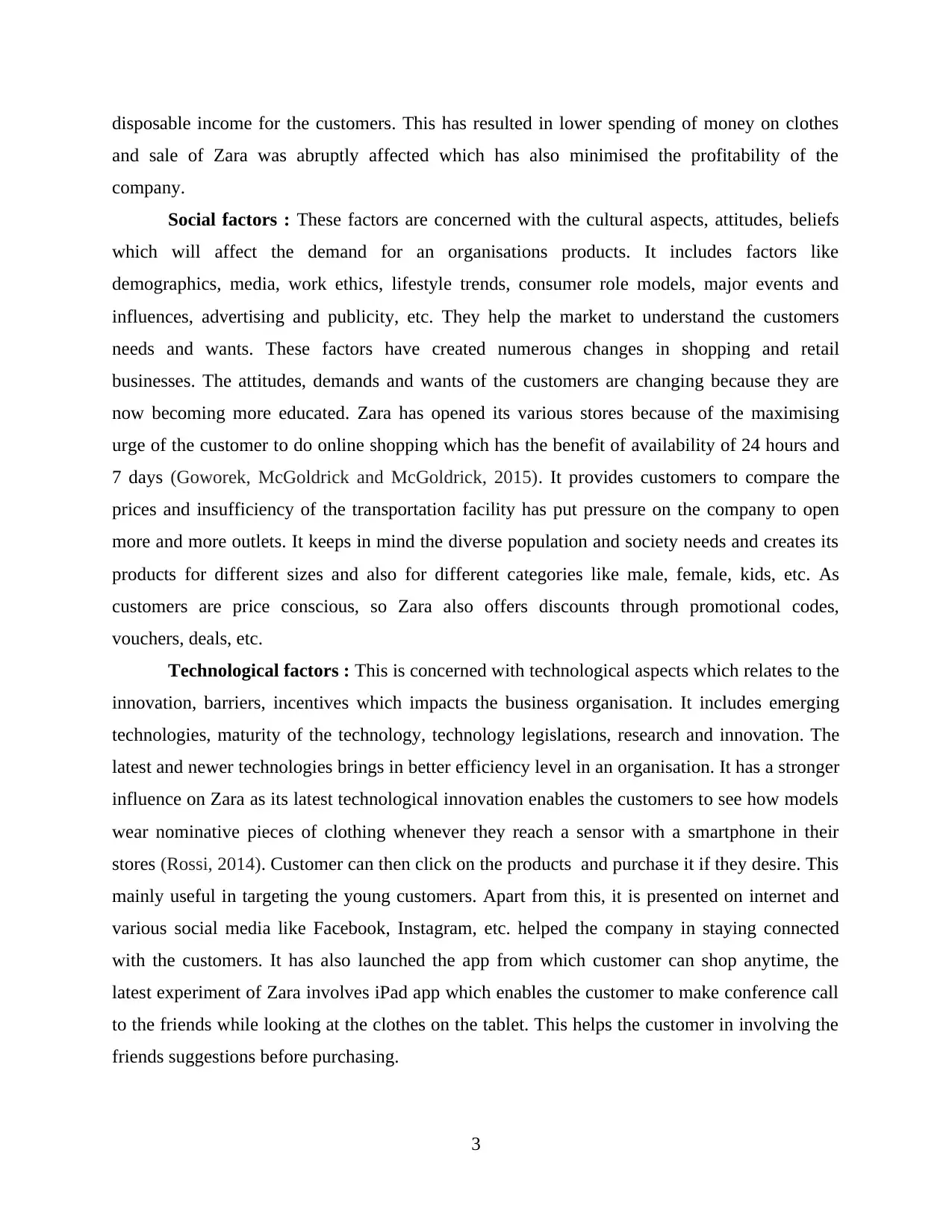
disposable income for the customers. This has resulted in lower spending of money on clothes
and sale of Zara was abruptly affected which has also minimised the profitability of the
company.
Social factors : These factors are concerned with the cultural aspects, attitudes, beliefs
which will affect the demand for an organisations products. It includes factors like
demographics, media, work ethics, lifestyle trends, consumer role models, major events and
influences, advertising and publicity, etc. They help the market to understand the customers
needs and wants. These factors have created numerous changes in shopping and retail
businesses. The attitudes, demands and wants of the customers are changing because they are
now becoming more educated. Zara has opened its various stores because of the maximising
urge of the customer to do online shopping which has the benefit of availability of 24 hours and
7 days (Goworek, McGoldrick and McGoldrick, 2015). It provides customers to compare the
prices and insufficiency of the transportation facility has put pressure on the company to open
more and more outlets. It keeps in mind the diverse population and society needs and creates its
products for different sizes and also for different categories like male, female, kids, etc. As
customers are price conscious, so Zara also offers discounts through promotional codes,
vouchers, deals, etc.
Technological factors : This is concerned with technological aspects which relates to the
innovation, barriers, incentives which impacts the business organisation. It includes emerging
technologies, maturity of the technology, technology legislations, research and innovation. The
latest and newer technologies brings in better efficiency level in an organisation. It has a stronger
influence on Zara as its latest technological innovation enables the customers to see how models
wear nominative pieces of clothing whenever they reach a sensor with a smartphone in their
stores (Rossi, 2014). Customer can then click on the products and purchase it if they desire. This
mainly useful in targeting the young customers. Apart from this, it is presented on internet and
various social media like Facebook, Instagram, etc. helped the company in staying connected
with the customers. It has also launched the app from which customer can shop anytime, the
latest experiment of Zara involves iPad app which enables the customer to make conference call
to the friends while looking at the clothes on the tablet. This helps the customer in involving the
friends suggestions before purchasing.
3
and sale of Zara was abruptly affected which has also minimised the profitability of the
company.
Social factors : These factors are concerned with the cultural aspects, attitudes, beliefs
which will affect the demand for an organisations products. It includes factors like
demographics, media, work ethics, lifestyle trends, consumer role models, major events and
influences, advertising and publicity, etc. They help the market to understand the customers
needs and wants. These factors have created numerous changes in shopping and retail
businesses. The attitudes, demands and wants of the customers are changing because they are
now becoming more educated. Zara has opened its various stores because of the maximising
urge of the customer to do online shopping which has the benefit of availability of 24 hours and
7 days (Goworek, McGoldrick and McGoldrick, 2015). It provides customers to compare the
prices and insufficiency of the transportation facility has put pressure on the company to open
more and more outlets. It keeps in mind the diverse population and society needs and creates its
products for different sizes and also for different categories like male, female, kids, etc. As
customers are price conscious, so Zara also offers discounts through promotional codes,
vouchers, deals, etc.
Technological factors : This is concerned with technological aspects which relates to the
innovation, barriers, incentives which impacts the business organisation. It includes emerging
technologies, maturity of the technology, technology legislations, research and innovation. The
latest and newer technologies brings in better efficiency level in an organisation. It has a stronger
influence on Zara as its latest technological innovation enables the customers to see how models
wear nominative pieces of clothing whenever they reach a sensor with a smartphone in their
stores (Rossi, 2014). Customer can then click on the products and purchase it if they desire. This
mainly useful in targeting the young customers. Apart from this, it is presented on internet and
various social media like Facebook, Instagram, etc. helped the company in staying connected
with the customers. It has also launched the app from which customer can shop anytime, the
latest experiment of Zara involves iPad app which enables the customer to make conference call
to the friends while looking at the clothes on the tablet. This helps the customer in involving the
friends suggestions before purchasing.
3
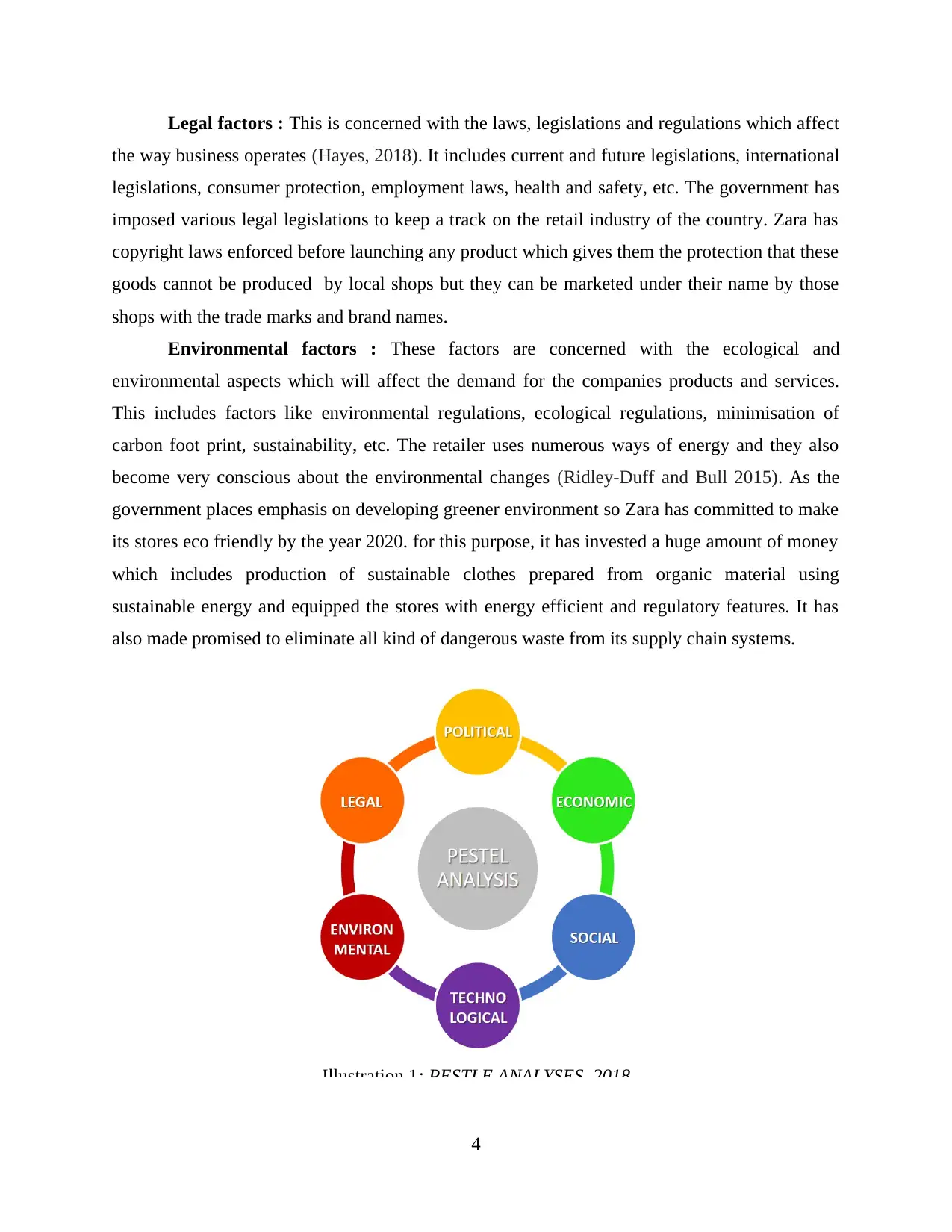
Legal factors : This is concerned with the laws, legislations and regulations which affect
the way business operates (Hayes, 2018). It includes current and future legislations, international
legislations, consumer protection, employment laws, health and safety, etc. The government has
imposed various legal legislations to keep a track on the retail industry of the country. Zara has
copyright laws enforced before launching any product which gives them the protection that these
goods cannot be produced by local shops but they can be marketed under their name by those
shops with the trade marks and brand names.
Environmental factors : These factors are concerned with the ecological and
environmental aspects which will affect the demand for the companies products and services.
This includes factors like environmental regulations, ecological regulations, minimisation of
carbon foot print, sustainability, etc. The retailer uses numerous ways of energy and they also
become very conscious about the environmental changes (Ridley-Duff and Bull 2015). As the
government places emphasis on developing greener environment so Zara has committed to make
its stores eco friendly by the year 2020. for this purpose, it has invested a huge amount of money
which includes production of sustainable clothes prepared from organic material using
sustainable energy and equipped the stores with energy efficient and regulatory features. It has
also made promised to eliminate all kind of dangerous waste from its supply chain systems.
4
Illustration 1: PESTLE ANALYSES. 2018
the way business operates (Hayes, 2018). It includes current and future legislations, international
legislations, consumer protection, employment laws, health and safety, etc. The government has
imposed various legal legislations to keep a track on the retail industry of the country. Zara has
copyright laws enforced before launching any product which gives them the protection that these
goods cannot be produced by local shops but they can be marketed under their name by those
shops with the trade marks and brand names.
Environmental factors : These factors are concerned with the ecological and
environmental aspects which will affect the demand for the companies products and services.
This includes factors like environmental regulations, ecological regulations, minimisation of
carbon foot print, sustainability, etc. The retailer uses numerous ways of energy and they also
become very conscious about the environmental changes (Ridley-Duff and Bull 2015). As the
government places emphasis on developing greener environment so Zara has committed to make
its stores eco friendly by the year 2020. for this purpose, it has invested a huge amount of money
which includes production of sustainable clothes prepared from organic material using
sustainable energy and equipped the stores with energy efficient and regulatory features. It has
also made promised to eliminate all kind of dangerous waste from its supply chain systems.
4
Illustration 1: PESTLE ANALYSES. 2018
⊘ This is a preview!⊘
Do you want full access?
Subscribe today to unlock all pages.
Trusted by 1+ million students worldwide
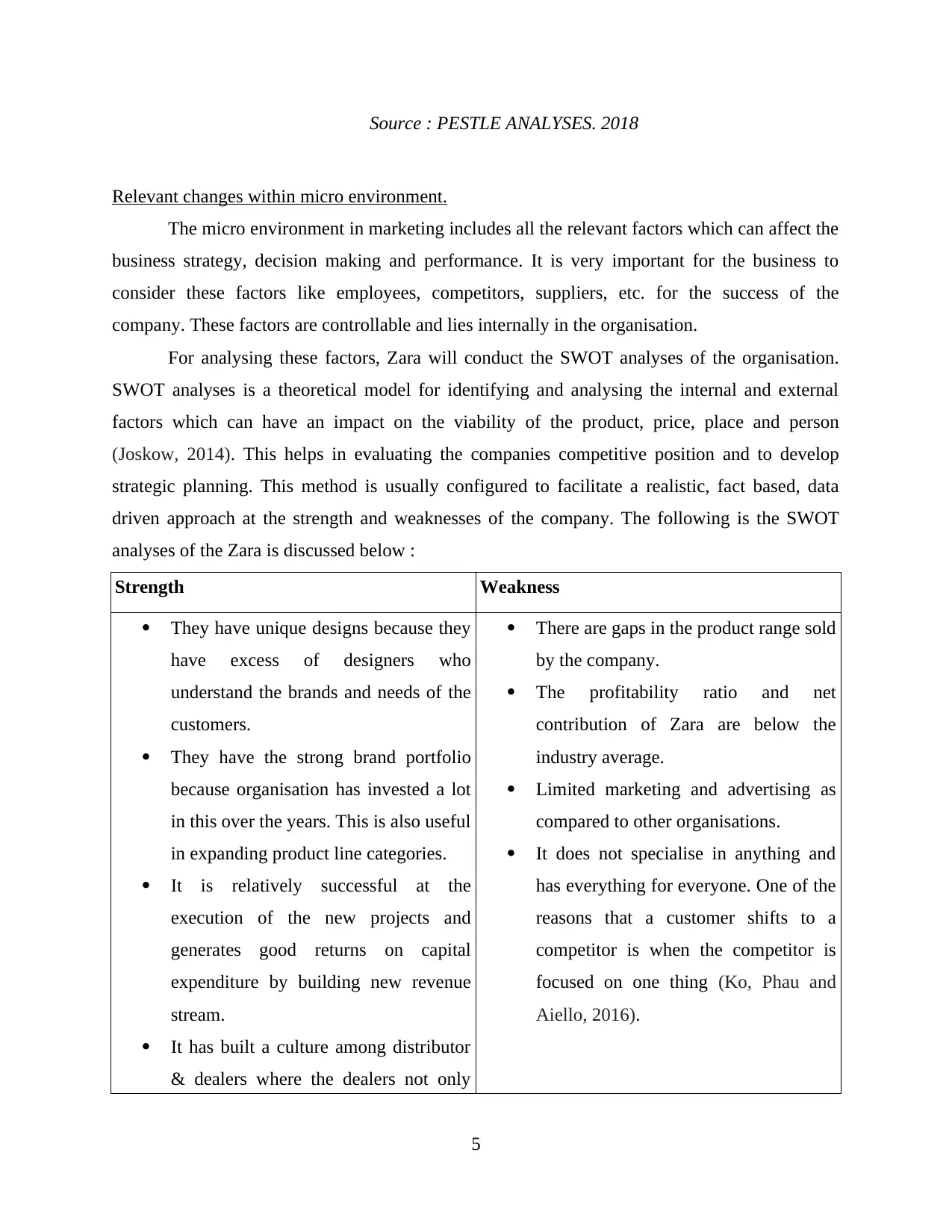
Source : PESTLE ANALYSES. 2018
Relevant changes within micro environment.
The micro environment in marketing includes all the relevant factors which can affect the
business strategy, decision making and performance. It is very important for the business to
consider these factors like employees, competitors, suppliers, etc. for the success of the
company. These factors are controllable and lies internally in the organisation.
For analysing these factors, Zara will conduct the SWOT analyses of the organisation.
SWOT analyses is a theoretical model for identifying and analysing the internal and external
factors which can have an impact on the viability of the product, price, place and person
(Joskow, 2014). This helps in evaluating the companies competitive position and to develop
strategic planning. This method is usually configured to facilitate a realistic, fact based, data
driven approach at the strength and weaknesses of the company. The following is the SWOT
analyses of the Zara is discussed below :
Strength Weakness
They have unique designs because they
have excess of designers who
understand the brands and needs of the
customers.
They have the strong brand portfolio
because organisation has invested a lot
in this over the years. This is also useful
in expanding product line categories.
It is relatively successful at the
execution of the new projects and
generates good returns on capital
expenditure by building new revenue
stream.
It has built a culture among distributor
& dealers where the dealers not only
There are gaps in the product range sold
by the company.
The profitability ratio and net
contribution of Zara are below the
industry average.
Limited marketing and advertising as
compared to other organisations.
It does not specialise in anything and
has everything for everyone. One of the
reasons that a customer shifts to a
competitor is when the competitor is
focused on one thing (Ko, Phau and
Aiello, 2016).
5
Relevant changes within micro environment.
The micro environment in marketing includes all the relevant factors which can affect the
business strategy, decision making and performance. It is very important for the business to
consider these factors like employees, competitors, suppliers, etc. for the success of the
company. These factors are controllable and lies internally in the organisation.
For analysing these factors, Zara will conduct the SWOT analyses of the organisation.
SWOT analyses is a theoretical model for identifying and analysing the internal and external
factors which can have an impact on the viability of the product, price, place and person
(Joskow, 2014). This helps in evaluating the companies competitive position and to develop
strategic planning. This method is usually configured to facilitate a realistic, fact based, data
driven approach at the strength and weaknesses of the company. The following is the SWOT
analyses of the Zara is discussed below :
Strength Weakness
They have unique designs because they
have excess of designers who
understand the brands and needs of the
customers.
They have the strong brand portfolio
because organisation has invested a lot
in this over the years. This is also useful
in expanding product line categories.
It is relatively successful at the
execution of the new projects and
generates good returns on capital
expenditure by building new revenue
stream.
It has built a culture among distributor
& dealers where the dealers not only
There are gaps in the product range sold
by the company.
The profitability ratio and net
contribution of Zara are below the
industry average.
Limited marketing and advertising as
compared to other organisations.
It does not specialise in anything and
has everything for everyone. One of the
reasons that a customer shifts to a
competitor is when the competitor is
focused on one thing (Ko, Phau and
Aiello, 2016).
5
Paraphrase This Document
Need a fresh take? Get an instant paraphrase of this document with our AI Paraphraser
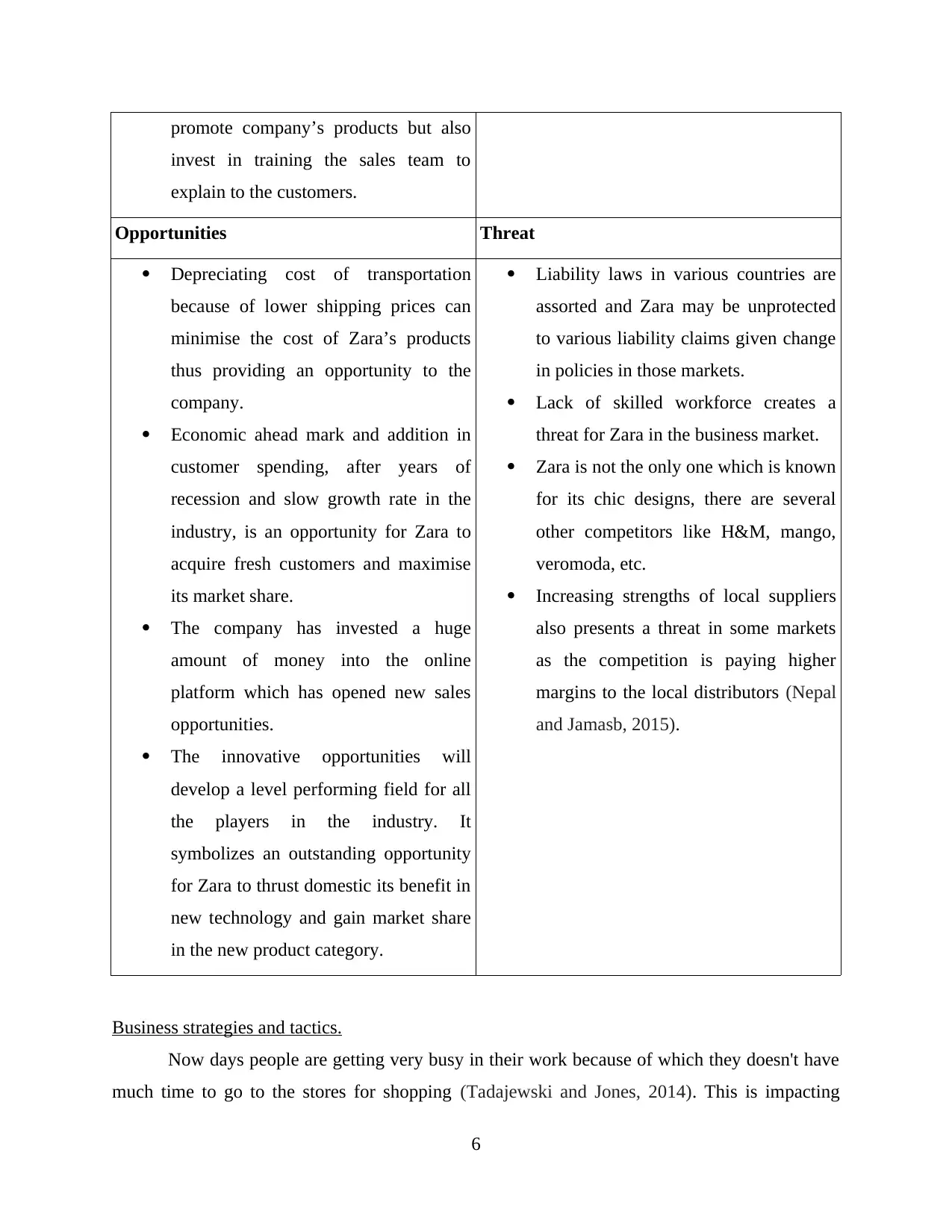
promote company’s products but also
invest in training the sales team to
explain to the customers.
Opportunities Threat
Depreciating cost of transportation
because of lower shipping prices can
minimise the cost of Zara’s products
thus providing an opportunity to the
company.
Economic ahead mark and addition in
customer spending, after years of
recession and slow growth rate in the
industry, is an opportunity for Zara to
acquire fresh customers and maximise
its market share.
The company has invested a huge
amount of money into the online
platform which has opened new sales
opportunities.
The innovative opportunities will
develop a level performing field for all
the players in the industry. It
symbolizes an outstanding opportunity
for Zara to thrust domestic its benefit in
new technology and gain market share
in the new product category.
Liability laws in various countries are
assorted and Zara may be unprotected
to various liability claims given change
in policies in those markets.
Lack of skilled workforce creates a
threat for Zara in the business market.
Zara is not the only one which is known
for its chic designs, there are several
other competitors like H&M, mango,
veromoda, etc.
Increasing strengths of local suppliers
also presents a threat in some markets
as the competition is paying higher
margins to the local distributors (Nepal
and Jamasb, 2015).
Business strategies and tactics.
Now days people are getting very busy in their work because of which they doesn't have
much time to go to the stores for shopping (Tadajewski and Jones, 2014). This is impacting
6
invest in training the sales team to
explain to the customers.
Opportunities Threat
Depreciating cost of transportation
because of lower shipping prices can
minimise the cost of Zara’s products
thus providing an opportunity to the
company.
Economic ahead mark and addition in
customer spending, after years of
recession and slow growth rate in the
industry, is an opportunity for Zara to
acquire fresh customers and maximise
its market share.
The company has invested a huge
amount of money into the online
platform which has opened new sales
opportunities.
The innovative opportunities will
develop a level performing field for all
the players in the industry. It
symbolizes an outstanding opportunity
for Zara to thrust domestic its benefit in
new technology and gain market share
in the new product category.
Liability laws in various countries are
assorted and Zara may be unprotected
to various liability claims given change
in policies in those markets.
Lack of skilled workforce creates a
threat for Zara in the business market.
Zara is not the only one which is known
for its chic designs, there are several
other competitors like H&M, mango,
veromoda, etc.
Increasing strengths of local suppliers
also presents a threat in some markets
as the competition is paying higher
margins to the local distributors (Nepal
and Jamasb, 2015).
Business strategies and tactics.
Now days people are getting very busy in their work because of which they doesn't have
much time to go to the stores for shopping (Tadajewski and Jones, 2014). This is impacting
6
ZARA negatively and to cope with this situation they have upgraded their technology and
launches their online stores for their busy customers. Through which buyers can shop anytime
anywhere. Only launching the online app is not sufficient for ZARA, for making it successful
they need to have some kind of strategies which help their technological development to be
successful. Company must invest more in research and development department of their other
online competitors to find out what is missing in their apps which ZARA can take advantage
and use it in their own product. It will make them more competitive and attractive to buyers.
People are getting eco friendly and their concern toward environment is increasing
rapidly, they want to eat organic and even wear organic. After analysing all this ZARA
has made a commitment that till 2020 they convert their stores into eco-friendly stores.
To keep this promise ZARA need to make strategies to achieve it. Production of organic
items is expensive, it will increase the cost of production which automatically rises the
price of their items. So firstly, company will need to have a strong financial plan, after
that it will have to conduct the research about the availability to organic cottons from
which they can produce clothes and after this they will be required to plan a strong
advertisement which directly hit the customers mind. This is not sufficient, ZARA is
already selling expensive clothes so they will need to make a strategy about reducing
their production cost cost. which They can do by reducing their production so that they
can maintain their selling price which retain their client base.
Customers are getting tech-savvy in every way, they love to share pictures of stuff before
buying it to their family and friends. ZARA has analysed this requirement of their
customers and came with an iPad app in which they have conference call option so that
they can ask for the opinion of their family and friends. This is one of the amazing
strategy that company has opted for increasing their customers. Buyers get attracted to
innovative things and always try to find something new and different, buy launching this
app ZARA has made life of many shopaholic easy. Impact of this strategy on company is
good as it increases the sale of the company and also improve the image.
Even with the rapid changes in fashion industry ,ZARA has unique design in their cloths,
which is their biggest strength to compete in the market even after having high prices of
their cloths. For maintaining this uniqueness they follow a strategy in which they keep
analysing the customers behaviour and their taste and preferences (Yakhlef, 2015). They
7
launches their online stores for their busy customers. Through which buyers can shop anytime
anywhere. Only launching the online app is not sufficient for ZARA, for making it successful
they need to have some kind of strategies which help their technological development to be
successful. Company must invest more in research and development department of their other
online competitors to find out what is missing in their apps which ZARA can take advantage
and use it in their own product. It will make them more competitive and attractive to buyers.
People are getting eco friendly and their concern toward environment is increasing
rapidly, they want to eat organic and even wear organic. After analysing all this ZARA
has made a commitment that till 2020 they convert their stores into eco-friendly stores.
To keep this promise ZARA need to make strategies to achieve it. Production of organic
items is expensive, it will increase the cost of production which automatically rises the
price of their items. So firstly, company will need to have a strong financial plan, after
that it will have to conduct the research about the availability to organic cottons from
which they can produce clothes and after this they will be required to plan a strong
advertisement which directly hit the customers mind. This is not sufficient, ZARA is
already selling expensive clothes so they will need to make a strategy about reducing
their production cost cost. which They can do by reducing their production so that they
can maintain their selling price which retain their client base.
Customers are getting tech-savvy in every way, they love to share pictures of stuff before
buying it to their family and friends. ZARA has analysed this requirement of their
customers and came with an iPad app in which they have conference call option so that
they can ask for the opinion of their family and friends. This is one of the amazing
strategy that company has opted for increasing their customers. Buyers get attracted to
innovative things and always try to find something new and different, buy launching this
app ZARA has made life of many shopaholic easy. Impact of this strategy on company is
good as it increases the sale of the company and also improve the image.
Even with the rapid changes in fashion industry ,ZARA has unique design in their cloths,
which is their biggest strength to compete in the market even after having high prices of
their cloths. For maintaining this uniqueness they follow a strategy in which they keep
analysing the customers behaviour and their taste and preferences (Yakhlef, 2015). They
7
⊘ This is a preview!⊘
Do you want full access?
Subscribe today to unlock all pages.
Trusted by 1+ million students worldwide
even analyse the particular demand for any design which help them to decide prices of
their products. This help company in retaining their customers as well as it increases their
sale
Recommendations
From the above report it has been recommended that Zara is one of the most known
fashion retailer in the UK market. It has a strong brand base. But at the same time there are some
recommendations which should be considered and they are discussed below :
It needs to focus on increasing the technology in the production department.
It should also focus on providing training to its employees by identifying the need and
requirements of the training.
It should invest more in advertising and promotional strategies to attract the customers.
The company should focus more on hiring specialised and exclusive designers so that
they can make new and innovative clothes with unique designs.
CONCLUSION
From the above report it has been concluded that retail sector is very dynamic because
customer tastes and preferences changes very rapidly with the changing fashion trends in the
market. So it is very important to keep regular focus on the customers and current and future
market trends so that company can also quickly deal with the changes. For this PESTLE has
been explained which is a useful tool for analysing the various environmental factors that can
directly or indirectly affect the company. For analysing the internal environment of the company
SWOT has been conducted so that the strength and weakness, opportunities and threats can be
identified.
8
their products. This help company in retaining their customers as well as it increases their
sale
Recommendations
From the above report it has been recommended that Zara is one of the most known
fashion retailer in the UK market. It has a strong brand base. But at the same time there are some
recommendations which should be considered and they are discussed below :
It needs to focus on increasing the technology in the production department.
It should also focus on providing training to its employees by identifying the need and
requirements of the training.
It should invest more in advertising and promotional strategies to attract the customers.
The company should focus more on hiring specialised and exclusive designers so that
they can make new and innovative clothes with unique designs.
CONCLUSION
From the above report it has been concluded that retail sector is very dynamic because
customer tastes and preferences changes very rapidly with the changing fashion trends in the
market. So it is very important to keep regular focus on the customers and current and future
market trends so that company can also quickly deal with the changes. For this PESTLE has
been explained which is a useful tool for analysing the various environmental factors that can
directly or indirectly affect the company. For analysing the internal environment of the company
SWOT has been conducted so that the strength and weakness, opportunities and threats can be
identified.
8
Paraphrase This Document
Need a fresh take? Get an instant paraphrase of this document with our AI Paraphraser
REFERENCES
Books and Journals
Baker, M.J. and Saren, M. eds., 2016. Marketing theory: a student text. Sage.
Black, J., 2018. Urban transport planning: Theory and practice. Routledge.
Bodie, Z., 2015. Thoughts on the future: Life-cycle investing in theory and practice. Financial
Analysts Journal.71(1). pp.43-48.
Bowen, D.E., 2016. The changing role of employees in service theory and practice: An
interdisciplinary view. Human Resource Management Review.26(1). pp.4-13.
Goworek, H., McGoldrick, P.J. and McGoldrick, P.J., 2015. Retail marketing management:
Principles and practice. Harlow, UK: Pearson.
Hayes, J., 2018. The theory and practice of change management. Palgrave.
Joskow, P.L., 2014. Incentive regulation in theory and practice: electricity distribution and
transmission networks. In Economic Regulation and Its Reform: What Have We
Learned? (pp. 291-344). University of Chicago Press.
Ko, E., Phau, I. and Aiello, G., 2016. Luxury brand strategies and customer experiences:
Contributions to theory and practice. Journal of Business Research.69(12). pp.5749-
5752.
Nepal, R. and Jamasb, T., 2015. Caught between theory and practice: Government, market, and
regulatory failure in electricity sector reforms. Economic Analysis and Policy.46. pp.16-
24.
Ridley-Duff, R. and Bull, M., 2015. Understanding social enterprise: Theory and practice. Sage.
Rossi, M., 2014. Capital budgeting in Europe: confronting theory with practice. International
Journal of Managerial and Financial Accounting.6(4). pp.341-356.
Tadajewski, M. and Jones, D.B., 2014. Historical research in marketing theory and practice: a
review essay. Journal of Marketing Management.30(11-12). pp.1239-1291.
Yakhlef, A., 2015. Customer experience within retail environments: An embodied, spatial
approach. Marketing Theory.15(4). pp.545-564.
Online
PESTEL Analysis. 2019.[Online] Available
Through :<https://www.ukessays.com/essays/business/next-pestle-analysis.php>.
9
Books and Journals
Baker, M.J. and Saren, M. eds., 2016. Marketing theory: a student text. Sage.
Black, J., 2018. Urban transport planning: Theory and practice. Routledge.
Bodie, Z., 2015. Thoughts on the future: Life-cycle investing in theory and practice. Financial
Analysts Journal.71(1). pp.43-48.
Bowen, D.E., 2016. The changing role of employees in service theory and practice: An
interdisciplinary view. Human Resource Management Review.26(1). pp.4-13.
Goworek, H., McGoldrick, P.J. and McGoldrick, P.J., 2015. Retail marketing management:
Principles and practice. Harlow, UK: Pearson.
Hayes, J., 2018. The theory and practice of change management. Palgrave.
Joskow, P.L., 2014. Incentive regulation in theory and practice: electricity distribution and
transmission networks. In Economic Regulation and Its Reform: What Have We
Learned? (pp. 291-344). University of Chicago Press.
Ko, E., Phau, I. and Aiello, G., 2016. Luxury brand strategies and customer experiences:
Contributions to theory and practice. Journal of Business Research.69(12). pp.5749-
5752.
Nepal, R. and Jamasb, T., 2015. Caught between theory and practice: Government, market, and
regulatory failure in electricity sector reforms. Economic Analysis and Policy.46. pp.16-
24.
Ridley-Duff, R. and Bull, M., 2015. Understanding social enterprise: Theory and practice. Sage.
Rossi, M., 2014. Capital budgeting in Europe: confronting theory with practice. International
Journal of Managerial and Financial Accounting.6(4). pp.341-356.
Tadajewski, M. and Jones, D.B., 2014. Historical research in marketing theory and practice: a
review essay. Journal of Marketing Management.30(11-12). pp.1239-1291.
Yakhlef, A., 2015. Customer experience within retail environments: An embodied, spatial
approach. Marketing Theory.15(4). pp.545-564.
Online
PESTEL Analysis. 2019.[Online] Available
Through :<https://www.ukessays.com/essays/business/next-pestle-analysis.php>.
9

1 out of 11


Related Documents


Your All-in-One AI-Powered Toolkit for Academic Success.
+13062052269
info@desklib.com
Available 24*7 on WhatsApp / Email
![[object Object]](/_next/static/media/star-bottom.7253800d.svg)
Unlock your academic potential
Copyright © 2020–2025 A2Z Services. All Rights Reserved. Developed and managed by ZUCOL.