Organisational Behaviour Report: Ziggy Green Restaurant Analysis
VerifiedAdded on 2022/12/28
|13
|3749
|98
Report
AI Summary
This report provides a comprehensive analysis of organisational behaviour, focusing on factors influencing it, such as organisational culture and politics, and their impact on the chosen case study, the Ziggy Green restaurant. It delves into various theories of motivation, including content and process theories, and explores motivational techniques, both financial and non-financial, applicable to the restaurant's workforce. The report also examines the characteristics of an effective team, including skills, experience, communication, and the importance of clear objectives. It emphasizes the significance of team dynamics, respect, and flexibility in achieving organisational goals and improving overall performance. The report highlights the importance of applying these principles to enhance employee satisfaction and productivity within the restaurant setting.
ORGANISATIONAL BEHAVIOUR

Paraphrase This Document
Need a fresh take? Get an instant paraphrase of this document with our AI Paraphraser
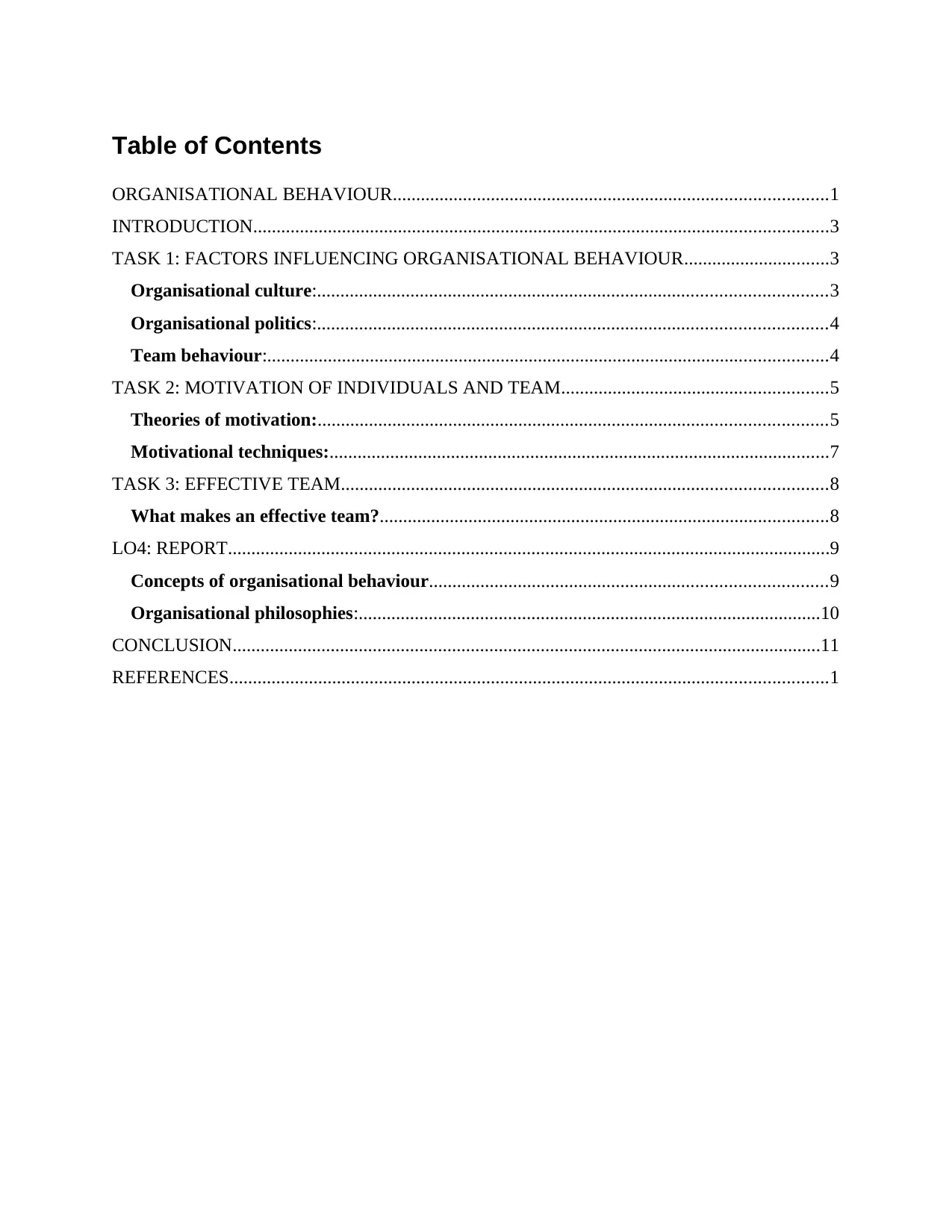
Table of Contents
ORGANISATIONAL BEHAVIOUR.............................................................................................1
INTRODUCTION...........................................................................................................................3
TASK 1: FACTORS INFLUENCING ORGANISATIONAL BEHAVIOUR...............................3
Organisational culture:.............................................................................................................3
Organisational politics:.............................................................................................................4
Team behaviour:........................................................................................................................4
TASK 2: MOTIVATION OF INDIVIDUALS AND TEAM.........................................................5
Theories of motivation:.............................................................................................................5
Motivational techniques:...........................................................................................................7
TASK 3: EFFECTIVE TEAM........................................................................................................8
What makes an effective team?................................................................................................8
LO4: REPORT.................................................................................................................................9
Concepts of organisational behaviour.....................................................................................9
Organisational philosophies:...................................................................................................10
CONCLUSION..............................................................................................................................11
REFERENCES................................................................................................................................1
ORGANISATIONAL BEHAVIOUR.............................................................................................1
INTRODUCTION...........................................................................................................................3
TASK 1: FACTORS INFLUENCING ORGANISATIONAL BEHAVIOUR...............................3
Organisational culture:.............................................................................................................3
Organisational politics:.............................................................................................................4
Team behaviour:........................................................................................................................4
TASK 2: MOTIVATION OF INDIVIDUALS AND TEAM.........................................................5
Theories of motivation:.............................................................................................................5
Motivational techniques:...........................................................................................................7
TASK 3: EFFECTIVE TEAM........................................................................................................8
What makes an effective team?................................................................................................8
LO4: REPORT.................................................................................................................................9
Concepts of organisational behaviour.....................................................................................9
Organisational philosophies:...................................................................................................10
CONCLUSION..............................................................................................................................11
REFERENCES................................................................................................................................1
INTRODUCTION
Organisational behaviour is defined as the set of principles that the organisation and businesses
follow that are designed to be worked for in the field they are operating. Every organisation or a
business is said to be bound by certainties that are arranged by the management and particularly
the human resources management. The organisational behaviour is the unique identity that a
company has in order to be differentiated by the others (Balwant, 2018). The entire report deals
with the organisational behaviour and the factors that are included in the organisational
behaviour out of which a company can adopt means that are important to be followed by the
employees. The chosen organisation to work for in this report is the Ziggy green, which is in
London. The restaurant is known for offering eclectic cocktails, a top Aussie brunch and coffee.
The organisational behaviour in context with the company are highlighted in this report.
TASK 1: FACTORS INFLUENCING ORGANISATIONAL BEHAVIOUR
The organisational behaviour is influenced by various factors. Some of them are as follows:
Organisational culture:
Organisational culture is one of the most important part of the human resources management of
the organisation. there are many people in the organisation with different hierarchy. Culture is a
set of rules that will bind every hierarchy of the organisation under one roof such that there will
not be any difference within the workspace (Curry and et.al, 2018). Being the newly appointed
manager of the restaurant Ziggy green bring back the reputation and good management
everything lies in basics. From small organisations to multinational organisations, the most
important aspect that will drive everyone is the identity they get through their management.
Types of culture:
Cognitive culture: this culture in the organisation relates to how employees think and work upon
the norms of the work.
Emotional culture: this include the emotions that the employees are showing or they are
undergoing which they will have to depict and things they will have to endure.
The different theories associated with culture are as follows:
Classical theory: in an organisation, the classical theory mainly focuses on the organisational
structure and leaves the human intervention to the specialists. The organisational authorities and
the works that are being taken up are all looked after. The restaurant Ziggy green is said to be
Organisational behaviour is defined as the set of principles that the organisation and businesses
follow that are designed to be worked for in the field they are operating. Every organisation or a
business is said to be bound by certainties that are arranged by the management and particularly
the human resources management. The organisational behaviour is the unique identity that a
company has in order to be differentiated by the others (Balwant, 2018). The entire report deals
with the organisational behaviour and the factors that are included in the organisational
behaviour out of which a company can adopt means that are important to be followed by the
employees. The chosen organisation to work for in this report is the Ziggy green, which is in
London. The restaurant is known for offering eclectic cocktails, a top Aussie brunch and coffee.
The organisational behaviour in context with the company are highlighted in this report.
TASK 1: FACTORS INFLUENCING ORGANISATIONAL BEHAVIOUR
The organisational behaviour is influenced by various factors. Some of them are as follows:
Organisational culture:
Organisational culture is one of the most important part of the human resources management of
the organisation. there are many people in the organisation with different hierarchy. Culture is a
set of rules that will bind every hierarchy of the organisation under one roof such that there will
not be any difference within the workspace (Curry and et.al, 2018). Being the newly appointed
manager of the restaurant Ziggy green bring back the reputation and good management
everything lies in basics. From small organisations to multinational organisations, the most
important aspect that will drive everyone is the identity they get through their management.
Types of culture:
Cognitive culture: this culture in the organisation relates to how employees think and work upon
the norms of the work.
Emotional culture: this include the emotions that the employees are showing or they are
undergoing which they will have to depict and things they will have to endure.
The different theories associated with culture are as follows:
Classical theory: in an organisation, the classical theory mainly focuses on the organisational
structure and leaves the human intervention to the specialists. The organisational authorities and
the works that are being taken up are all looked after. The restaurant Ziggy green is said to be
⊘ This is a preview!⊘
Do you want full access?
Subscribe today to unlock all pages.

Trusted by 1+ million students worldwide
adhered from the basics of the managerial development since there was no proper one till date.
The classical culture is applied to the restaurant with respect to the managerial development.
Human relations theory: in the human relations theory, the people are prioritised and are said to
be managed with all the behavioural patterns. The Ziggy green company since termed as one of
the improper functional unit and the employees are not trained on a subtle basis is said to be
defined under the human relations theory where the organisational behaviour stresses upon the
development of the workforce.
Organisational politics:
At some point in the workspace, people intend to make others get influenced by their ideas and
the decisions. Politics are a part of employee actions in the organisation. There are two types of
organisational politics that are seen in the organisation:
Legitimate: these are normally seen at an organisation which include complaining, bypassing and
obstructing which are considered to be petite politics.
Illegitimate: this is considered to be extreme political behaviour like symbolic protest which are
more dynamic ones.
The reasons for organisational politics are as follows:
Resource scarcity: limited resources lead to politics in an organisation. Sometimes a single
decision might to political to one person while it looks like an effective management to the other.
Everything lies on the eye of the beholder (Eldor, 2017).
Zero-sum reward policies: sometimes the politics in an organisation will be because of the
absence of the rewards. Workforce tend to gain rewards for the tasks they have accomplished
where the management sometimes fail to. This will give rise to politics.
Team behaviour:
It is important in an organisation to first understand the behaviour of the team. There are five
types of team behavioural patterns that can be observed in an organisation:
Showing accountability: this means that every person in the team understands the importance of
the work that is allotted and take responsibility upon accomplishing without any push up.
General helpfulness: it is important in any team to maintain harmony. This type of behaviour is
where the members of the team tend to help the ones that seek help to do work.
The classical culture is applied to the restaurant with respect to the managerial development.
Human relations theory: in the human relations theory, the people are prioritised and are said to
be managed with all the behavioural patterns. The Ziggy green company since termed as one of
the improper functional unit and the employees are not trained on a subtle basis is said to be
defined under the human relations theory where the organisational behaviour stresses upon the
development of the workforce.
Organisational politics:
At some point in the workspace, people intend to make others get influenced by their ideas and
the decisions. Politics are a part of employee actions in the organisation. There are two types of
organisational politics that are seen in the organisation:
Legitimate: these are normally seen at an organisation which include complaining, bypassing and
obstructing which are considered to be petite politics.
Illegitimate: this is considered to be extreme political behaviour like symbolic protest which are
more dynamic ones.
The reasons for organisational politics are as follows:
Resource scarcity: limited resources lead to politics in an organisation. Sometimes a single
decision might to political to one person while it looks like an effective management to the other.
Everything lies on the eye of the beholder (Eldor, 2017).
Zero-sum reward policies: sometimes the politics in an organisation will be because of the
absence of the rewards. Workforce tend to gain rewards for the tasks they have accomplished
where the management sometimes fail to. This will give rise to politics.
Team behaviour:
It is important in an organisation to first understand the behaviour of the team. There are five
types of team behavioural patterns that can be observed in an organisation:
Showing accountability: this means that every person in the team understands the importance of
the work that is allotted and take responsibility upon accomplishing without any push up.
General helpfulness: it is important in any team to maintain harmony. This type of behaviour is
where the members of the team tend to help the ones that seek help to do work.
Paraphrase This Document
Need a fresh take? Get an instant paraphrase of this document with our AI Paraphraser
Recognition: this is another important feature in which the members of the team will credit the
one that has performed well without being jealous. Though there is a competition to reach the
best mark, the team will be regarded as an effective one.
Flexibility: this is the main behavioural pattern where the members of the team are flexible
enough to carry out their works no matter how hard it is to cope up with. This feature will define
the way they enact the policies.
Respect: it is an essential factor to show respect towards each person in the team which is vital to
maintain good working relationship. This will in turn contribute to the team upliftment.
TASK 2: MOTIVATION OF INDIVIDUALS AND TEAM
Motivation is defined as the ability to sum up all the essentials that are required to fill the
employee with all the required rewards and the establishments in order to make them interested
towards further working norms.
Theories of motivation:
These theories are those that push the workforce into achieving the things that are impeccable.
The organisations tend to imply these theories because, the motivational employees are more
productive in doing the tasks. There are different theories of motivation in the organisational
behaviour:
Content theory of motivation:
This theory focuses upon what factors are responsible to motivate the employee behaviour. The
different theories in the content theory are as follows:
Maslow’s hierarchy of needs: in this Maslow describes the needs in five types. The
physiological, safety, social, self-esteem, self-actualisation needs of the team are to be taken care
about such that the employees can have freedom of work and recognition which will further
motivate them towards having a better working relationship. Ziggy green will have to employ
this motivation to carry the praise and recognition which are the certainties that are most
concerned with the staff in achieving a good motivation (Madhukar and Sharma, 2017).
Herzberg’s two factor theory: there are two factors that will include motivation factors and the
poor hygiene factors where the employees tend to get motivated by few positive factors but tend
to fail when there are poor hygiene factors like poor working and poor pay. Ziggy green must
ensure to provide the proper motivational factors by avoiding un hygiene kinds of motivation.
one that has performed well without being jealous. Though there is a competition to reach the
best mark, the team will be regarded as an effective one.
Flexibility: this is the main behavioural pattern where the members of the team are flexible
enough to carry out their works no matter how hard it is to cope up with. This feature will define
the way they enact the policies.
Respect: it is an essential factor to show respect towards each person in the team which is vital to
maintain good working relationship. This will in turn contribute to the team upliftment.
TASK 2: MOTIVATION OF INDIVIDUALS AND TEAM
Motivation is defined as the ability to sum up all the essentials that are required to fill the
employee with all the required rewards and the establishments in order to make them interested
towards further working norms.
Theories of motivation:
These theories are those that push the workforce into achieving the things that are impeccable.
The organisations tend to imply these theories because, the motivational employees are more
productive in doing the tasks. There are different theories of motivation in the organisational
behaviour:
Content theory of motivation:
This theory focuses upon what factors are responsible to motivate the employee behaviour. The
different theories in the content theory are as follows:
Maslow’s hierarchy of needs: in this Maslow describes the needs in five types. The
physiological, safety, social, self-esteem, self-actualisation needs of the team are to be taken care
about such that the employees can have freedom of work and recognition which will further
motivate them towards having a better working relationship. Ziggy green will have to employ
this motivation to carry the praise and recognition which are the certainties that are most
concerned with the staff in achieving a good motivation (Madhukar and Sharma, 2017).
Herzberg’s two factor theory: there are two factors that will include motivation factors and the
poor hygiene factors where the employees tend to get motivated by few positive factors but tend
to fail when there are poor hygiene factors like poor working and poor pay. Ziggy green must
ensure to provide the proper motivational factors by avoiding un hygiene kinds of motivation.
Three needs theory: this will determine the three mandatory needs to motivate which are the
need for achievement, need for affiliation and need for power which will bring out the
importance to achieve the target and collaborate with others to derive the components and
employ them in satisfying the need of the customers. This when applied to the restaurant will
bring out the motivational components of the organisation.
Theory X and Theory Y: this contains two categories called theory x and theory y which will
bring out the extrinsic and intrinsic motivations. The Ziggy green will have to employ the
techniques of intrinsic and extrinsic motions in order to cope up with the employee management.
ERG Theory: this is regarded as the simplified Maslow’s theory which contains three
components called existence needs, relatedness needs, growth needs which are used to define the
physical well-being, and meaningful work. Ziggy restaurant will develop the certainties with
growth prospects on employing this method.
Mayo’s motivational theory: Mayo is the first to detect that if the employee is treated well, then
the individual will cross boundaries to accomplish the task (Ezenwakwelu, 2017). The employee
performance can be attributed using two factors which are norms and group cohesiveness to
encourage the positive and negative behaviour and helps them get along with each other. The
Ziggy green restaurant will have to motivate the employees in terms of getting with each other
which will further imbibe positivity.
Process theory of motivation:
These theories involve the procedures that are put into implementing the required motivation.
The different process theories are as follows:
Equity theory: this theory says that high levels of the employee motivation can only be achieved
when each employee accept the treatment that is given to others is fair without negotiations.
Ziggy green restaurant being one of the best will have more customer demand which will further
pressurise the employee this motivation will help to overcome these pressures.
Expectancy theory: this says that a person’s behaviour will be based on the expectations that he
has upon a particular thing. Three factors will contribute to this are expectancy, instrumentality
and valence which helps the individual at the Ziggy green to achieve the task, and hits the targets
which will be valuable.
need for achievement, need for affiliation and need for power which will bring out the
importance to achieve the target and collaborate with others to derive the components and
employ them in satisfying the need of the customers. This when applied to the restaurant will
bring out the motivational components of the organisation.
Theory X and Theory Y: this contains two categories called theory x and theory y which will
bring out the extrinsic and intrinsic motivations. The Ziggy green will have to employ the
techniques of intrinsic and extrinsic motions in order to cope up with the employee management.
ERG Theory: this is regarded as the simplified Maslow’s theory which contains three
components called existence needs, relatedness needs, growth needs which are used to define the
physical well-being, and meaningful work. Ziggy restaurant will develop the certainties with
growth prospects on employing this method.
Mayo’s motivational theory: Mayo is the first to detect that if the employee is treated well, then
the individual will cross boundaries to accomplish the task (Ezenwakwelu, 2017). The employee
performance can be attributed using two factors which are norms and group cohesiveness to
encourage the positive and negative behaviour and helps them get along with each other. The
Ziggy green restaurant will have to motivate the employees in terms of getting with each other
which will further imbibe positivity.
Process theory of motivation:
These theories involve the procedures that are put into implementing the required motivation.
The different process theories are as follows:
Equity theory: this theory says that high levels of the employee motivation can only be achieved
when each employee accept the treatment that is given to others is fair without negotiations.
Ziggy green restaurant being one of the best will have more customer demand which will further
pressurise the employee this motivation will help to overcome these pressures.
Expectancy theory: this says that a person’s behaviour will be based on the expectations that he
has upon a particular thing. Three factors will contribute to this are expectancy, instrumentality
and valence which helps the individual at the Ziggy green to achieve the task, and hits the targets
which will be valuable.
⊘ This is a preview!⊘
Do you want full access?
Subscribe today to unlock all pages.
Trusted by 1+ million students worldwide
Taylor’s scientific management: this theory is broken down into two parts called as philosophy
and money. These will define the workforce nature in the Ziggy green restaurant.
Self-efficacy theory of motivation: the more the efficacy, the more will be the output. There are
four factors that define this which are experience, vicarious experience, social persuasion and
physiological feedback. These when implied to the Ziggy green work force will help them get to
know the attributes that influence and the desired output that can be achieved.
Reinforcement theory of motivation: according to this theory there are four factors that will
influence motivation positive reinforcement, which is to provide positive feedback upon the
behaviour, negative reinforcement which is the reward that is offered by removing something
negative from the work environment, punishment which means using the threat of a negative
consequence taking measures to avoid mistakes and extinction which is to stop someone’s odd
behaviour forever with the organisation (Huo and et.al 2018).
Locke’s goal setting theory: there are five factors that will bring about a clarity upon goal setting
which are clarity, challenge, commitment, feedback and task complexity. These will help the
individual of the Ziggy green restaurant to develop clear vision with proper goal determination.
The employee withstands pressure and can make up for hard goals.
Motivational techniques:
Motivational techniques are defined as both financial and non-financial techniques. They are as
follows:
Financial techniques:
The financial technique motivation is the one that includes the monetary value. In order to
motivate the individual, the currency is used. This can be in the form of more wages or salary,
bonus a, medical reimbursement etc. this when applied to the restaurant Ziggy, the workforce
that are concerned with the particular work are said to be expecting the rewards in terms of the
currency for their work done. This will be satisfied by the management if at all the terms and
conditions are satisfied.
Non-financial techniques:
The non-financial techniques include the nature of better status, work recognition, participation,
job security etc. this technique of motivation does not involve money in order to drive
motivational concepts.
and money. These will define the workforce nature in the Ziggy green restaurant.
Self-efficacy theory of motivation: the more the efficacy, the more will be the output. There are
four factors that define this which are experience, vicarious experience, social persuasion and
physiological feedback. These when implied to the Ziggy green work force will help them get to
know the attributes that influence and the desired output that can be achieved.
Reinforcement theory of motivation: according to this theory there are four factors that will
influence motivation positive reinforcement, which is to provide positive feedback upon the
behaviour, negative reinforcement which is the reward that is offered by removing something
negative from the work environment, punishment which means using the threat of a negative
consequence taking measures to avoid mistakes and extinction which is to stop someone’s odd
behaviour forever with the organisation (Huo and et.al 2018).
Locke’s goal setting theory: there are five factors that will bring about a clarity upon goal setting
which are clarity, challenge, commitment, feedback and task complexity. These will help the
individual of the Ziggy green restaurant to develop clear vision with proper goal determination.
The employee withstands pressure and can make up for hard goals.
Motivational techniques:
Motivational techniques are defined as both financial and non-financial techniques. They are as
follows:
Financial techniques:
The financial technique motivation is the one that includes the monetary value. In order to
motivate the individual, the currency is used. This can be in the form of more wages or salary,
bonus a, medical reimbursement etc. this when applied to the restaurant Ziggy, the workforce
that are concerned with the particular work are said to be expecting the rewards in terms of the
currency for their work done. This will be satisfied by the management if at all the terms and
conditions are satisfied.
Non-financial techniques:
The non-financial techniques include the nature of better status, work recognition, participation,
job security etc. this technique of motivation does not involve money in order to drive
motivational concepts.
Paraphrase This Document
Need a fresh take? Get an instant paraphrase of this document with our AI Paraphraser
TASK 3: EFFECTIVE TEAM
What makes an effective team?
An effective team is said to be the one that has a working harmony which will help to unite with
all the members of the team and work with same vision. This brings out the overall performance
of the organisation with the stipulated results. In order to make the team more effective, the
management will have to clearly define the objectives that are to be performed.
Skills and experience:
There are seven skills thar are required for an effective team work:
Communication: communication is an important asset which when maintained in conveying the
works and the tasks will result in the great outputs. the communication between the team as well
as the management will contribute to effective team work.
Time management: every person in the team will have to be equally responsible towards the
work that is allotted. The team must ensure to complete the task in the respective time intervals.
Problem solving: there will be few effective problem solvers in the team who are responsible to
help the ones that are lacking behind. It is important for the team to coordinate with each other
and solve the problems.
Listening: listening is one of the main and important aspect of an effective team management.
All the members of the team will have to be equally treated in terms of explaining their views.
Critical thinking: it is important to maintain the group decisions and when the team is operating
upon a particular work it is important to coordinate with every single decision of the team.
Collaboration: it is important that the team will have to collaborate with all the members of the
team in order to carry out the output.
Leadership: The leader is the one who is responsible in managing the finite decisions of the team
by collaborating with them. Therefore, a perfect leadership will bring forth an effective
teamwork.
Benefits of working as a leader in the team:
The benefits that are associated upon taking the responsibility as the leader of the team are as
follows:
What makes an effective team?
An effective team is said to be the one that has a working harmony which will help to unite with
all the members of the team and work with same vision. This brings out the overall performance
of the organisation with the stipulated results. In order to make the team more effective, the
management will have to clearly define the objectives that are to be performed.
Skills and experience:
There are seven skills thar are required for an effective team work:
Communication: communication is an important asset which when maintained in conveying the
works and the tasks will result in the great outputs. the communication between the team as well
as the management will contribute to effective team work.
Time management: every person in the team will have to be equally responsible towards the
work that is allotted. The team must ensure to complete the task in the respective time intervals.
Problem solving: there will be few effective problem solvers in the team who are responsible to
help the ones that are lacking behind. It is important for the team to coordinate with each other
and solve the problems.
Listening: listening is one of the main and important aspect of an effective team management.
All the members of the team will have to be equally treated in terms of explaining their views.
Critical thinking: it is important to maintain the group decisions and when the team is operating
upon a particular work it is important to coordinate with every single decision of the team.
Collaboration: it is important that the team will have to collaborate with all the members of the
team in order to carry out the output.
Leadership: The leader is the one who is responsible in managing the finite decisions of the team
by collaborating with them. Therefore, a perfect leadership will bring forth an effective
teamwork.
Benefits of working as a leader in the team:
The benefits that are associated upon taking the responsibility as the leader of the team are as
follows:
Develop: the main responsibility of the team is to develop the entire team with regards to the
work of the organisation. The projects are to be addressed over and will have to employ means to
coordinate with the team.
Identify team goals: the leader will have to identify the goals and then respond back to the
objectives that requires the solutions. The objectives can be met one the leader collaborates with
the team in working.
Benefits of working as a team member:
Actively listen: the member of the team can actively listen towards the proceeding of the leader
and employ means of working towards the goals.
Ready to help: one of the main advantage of being a team member is to render help to those that
cannot individually perform the task.
Two group development models: the two group development models are:
Tuckman group development model: this theory was derived by Tuckman after 50 research
papers which includes the study of different groups called therapy groups, T-groups, natural
groups, and laboratory groups. He started the process sequentially with testing and dependence.
These methods are identified as interpersonal group activities and group task activities. The
different group that are present in the working field are said to be categorised under these which
will have to be endured upon the fact to scrutiny and then different perceptions are taken.
Punctuated equilibrium model: in this model the groups are performed under different
environmental conditions. The external factors are the ones that tend to impact the organisation
on a whole. No empirical testing is involved in this group and by considering the external
factors, the group is determined. Romanelli and Tuckman tested this model in an organisation
whose end result were the consequences that occurred in the external factors.
LO4: REPORT
Concepts of organisational behaviour
Organisational behaviour is like an asset to an organisation or a management in order to deal
with the tasks that are associated with the workforce, their culture and the principles. The
different concepts of organisational behaviour in regards to the restaurant Ziggy green are as
follow:
Individual differences:
work of the organisation. The projects are to be addressed over and will have to employ means to
coordinate with the team.
Identify team goals: the leader will have to identify the goals and then respond back to the
objectives that requires the solutions. The objectives can be met one the leader collaborates with
the team in working.
Benefits of working as a team member:
Actively listen: the member of the team can actively listen towards the proceeding of the leader
and employ means of working towards the goals.
Ready to help: one of the main advantage of being a team member is to render help to those that
cannot individually perform the task.
Two group development models: the two group development models are:
Tuckman group development model: this theory was derived by Tuckman after 50 research
papers which includes the study of different groups called therapy groups, T-groups, natural
groups, and laboratory groups. He started the process sequentially with testing and dependence.
These methods are identified as interpersonal group activities and group task activities. The
different group that are present in the working field are said to be categorised under these which
will have to be endured upon the fact to scrutiny and then different perceptions are taken.
Punctuated equilibrium model: in this model the groups are performed under different
environmental conditions. The external factors are the ones that tend to impact the organisation
on a whole. No empirical testing is involved in this group and by considering the external
factors, the group is determined. Romanelli and Tuckman tested this model in an organisation
whose end result were the consequences that occurred in the external factors.
LO4: REPORT
Concepts of organisational behaviour
Organisational behaviour is like an asset to an organisation or a management in order to deal
with the tasks that are associated with the workforce, their culture and the principles. The
different concepts of organisational behaviour in regards to the restaurant Ziggy green are as
follow:
Individual differences:
⊘ This is a preview!⊘
Do you want full access?
Subscribe today to unlock all pages.
Trusted by 1+ million students worldwide
Most of the organisations fail to maintain a perfect organisational structure and the behaviour
because of the dominating factors both regards to work and the people. the Ziggy green company
is said to not full flourish because of the dominating manager part that made the entire workforce
suffer. The individual differences when sorted will give room to harmony and good working
relationship. The management in the Ziggy Green will have to start motivating the staff upon
encouraging means to develop prospects of business management. Working as a team of
stipulated crew that will serve the befits of the organisation will let people come across many
differences which the management will have to solve at instances.
Perception:
Every human perception varies from another. When the crew of the restaurant are working under
same roof there are different ways people respond to the atrocities. One perception will make the
people think that there is political influence in the organisation where as others think that it is an
effective management (King and Brooks, 2018). While working for the Ziggy green, the staff
may not take the orders of the superior towards works. Being a manager the entire duty is to
monitor the employees and get to know their perceptions such that individuals can be treated
based on their perceptions.
Organisational philosophies:
The organisational philosophies are the principles and the core values that are used to determine
the organisational behaviour. The ethics and the morals that are employed by the organisation in
order to main the workforce are said to be contained in the organisational philosophies. These
will help the company to withstand the policies of the customers and will define the aspect of the
company in thriving for success. The philosophies usually define the crew of the organisation
and the behavioural pattern. Things that are incorporated aand are employed will be depicted.
because of the dominating factors both regards to work and the people. the Ziggy green company
is said to not full flourish because of the dominating manager part that made the entire workforce
suffer. The individual differences when sorted will give room to harmony and good working
relationship. The management in the Ziggy Green will have to start motivating the staff upon
encouraging means to develop prospects of business management. Working as a team of
stipulated crew that will serve the befits of the organisation will let people come across many
differences which the management will have to solve at instances.
Perception:
Every human perception varies from another. When the crew of the restaurant are working under
same roof there are different ways people respond to the atrocities. One perception will make the
people think that there is political influence in the organisation where as others think that it is an
effective management (King and Brooks, 2018). While working for the Ziggy green, the staff
may not take the orders of the superior towards works. Being a manager the entire duty is to
monitor the employees and get to know their perceptions such that individuals can be treated
based on their perceptions.
Organisational philosophies:
The organisational philosophies are the principles and the core values that are used to determine
the organisational behaviour. The ethics and the morals that are employed by the organisation in
order to main the workforce are said to be contained in the organisational philosophies. These
will help the company to withstand the policies of the customers and will define the aspect of the
company in thriving for success. The philosophies usually define the crew of the organisation
and the behavioural pattern. Things that are incorporated aand are employed will be depicted.
Paraphrase This Document
Need a fresh take? Get an instant paraphrase of this document with our AI Paraphraser
CONCLUSION
The entire report deals with the organisational behaviour and that with regards to the restaurant
Ziggy green which is in London. The organisational behaviour is defined as the set of norms that
the workforce in the organisation maintain and follow with the aim of maintaining a good
management which uplifts the organisation in return. The organisational culture is explained in
the reports with the theories it contains. The organisational politics is out forth with the different
types that are adopted. The motivation concept is clearly put forth with the aim of employing the
type of motivation that will encourage the workforce towards employing means to establish the
company. adopting different motivational concepts like the content theory and the process
theory of motivation that is implied upon the organisation in order to explain the organisational
behaviour. The report overall gives a clear understanding covering all the prospects of
organisational behaviour.
The entire report deals with the organisational behaviour and that with regards to the restaurant
Ziggy green which is in London. The organisational behaviour is defined as the set of norms that
the workforce in the organisation maintain and follow with the aim of maintaining a good
management which uplifts the organisation in return. The organisational culture is explained in
the reports with the theories it contains. The organisational politics is out forth with the different
types that are adopted. The motivation concept is clearly put forth with the aim of employing the
type of motivation that will encourage the workforce towards employing means to establish the
company. adopting different motivational concepts like the content theory and the process
theory of motivation that is implied upon the organisation in order to explain the organisational
behaviour. The report overall gives a clear understanding covering all the prospects of
organisational behaviour.
REFERENCES
Books and journals
Balwant, 2018. The meaning of student engagement and disengagement in the classroom
context: Lessons from organisational behaviour. Journal of Further and Higher Education.
42(3). pp.389-401.
Curry and et.al, 2018. Influencing organisational culture to improve hospital performance in care
of patients with acute myocardial infarction: a mixed-methods intervention study. BMJ
quality & safety. 27(3). pp.207-217.
Eldor, 2017. Looking on the bright side: The positive role of organisational politics in the
relationship between employee engagement and performance at work. Applied
Psychology. 66(2). pp.233-259.
Madhukar and Sharma, 2017. Impact of organisational climate on employee motivation: A
conceptual perspective. International Journal in Management & Social Science. 5(7).
pp.325-336.
Ezenwakwelu, 2017. Determinants of Employee Motivation for Organisational Commitment.
IOSR Journal of Business and Management. 19(7). pp.1-9.
Huo and et.al 2018. Supply chain flexibility concepts, dimensions and outcomes: an
organisational capability perspective. International Journal of Production Research. 56(17).
pp.5883-5903.
King and Brooks, 2018. Thematic analysis in organisational research. The Sage Handbook of
qualitative business and management research methods, pp.219-236.
Online
Organisational behaviour: [ONLINE] available through:<
https://www.economicsdiscussion.net/management/organisational-behaviour/31869>
Organisational culture: [ONLINE] available through:< https://gothamculture.com/what-is-
organizational-culture-definition/#:~:text=Organizational%20culture%20includes%20an
%20organization%E2%80%99s%20expectations,%20experiences,%20philosophy,,interactions
%20with%20the%20outside%20world,%20and%20future%20expectations.>
1
Books and journals
Balwant, 2018. The meaning of student engagement and disengagement in the classroom
context: Lessons from organisational behaviour. Journal of Further and Higher Education.
42(3). pp.389-401.
Curry and et.al, 2018. Influencing organisational culture to improve hospital performance in care
of patients with acute myocardial infarction: a mixed-methods intervention study. BMJ
quality & safety. 27(3). pp.207-217.
Eldor, 2017. Looking on the bright side: The positive role of organisational politics in the
relationship between employee engagement and performance at work. Applied
Psychology. 66(2). pp.233-259.
Madhukar and Sharma, 2017. Impact of organisational climate on employee motivation: A
conceptual perspective. International Journal in Management & Social Science. 5(7).
pp.325-336.
Ezenwakwelu, 2017. Determinants of Employee Motivation for Organisational Commitment.
IOSR Journal of Business and Management. 19(7). pp.1-9.
Huo and et.al 2018. Supply chain flexibility concepts, dimensions and outcomes: an
organisational capability perspective. International Journal of Production Research. 56(17).
pp.5883-5903.
King and Brooks, 2018. Thematic analysis in organisational research. The Sage Handbook of
qualitative business and management research methods, pp.219-236.
Online
Organisational behaviour: [ONLINE] available through:<
https://www.economicsdiscussion.net/management/organisational-behaviour/31869>
Organisational culture: [ONLINE] available through:< https://gothamculture.com/what-is-
organizational-culture-definition/#:~:text=Organizational%20culture%20includes%20an
%20organization%E2%80%99s%20expectations,%20experiences,%20philosophy,,interactions
%20with%20the%20outside%20world,%20and%20future%20expectations.>
1
⊘ This is a preview!⊘
Do you want full access?
Subscribe today to unlock all pages.
Trusted by 1+ million students worldwide

1 out of 13


Related Documents


Your All-in-One AI-Powered Toolkit for Academic Success.
+13062052269
info@desklib.com
Available 24*7 on WhatsApp / Email
![[object Object]](/_next/static/media/star-bottom.7253800d.svg)
Unlock your academic potential
Copyright © 2020–2025 A2Z Services. All Rights Reserved. Developed and managed by ZUCOL.